Access All Areas / By Mark Gidley
Legends of the Lost City 1992
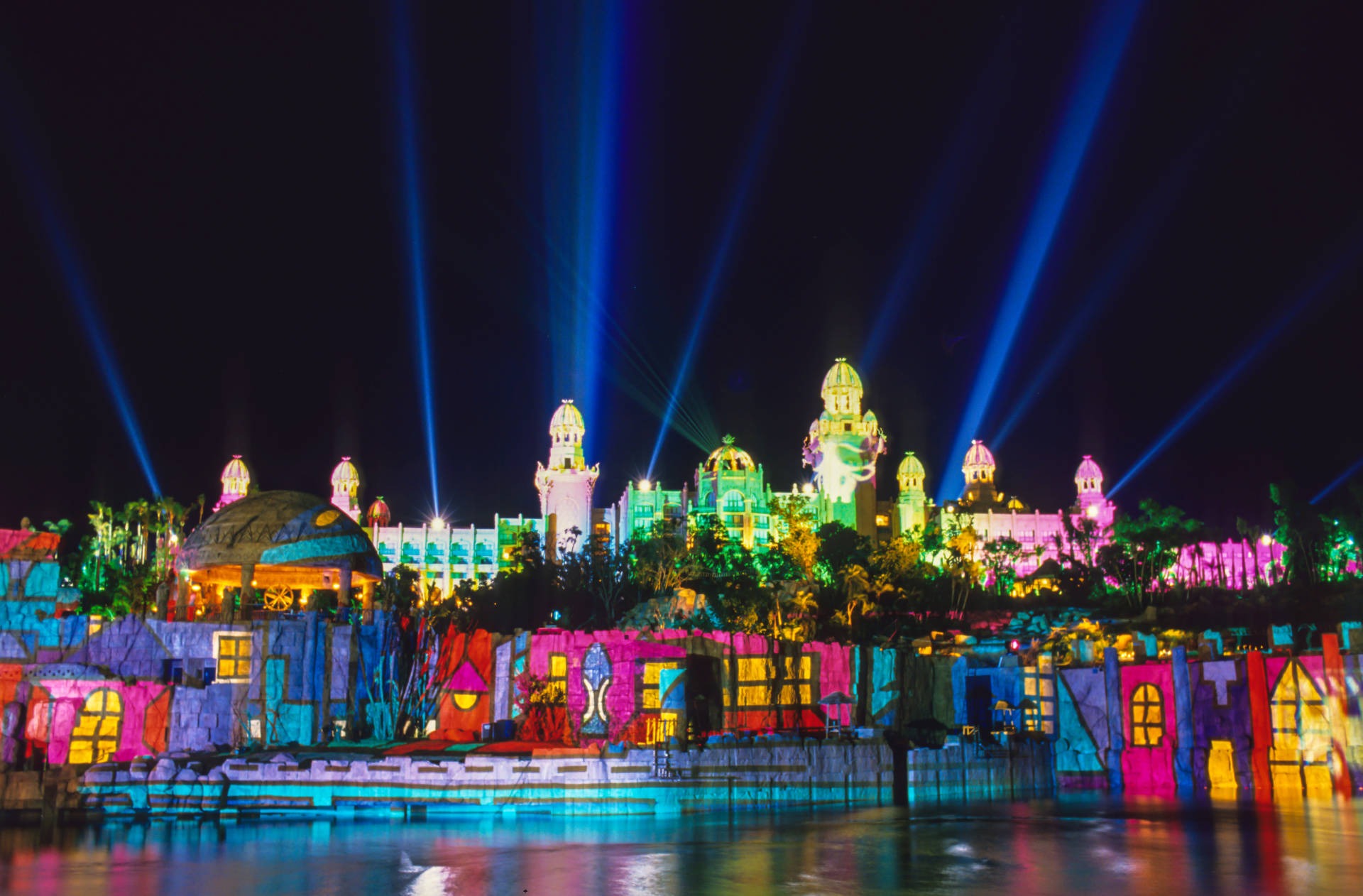
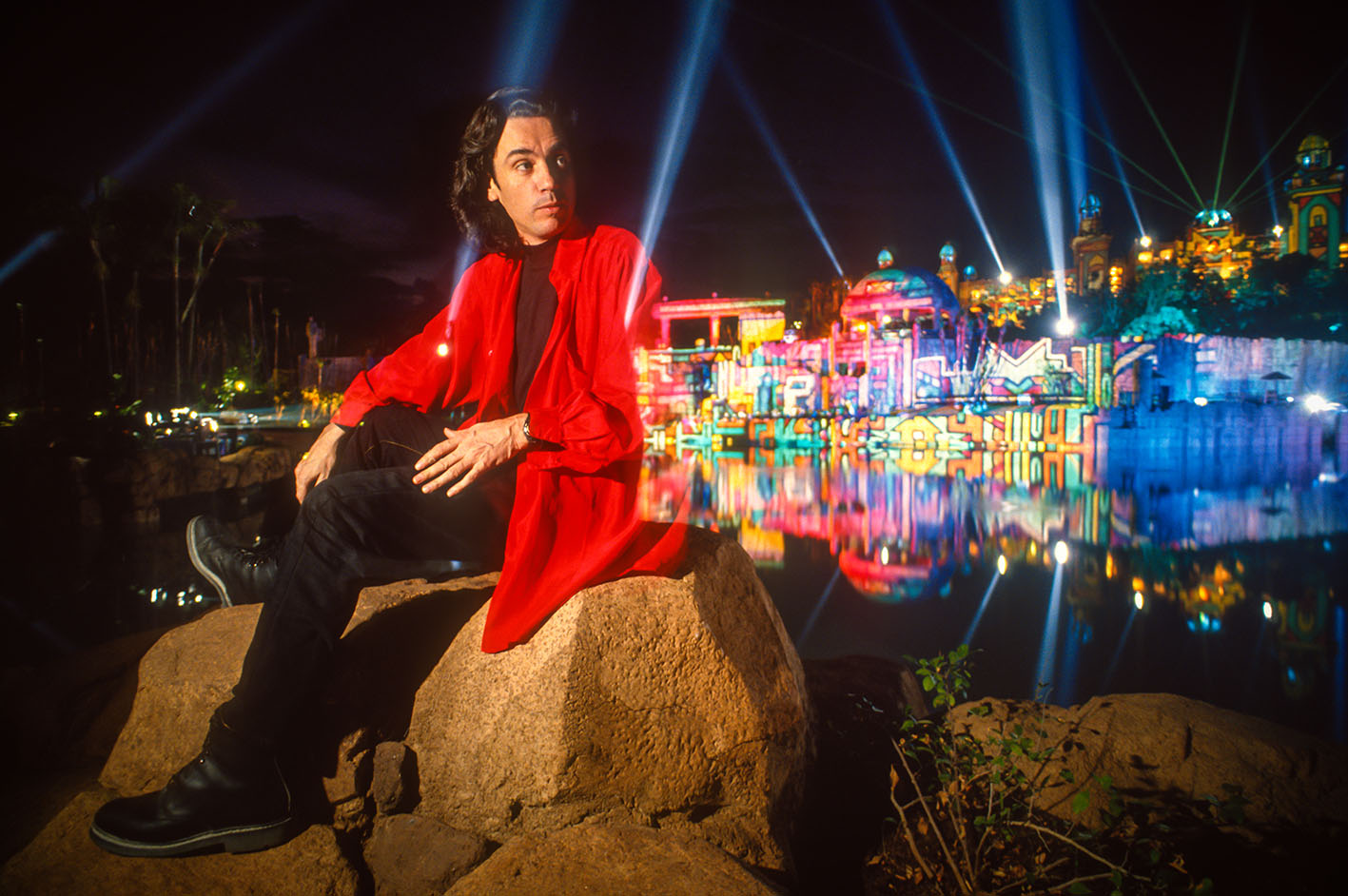
Jean-Michel Jarre transformed the Lost City and its majestic Palace in an explosive techno-fantasy of sound, light and colour.
Chapters
5
01/Feature
African Techno-Fantasy
The Lost City shows were Jarre's first venture in Africa and he said before them that it was a particularly ambitious one.
"The shows will be a kind of an opera, though not in a pretentious way," he explained, "The Lost City itself will be the main actor and the surrounding hills will become three-dimensional screens for the visuals. I see the Lost City as an Indiana Jones-type setting and I don't want electronic cables snaking through the jungle spoiling that image."
Photographs by Christine Ferreira and Mark Wolhuter
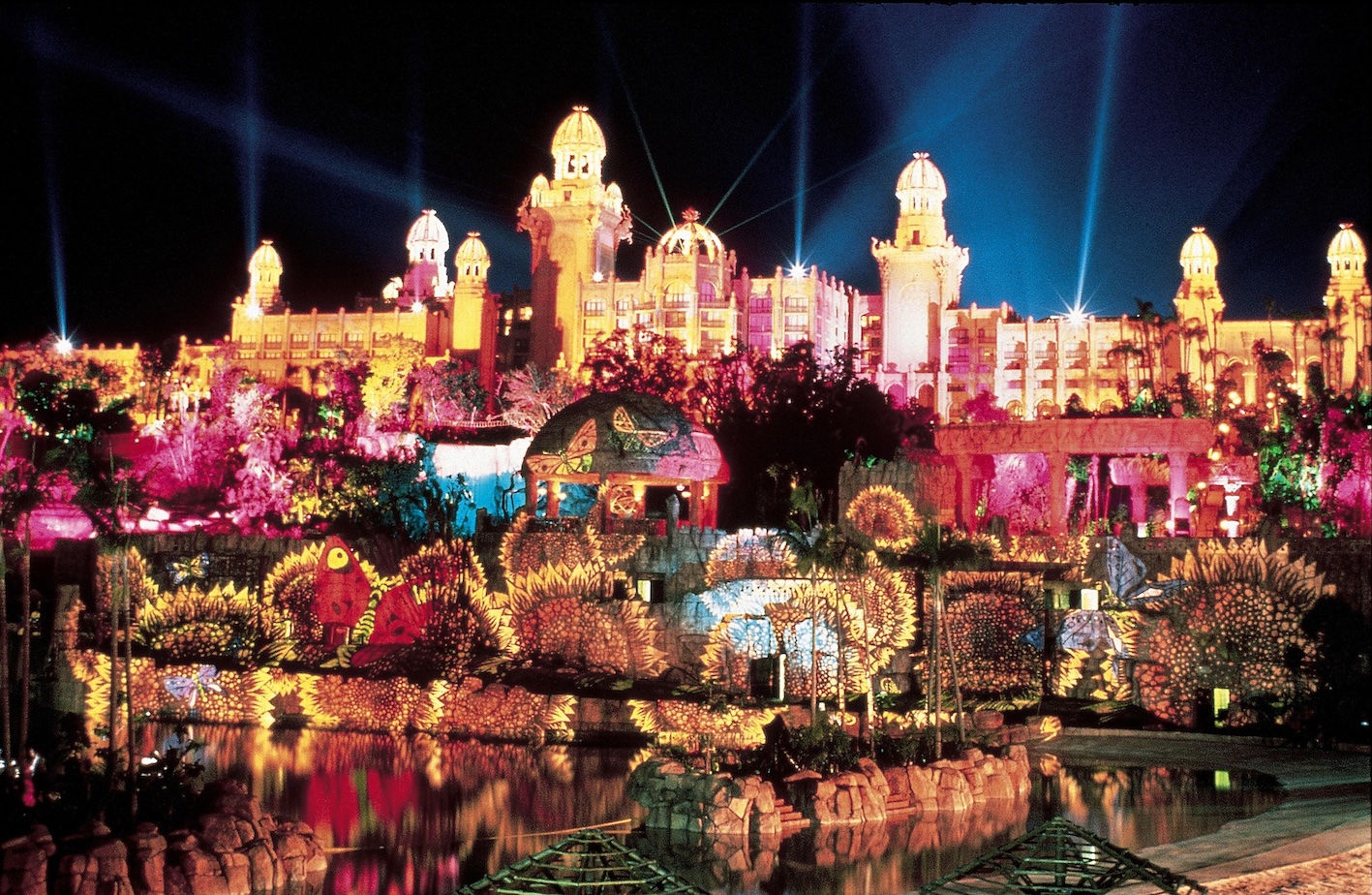
Jean-Michel Jarre transformed the Lost City and its majestic Palace in an explosive techno-fantasy of sound, light and colour. The project, never to be repeated anytime, anywhere, was Jarre's first encounter with the African Continent and it culminated in a performance unlike anything seen before.
The Lost City is a mixture between Kipling's Jungle Book with a large dose of Indiana Jones and the Temple of Doom. A homage to art and architecture from past centuries in Africa, the Lost City is an African fantasy world with the theme of the ruins of a lost civilisation rediscovered in a densely jungled, hidden valley.
For three days at the beginning of December, The Lost City in the Republic of Bophuthatswana exploded in a techno-fantasy of music, colour and images, conceived by Jean-Michel Jarre.
Just two months after the spectacular multimedia shows in Zermatt in the heart of the Swiss Alps celebrating with Swatch, Jean-Michel Jarre once again transformed an area that was far removed from those places where he is normally associated with, such as the city centres of Paris and Houston and the Docklands of London. The Lost City, built around mythical legends of past civilisation, is set within an exotic jungle, no skyscrapers or warehouses, just a majestic Palace rising from within the volcanic crater in which it was built.
The Lost City's legends were first conceptualised by Sol Kerner and Gerald Allison, a distinguished American architect. The idea came as the two men stood in the extinct volcanic crater ringed by the Pilanesberg mountains. Slopes of unspoilt, natural bushveld rolled to the horizon and imaginations took wing.
"This seemed the perfect spot in which a lost civilisation might be discovered," said Allison. "The site stirred our imaginations, and we created the story of a mythical tribe which immigrated from the north and settled in this lovely, secluded valley."
"In the legend we created, these ancient people drew on memories of exotic towers and domes from their distant past and combined them with the natural elements of southern Africa to create an entirely new, extraordinarily rich architecture."
It was these legends that Jean-Michel Jarre traced during his shows - the rise of the civilisation which built the Lost City from the time of the first discovery of the hidden Valley where it was centred, through the building of the civilisation, the cataclysmic eruption of the volcano, to the archaeological expedition which rediscovered The Lost City.
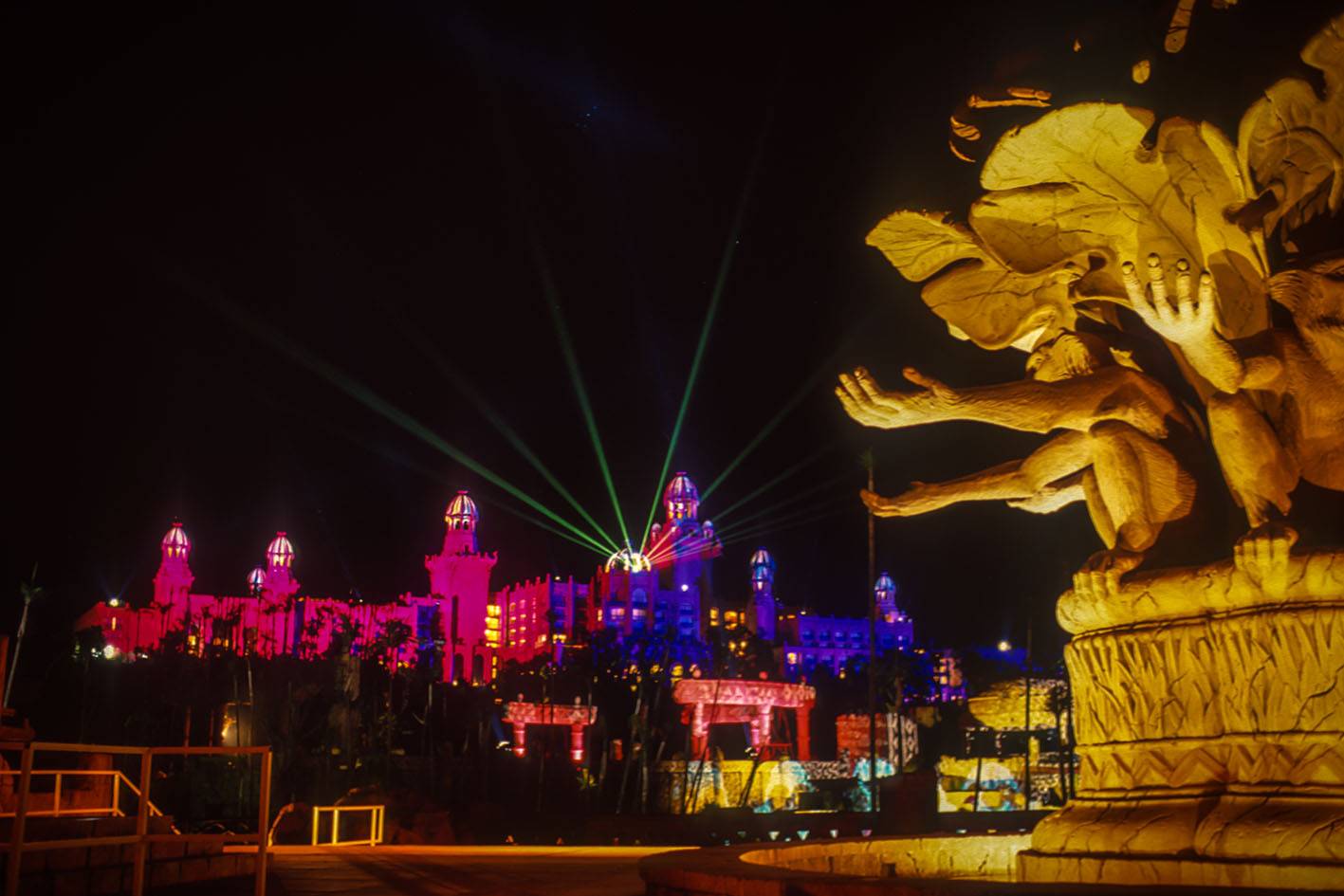
On the scale of Disney, the jewel in the crown of The Lost City is The Palace. Its exterior architecture is dominated by soaring towers, decorated with elaborate carvings of wild animals. The Palace formed the centrepiece to Jean-Michel Jarre's shows, transformed by light and images, echoing the sounds that had been specially created for this African Rendez-vous.
Surrounding the Palace is a 25-hectare jungle, the world's first ever man-made rain forest. More than 1,600,000 plants, trees, shrubs and ground covers were gathered from all over the world and propagated, nurtured and transplanted into what today is called the Valley of the Ancients.
Everywhere one looks, one sees only that which is unique. Sculptured cranes with wings outstretched seem about to fly from tower walls, elephants guard triumphal stairways and bridges, and a life-size bronze model of one of Africa's most famous tuskers reigns supreme at the end of the Palace's Elephant Walk. More than 150,000 individual pre-cast pieces have been made by artists, the greatest number ever incorporated in a project of this nature.
Water is an integral part of life in the ancient valley, and the jungle is threaded with paths meandering past cascades and waterfalls, lakes and pools. The waterpark is to be inhabited by wild birds and animals.
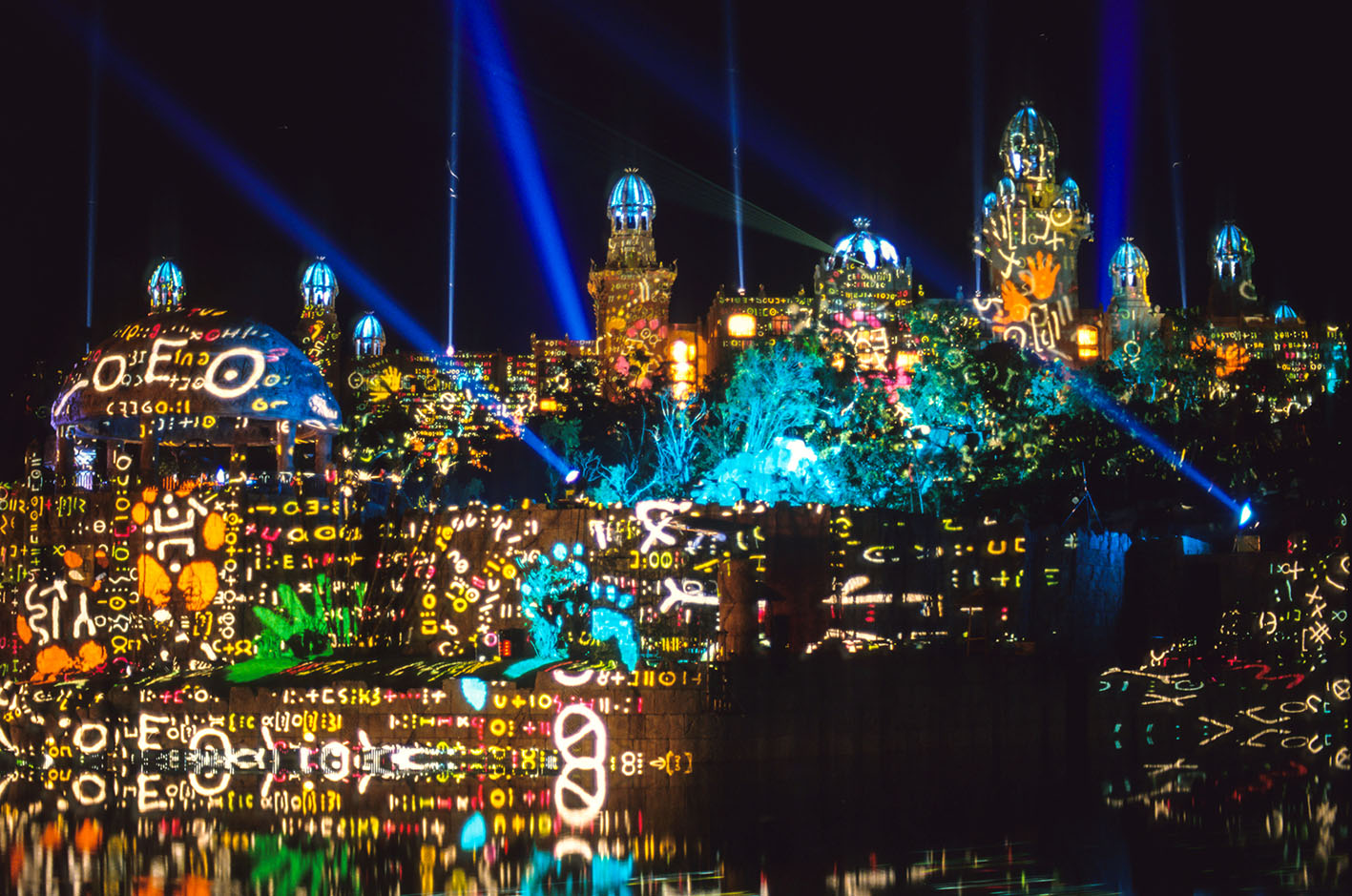
It is this glorious natural architecture that attracted Jean-Michel Jarre to The Lost City. It took over ten months to actually prepare the three one-hour shows which took place on the nights of December 1st / 2nd / 3rd but on his first visit to The Lost City in February, the format for the performances emerged after one night's work. Jarre said, "I visited the Lost City, then went back to my hotel room and worked the whole night. In the morning the concept was there. It will be unlike anything else I have ever created."
Jarre created a unique African musical experience designed to showcase the magnitude and romance of The Lost City. The owners of the resort rightly concluded that they had achieved a major coup in persuading Jean-Michel Jarre to open their African theme resort as Jarre's incredible shows are rarely produced due to the scale, size and content it takes.
He is internationally acclaimed for his radical ground-breaking open-air spectaculars in cities. In Paris, China, Houston, his hometown of Lyon and in the London Docklands, Jarre astounded the millions who flocked to witness his shows, with his unique ability to fuse his state-of-the-art sound and light technology with any environment, creating each time a unique, memorable and complete happening.
Hazel Feldman, Entertainments Director for The Lost City stated "This is the most ambitious production ever to be undertaken here, in terms of sheer scale and technology. Jean-Michel Jarre is the ideal artist to create a spectacular opening event to do justice to a project the size and magnitude of the Lost City - The Lost City will meet its match."
In order to stage this spectacular event, Jarre's production company, CICS, had to organise the airlift of over 33 tons of state-of-the-art equipment from Paris to the resort. The technical specifications of the shows were impressive.
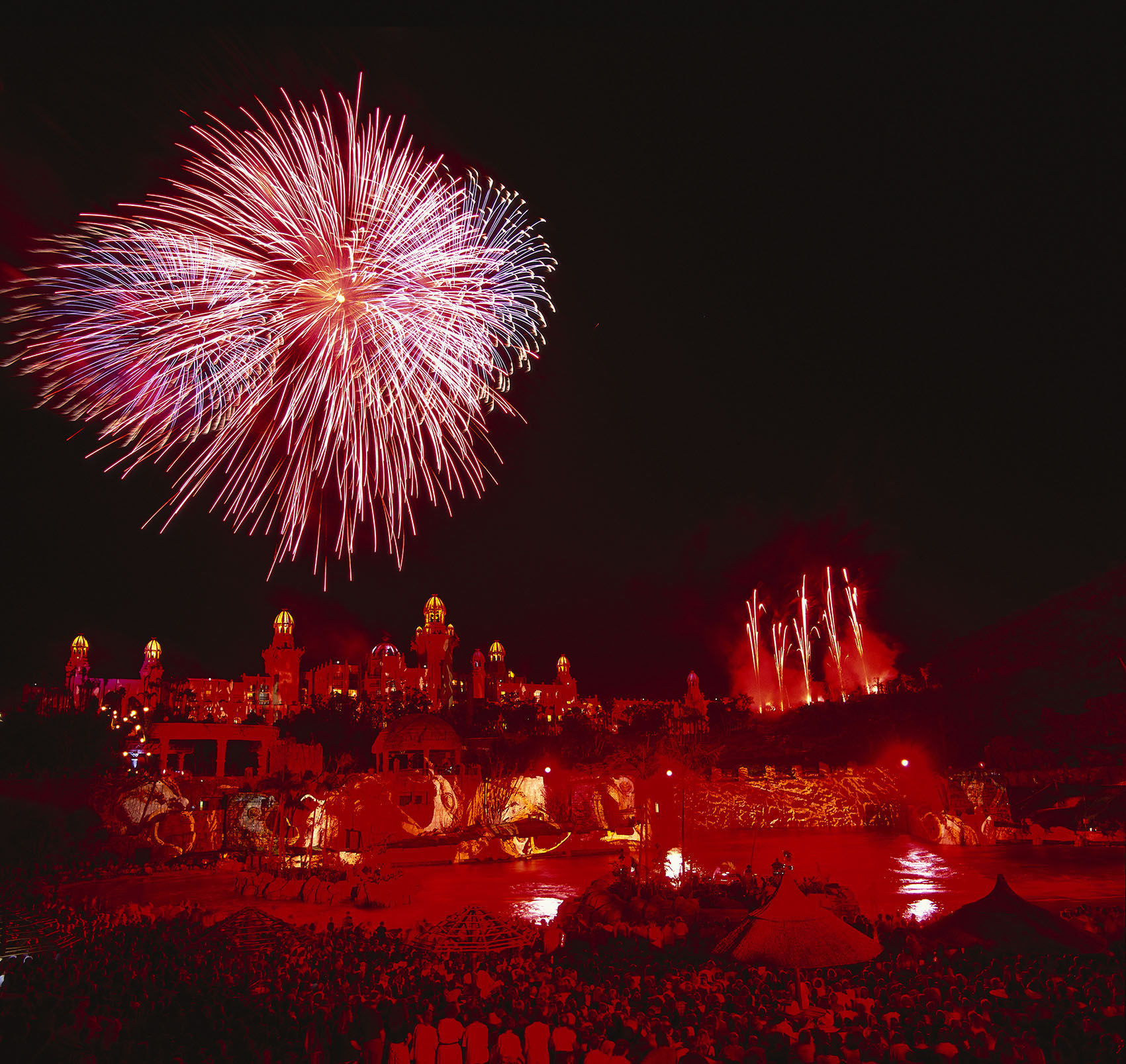
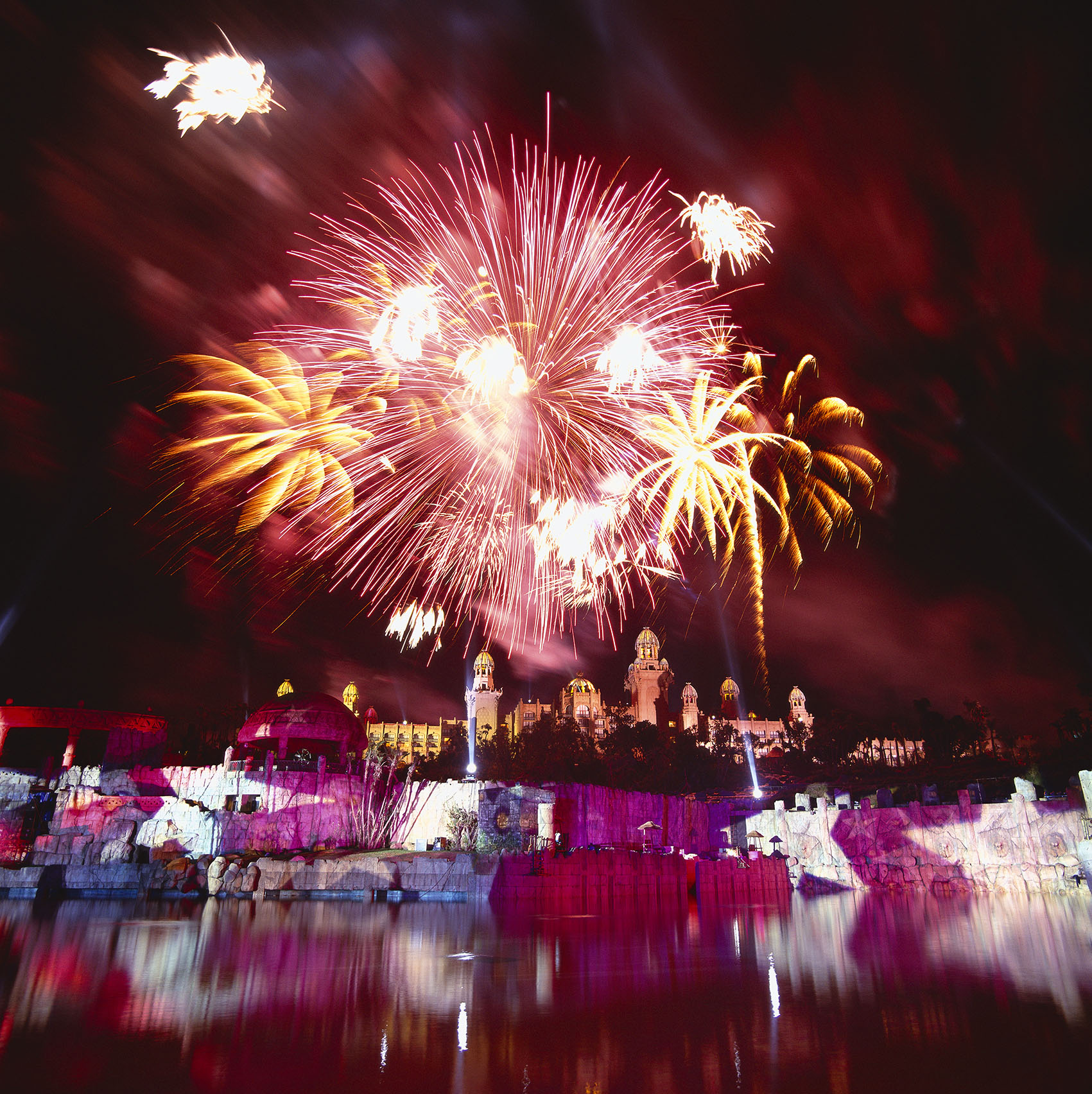
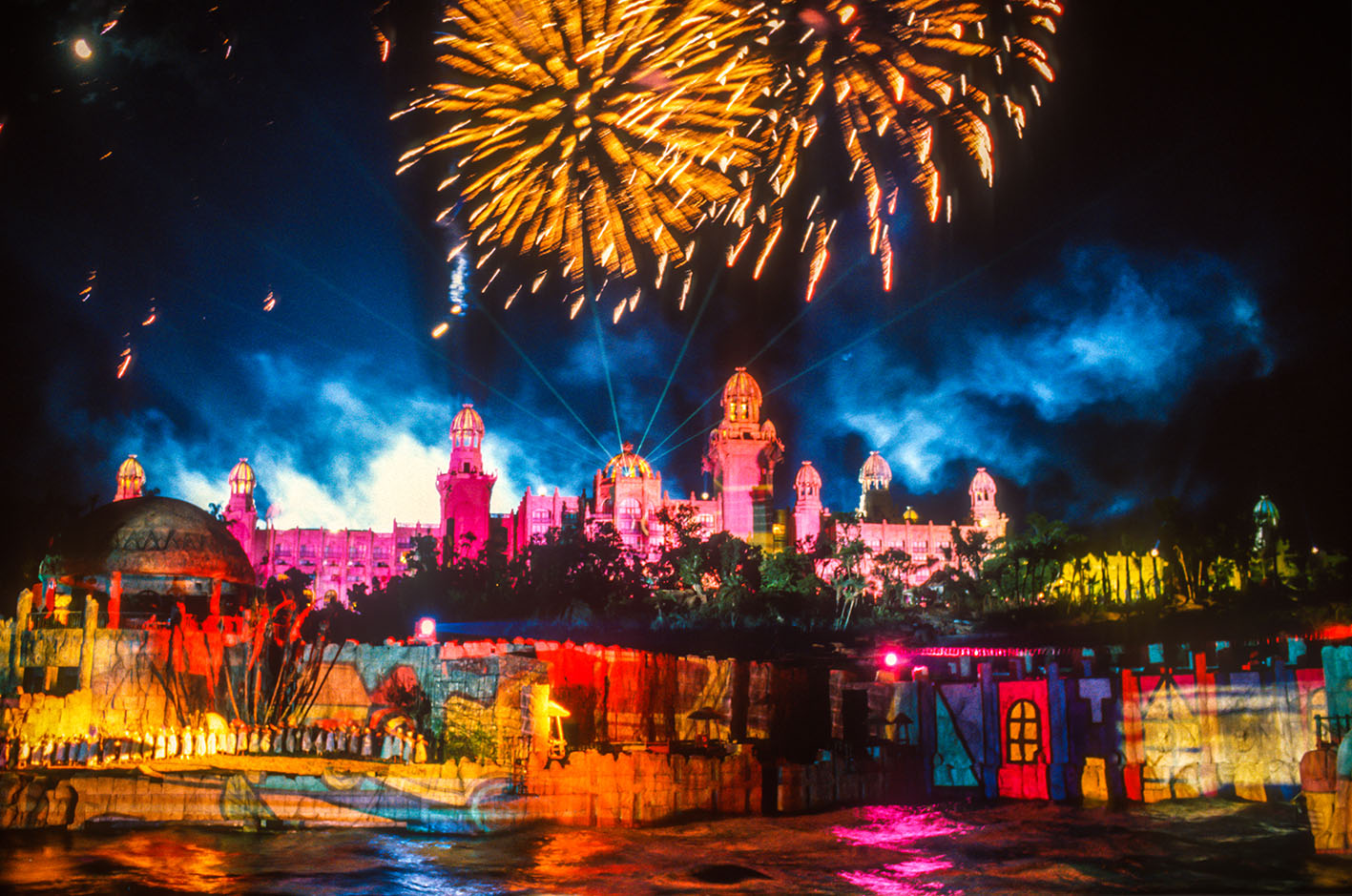
The Lost City extravaganza incorporated 15 tons of spectacular fireworks (about 10 000 shells for each of the three shows) and a team of 24 people took three weeks to prepare the installation of the fireworks for the shows.
The sound system - through which Jarre's haunting original scores enveloped the Valley of Waves for 60 minutes each night - was three times the size of the existing Superbowl system.
Most of the special lighting effects were flown in from France because they were not available locally. Eighteen computer-controlled 7000W beams were spread across the site, and more than 100 arena lamps were used to light the valley and surrounding hills.
In all, more than 21 500 individual items were brought into the Lost City complex from Paris and coordinating it all were more than 100 French and South African technicians. It took three weeks to install the systems that were needed to make the Jarre magic come alive at the Lost City.
However, regardless of how impressive the specifications are, unless they are united in concert, they are useless. Needless to say, Jarre's magic touch mastered the technology and, using elements of Africa and The Legends of the Lost City, he managed to give the event a distinctive quality, capturing the themes perfectly.
In keeping with his insistence on the participation of the local community in his projects, Jarre composed a new African-inspired track with South African musician, arranger and composer, Cedric Sampson and worked in conjunction with the country's top percussionists. This ensured that he accurately captured the ambience and rhythms of African music.
The resulting track was mesmerising, entitled Volcanic Dance which, along with Jarre's other compositions used during the shows, helped to tell the story of the Legends of The Lost City.
The crowds watching the shows were spread amongst the rambling ruins of the Lost City, a total of 15,000 for each night. They sat on the artificial beach of the Valley of the Waves, perched on the artificial rocks of the Valley of the Ancients, or in the case of the 200 or so VIP guests, in chairs overlooking the artificial but nevertheless awe-inspiring scene.
The format of the shows followed those Jarre staged for Swatch in Switzerland two months earlier. Once again, this was not a live musical performance, instead it was a musical spectacular in which Jean-Michel Jarre designed an enthralling show especially for the residents of southern Africa, mixing music with images to paint a story over an entire arena, not stopping at buildings but also a rainforest and a mountain. Jean-Michel Jarre again took overall control of the shows from within the main tower, positioned in front of the Palace, directing the show as it progressed.
From a special platform in front of the audience, Jarre introduced each show, explaining what they could expect to see in the next sixty minutes or so and introduced the various effects. Images, fireworks, beams, lasers and arena lamps amongst them. Before the music started, Jarre withdrew from the platform, making his way back up to the control tower where he was to command the show, only to return to the platform at the end of each of the hypnotic shows.
The gigantic number nine started the countdown to the spectacular Legends of The Lost City, beamed in white light upon the sculptured walls of the majestic Palace. A voice echoed each number from nine to zero as the crowd gasped with each introduction, accompanied by a similar blend of sounds used in Switzerland.
Jarre's first project in the African continent also revealed the first live 'performance' of the Images-debut track, Eldorado, previously composed for the ill-fated concert in Mexico. This track was ideally suited to such a vast arena and opened the first part of the four-part shows beautifully. This initial section envisaged the idealism of the Valley of the Ancients in its very beginnings, when the nomadic tribe first encountered the new world that was to become the Lost City. Everything about it was magical and in order to portray this, Jarre fluttered images of butterflies across the Palace walls, birds around the mountains and lions throughout the ruins, everything connected with Mother Nature.
Paradoxically though, during this first part, beautifully drawn colourful images of steam trains and planes transformed the walls of the Lost City and others floated around the architecture leaving the audience standing in awe. He was telling his story in a unique way. One moment a seahorse sails across the Pilanesberg mountain and the next, a huge figure is dancing on the same mountain.
The whole of the resort was transformed as Jarre manipulated the Palace, the beach, the tropical gardens, the ruins and the rain forest. The crowds "ooh-ed and aah-ed" as he daubed his 'canvas' with cartoon characters and laser sketches. The dilemma faced by the crowd during the sixty-minute panorama was: where to look? The sky remained a burning beacon for the entire performance as the African heavens lit up with thousands of spectacular fireworks from the creative hands of Daniel Azancot, long time pyrotechnics expert for Jean-Michel Jarre.
In complete contrast to the first track, the show continued with Jarre's ethereal Equinoxe IV.
During this blast back to reality, the Equinoxe audience stared back at their African counterparties, flashing between the Palace and the mountain, filling the walls of the ruins above the beach.
A waterfall from the top of a mountain next to the Palace turned into a spray of sparks, climaxing the end of the first part of the shows. Not since Rons' Piece in Lyon and The Emigrant in London had we seen this effect used so beautifully. Jarre dropped the cascade from his shows in Zermatt but re-kindled them with great effect for this happening.
The menacing cobra, sketched onto the Palace walls signalled the beginning of another classic, Magnetic Fields II. The display of beautiful butterflies flitted around the mountains and ruins, a celebration of ecology and technology, culminating in dazzling fireworks exploding over the crowds.
Hopefully the photographs here give you some idea of the splendour of the whole picture painted by Jean-Michel Jarre all over the resort and succeed to some degree, in capturing the shows' eminence.
Another crowd favourite, Oxygene IV was very reminiscent of its performance in Switzerland. The whole of the Lost City was taken underwater, transformed into an aquatic environment, white bubbles of air moving exquisitely over the ruins.
The marine life was beautifully painted and gave a tranquil lull in the proceedings, fish and sea horses gliding elegantly amongst the palm trees and plants.
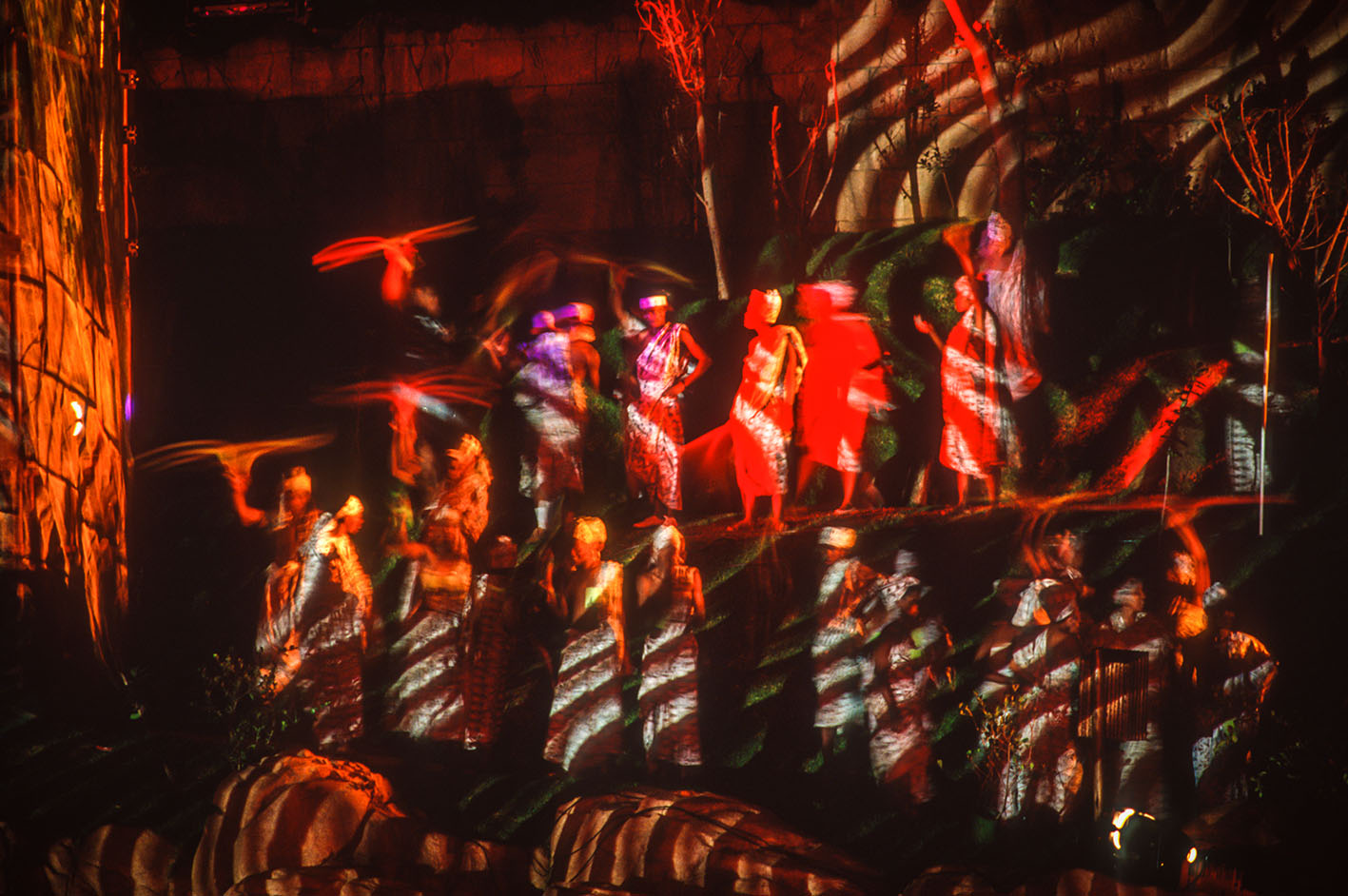
The third part of The Legends of The Lost City was sub-titled Paradise Lost and was the most moving of the four sub-sections. The idea was to convey the fictitious volcanic eruption and accompanied by Jarre's new Volcanic Dance, the entire Lost City turned blood-red with the graphic depiction of death through images of the dead inhabitants of this once glorious city. Laser-generated human figures, sweeping over the architecture of the Palace and surrounding ruins reminded the audience that this was pure fantasy.
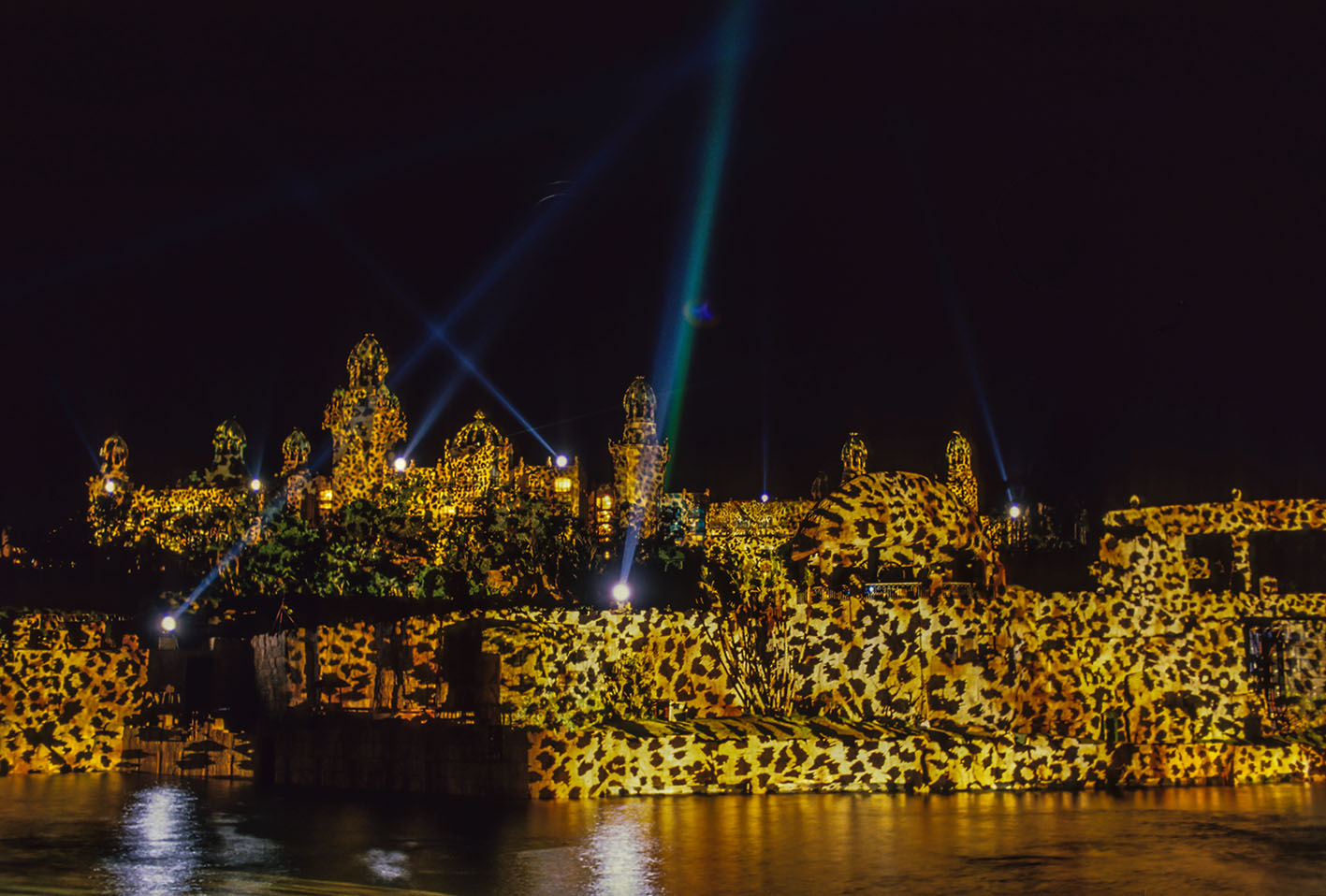
Jarre's theme was very much African. He clothed the Palace in leopard skin and Ndebele patterns. The African beat in his new music was set off beautifully and made this track very unique amongst the others played during the shows.
Volcanic Dance was in complete contrast to the music composed for the Swatch events, mixing the high-tech of the synthesizer with the very roots of African music and percussion.
More than 200 torch-bearing dancers emerged from caves within the hills and began making their way down the facing hill as the imposing synthesised chords of Jarre's Lost City theme resounded through the vast amphitheatre. Others emerged from the walls of the Palace bearing torches and streamed down the staircases. A total of 240 dancers in all, creating a human flow of devastating molten larva.
Wooloomooloo has not featured in any of Jarre's shows since his Rendez-vous with his hometown of Lyon. However, it turned out to be one of the most memorable tracks of the first night for all the wrong reasons. It was a rumble of reality from this world of fantasy that Jarre had created when some of the foliage on the hillside caught fire. It was the spectacular depiction of the fictitious earthquake that originally destroyed the Lost City that caused the crowd to gasp a little longer than had been intended. One unkind press report tried to suggest that it could have been the ancient gods of music trying to tell Jarre something but maybe though with so much illusion and fantasy, the blaze may not have been real, just Jarre toying with the crowd.
The deep tones of Rendez-vous Il marked the introduction of the fourth and final part of these extraordinary shows. Once again, it was very similar in format to its performance in Zermatt but nevertheless, stunning. Unlike in Zermatt, the Palace was a more natural projection site and so allowed the flags of many nations to be painted in light in elongated strips, covering the centrepiece from head to foot. The cartoon characters which made such an impact in Switzerland also made a welcome return, turning this fantasy world on its head once more. Cars sweep across the ruins, lasers erupted from the towers of the Palace, illuminated by the arena lamps positioned throughout the resort.
For the first since 1986, Rendez-vous IV concluded one of Jean-Michel Jarre's spectacular shows, the crowd clapping along in a display of joy. As with Zermatt, the finale amalgamated the images from throughout the shows, and it left the crowd trying to piece together the aspects of each part of the Legends. Using the version mixed especially for the Bastille Day concert in Paris in 1990, ending with a gigantic climax of exploding fireworks and music, sensational is the only way to describe this African culmination.
The film of the event, broadcast in South Africa on February 2nd 1993, didn't entirely do justice to the finale, nor to the scale of the show.
For most people, the shows were an extremely intense and overwhelming experience. Colourful, full of energy, dynamic and pulsating, that's the only way to describe them.
The creator of the shows was characteristically modest. Jean-Michel Jarre commented, "I am very pleased with the shows. But performing in southern Africa is really an excuse for me to have an adventure; to experience new places and interact with new people; for me these things are almost as important as the show itself."
One of the most enjoyable aspects of Jarre's show was the fact that every individual person could make his/her own story of what they were seeing, everyone decided for him or herself what the message was. People should not search too deep though. This was a once-in-a-lifetime experience.
The excitement and screams of astonishment from the audience were an obvious sign that they loved the spectacle that Jean-Michel Jarre had created. The most fascinating aspect of the performances was that the story that Jarre tried to tell became alive and reality, you were encapsulated in a fantasy world for a short moment in time. A glittering palace of light of your very own.
Performing in southern Africa is really an excuse for me to have an adventure; to experience new places and interact with new people; for me these things are almost as important as the show itself.
02/By the numbers
Show Facts
- 3 shows
- over three nights
- 15,000
- audience each night
- 21 500
- individual items flown in from Paris
- 100
- French and South African technicians
- 3 weeks
- to install
- 15 tons
- of spectacular fireworks
- 30,000
- shells
- 24
- people to prepare the fireworks
- 18
- computer-controlled 7000W beams
- 100
- arena lamps
- 240
- dancers
03/Feature
Making of Legends of the Lost City
Jean-Michel Jarre's explosive show was the event of the decade in Africa - a once-in-a-lifetime opportunity to witness a unique musical and visual experience. Jean-Michel Jarre transformed The Lost City, one of the world's most spectacular resorts, in a techno-fantasy of light, sound and colour.
In this extraordinary setting, Jarre created a musical landscape, using his majestic electro-acoustic sounds to flood the area and incorporated his revolutionary use of visual techniques such as giant projected images, pyrotechnical effects andlasers, synchronised to the music. They seemed to set the night on fire, illuminating The Lost City as the star of the show.
"The concept of this show is based on the Legends of the Lost City,” Jean-Michel Jarre explained when he first arrived in Bophuthatswana, “Ancients arriving in the Valley, building a kind of civilisation, creating paradise, and suddenly the nature is reacting, maybe in the wrong way, maybe the right way, we don't know, with volcanoes destroying the whole city and the whole valley. And then, time is passing and people rediscover this valley and until modern time when this valley is brought to life again by new generations of people, a new civilisation towards the future.”
Over 25 tons of freight, incorporating over 2,500 items, was transported from Paris to The Lost City, in a Russian Ilyushin 76 aircraft. As Willie Saayman of South African Airways explained during the unloading of the freight from the aircraft, 8 days before the first show, this airlift was unique for the South African carriers. “From Paris toCairo, it was a 5-hour flight," he said, "From Cairo down to Niarobi, it was another 6-7 hours and from Niarobi to Johannesburg, another 4 1/2 hours. We've done all sorts of cargo, but it was the first time that South African Airways have carried this kind of a cargo, delicate instruments of this volume into the country. We managed to bring through in the region of 30,000 kilos of cargo. The customs clearance is going to be done here so maybe we are going to unload this truck tomorrow morning at 6.00am”
There were worries that with the tremendous amount of cargo being brought in, the South African authorities may have been slow in clearing the equipment before it could go onto the concert site. However, the day after the cargo arrived it was clear to be moved directly to The Lost City, one person responsible for the cargo declaring, “We've actually unloaded a lot quicker than we expected to. Customs? Easy. It happened. They were very co-operative and it all just came off the trucks and we've been distributing since.”
Jean-Michel Jarre devised the original concept for the show in a visit to The Lost City in February 1992, before it had been completed. He explained that after seeing the spectacular resort, he went back to his hotel room and worked the whole night and had the concept worked out by the next morning. Eight months later though, when Jean-Michel Jarre arrived to actually conceive the shows, he knew that he faced similar problems to those he had faced before with previous projects on such a scale.
He explained, “Whatever you conceive on a piece of paper is always fairly different when you are physically on site because suddenly the perspectives are always different, the nature of the air is different. Also, because of technical problems you can only discover when you are actually doing the job. It forces me to adapt the original concept.”
With over 100 personnel involved in the project, 55 French technicians and 50 South African technicians, the project evoked its own team spirit, which is always present in Jarre's projects.
“Everybody is concentrating for six months for two hours. I think when you have people working sometimes 17 hours a day, they develop a kind of team spirit," Jarre explained, “and this team spirit for me is very important, as important as the result itself.
“We have lost these past few decades the unique aspect of a creation. I think these days where we have more and more images through computers, videos or TV, people need to come back to a very natural way of sharing the same emotions at the same time in the physical way.
“The relationship I have developed with the head of each technique has changed since these last 12-15 years. At the beginning these people were technicians or artists, totally isolated in their own technique and then suddenly they had to share with the others, the predominance that they used to have. The team has developed a pretty unique know-how and a mutual trust through all these years.”
The techniques for the show took a grand total of one month to physically set-up. Of that, three weeks were needed to lay the necessary 60km of cables for power distribution. Proper rehearsals were scheduled to start on Friday 27th November and so with the majority of the equipment not arriving until Monday 23rd November, most of the cables were ready by the time the equipment arrived.
By the Thursday, the lighting side of the show was well under-way, as South African Mickey Lehr explained, “So far, we haven't quite configured the lighting installation, but we have installed 51/2 km of multi-core cable. On the Palace roof alone we've only got 120 light-fittings but there is 21/2 km of cable in there. We are very used to setting up 600 light fittings in stage environments in a hall but to spread it out over, I don’t know how many acres of land, that is certainly a steep learning curve. Jean-François Touilland, who is the French lighting designer doesn't speak any English and I speak practically no French but by speaking two different languages actually gets together with the universal language of lighting and we are actually doing very well and we understand each other.”
As has been seen before in China, London, and Houston, the problems of language differences seem to unite everyone working on such a project, rather than the opposite. English-speaking Tim Dunn, also working on the lighting of the buildings felt that the common goal was important.
“There's a lot of respect between people - we have to otherwise the job wouldn't be done.” he said, “We all wait for the same things, we all have the same problems as in the weather, difficulty in access to some of the buildings and falling over cables you've run during the day, falling over rocks and whatever else.”
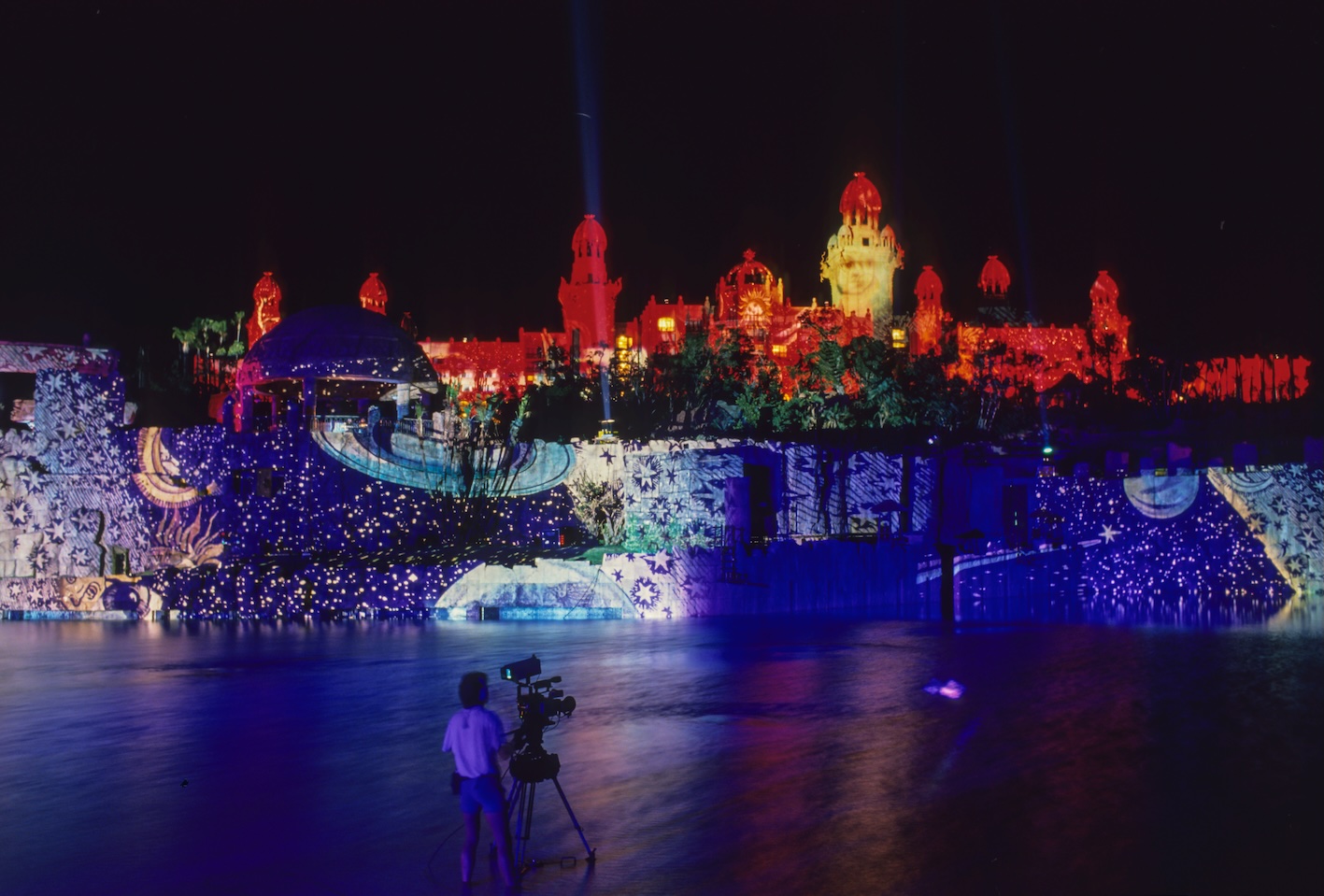
One of the most important and creative aspects of Jean-Michel Jarre's shows has been the projections. In London over 1,000 slides were created but although there were fewer in The Lost City, the terrain in which they were projected upon made them extra special. Without the usual covering of white cloth, the projections moulded themselves around architecture that was unlike anything seen before but it worked beautifully.
Marie-Jeanne Gauthe has worked with Jean-Michel Jarre for many years and, along with her team of artists, has helped make the projects in places like the London Docklands and Paris such an absorbing spectacle.
Standing near to the ruins in The Lost City, Marie-Jeanne remarked, “I am the creative designer of the site. Jean-Michel always has an idea of what he wants and I search to have the right pictures he has in his mind. There are 230 slides and 30-35 films. Jean-Michel always decides with Bruno Tric all the final pictures. I am a little anxious about the results on this surface.”
So much time is taken over each slide, they have to be careful not to make mistakes. However, there is a process in which to rescue slides from possible disasters. “If a slide burns or if there is an accident with the colouration, we make two contacts in order to replace it and to make it with colour again.” Marie-Jeanne explained, “I put gelatine on the slides and after, with my knife, I cut out the wrong part of the gelatine. Downstairs in the dining rooms, there is a place with the lighting table and we have all our materials.”
Another technique used during the show was the moving projections which are less restrained to the ones which Marie-Jeanne Gauthe designs. For the Swiss Alps show, six of the PAE operator-controlled follow spots were used to great effect. The Lost City incorporated nine of these units, projecting moving images onto the ruins, gardens and hillsides, projecting over hundreds of metres. Phillippe Moreau of Contre Jour demonstrated one such unit on the main control area, explaining, “This system will move through the X and Y. We don't have a zoom because we'd lose light with a zoom. There are 4 machines on this island and at the front of the Palace there are 5 machines. We take orders by the intercom .... all the time!”
The event involved one of the largest display of fireworks in South Africa, incorporating over 15 tons of fireworks. One of the members of the South African team remarked, “We've been contracted to supply local pyrotechnicians to help out with the French. There will be various firing positions around the Palace. The guys will be working in teams, and it'll all be coordinated by radio, directed by Daniel Azancot and we will be firing to his fuses.”
Phil Baker, another South African involved with the pyrotechnics explained, “Jean-Michel Jarre uses fireworks as another medium. The fire actually represents a backdrop, a curtain so to speak. This particular shell is a Red Penny, it weighs roughly 15kg. When it bursts at about 250m, it'll cover a rugby stadium. Underneath is the lifting charge which is about 1/2kg of black powder which will propel it to the height of about 250m. The guys now are just finishing off the magnesium waterfall which is a magnesium cascade. As you can see, they are busy wiring it up, it's a very intricate and fiddly part of the procedure but very, very effective.”
One of the French technicians, Pierre Albertson, who has previously worked with Jean-Michel Jarre on many occasions, including London Docklands, Paris and Mexico, took a light-hearted view of the fact that they were using explosives in an extremely hot environment, “This is a safe area, that's why we are in the middle of nowhere. Here we have the explosive stuff and we prepare the fireworks. These shells are coming from China. You have to put it completely in the bottom of the mortar, if not, there will be some air between the shell and the bottom and the shell doesn't lift high enough, it comes back down, which isn't too good a solution!”
By Saturday 28th November, the rehearsals were underway but not everything was in place. There had been problems both with the searchlights and the lasers.
Jean-Michel Jarre explained, “It's my second day with real rehearsals and at the moment we are running late because we are still awaiting the big, giant searchlights, they are still not on site today, I hope for tomorrow. We also had a problem with the lasers because not only do they need power but also water to cool the system. Very good news is the way the light is responding in this climate. Due to water, we have a lot of humidity, and the light is much brighter than I thought and so that is good news. Actually, at the moment, I'm in the middle of process I know well, with disappointment and good surprises.
"Tonight I'm going to take care of the architecture of the beams. The idea to try to build some effect like a fan of light or pyramid of light and this requires some time to get each beam focusing at the same point. This is a long process we started last night.
“When I arrived, I realised that because of the rain over the last 3 weeks, suddenly everything became much greener, particularly on the hill. One of the main screens for projections, images and effects was on the hill. I thought that it was going to be a problem but from the rehearsal last night, I think it is going to be more or less ok.”
Two days before the first performance, the laser systems were sorted out and the technicians were able to test out the designs that had been prepared in Paris. Two giant animated apes were leaping around the hillside to give probably the most stunning use of the laser images seen to date.
Loic de Montaignac explained, “There are four lasers, two on the top of the roof and two on the top of the Palace. I'm doing the lasers, controlling the animation of different graphics. The first step is the graphics on the computer, and everything is stored in memory on a hard disk. After that we then go through different mixing desks and different equipment, completely dedicated for laser. After that, there is another step, here on site.
“It is quite difficult to know when you are in the studio what you want. You can imagine the site but you are not on site, working and positioning exactly and precisely the actual graphics you want or sequences you want.”
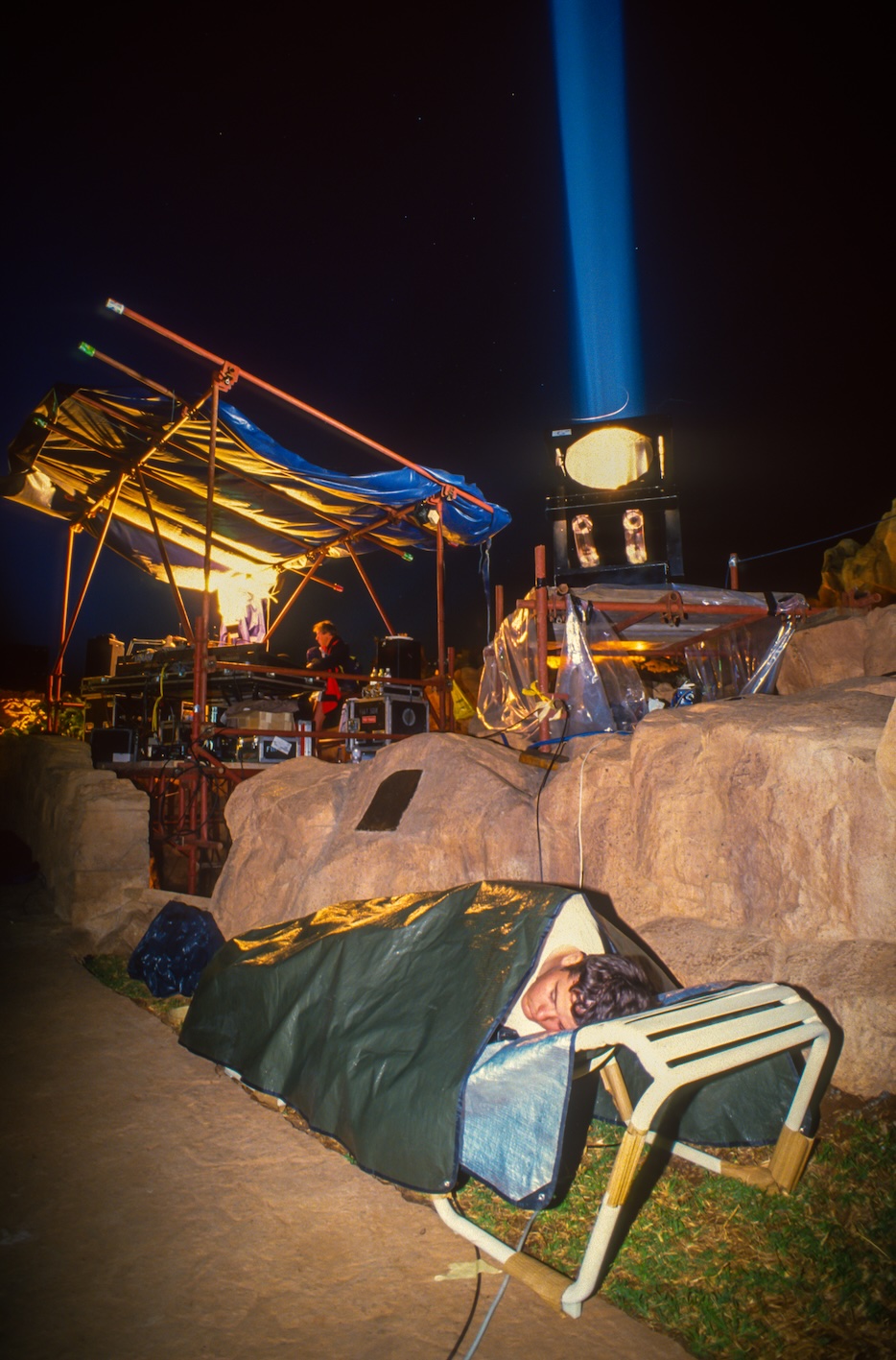
As techniques go, searchlights would seem one of the most straightforward elements. However, the problem that Jarre faced in The Lost City was actually getting his hands on them in the first place. Weighing over 2,300 kilos, two of these units eventually arrived in the nick of time, two days before the first show. One of the South African crew members commented, while helping to unload one of the units, “This is one of the military searchlights that we purloined or hired from the S.A.D.F. We're going to be using them to augment what we're using in the show that Jarre's brought out and these are nice big ones. These can be seen approximately 8-10km up in the air and on a clear night, even further than that. We were originally trying to get at least 5; there are 10 in South Africa, but the military don't use them anymore and they are finding it difficult getting spare parts because they are from World War II. So we've dwindled it down and ended up with two.”
By Sunday 29th, everything was in place and full rehearsals could go ahead, much to the relief of Jarre, “The various techniques are now on their way, all the equipment has arrived. This is my first spectacle in Africa, and this is a very unusual site for Africa and even for the rest of the world. It is a mixture of environments because of the presence of water and trees and all this mad architecture that we can see. Plus the cultural encounter between electronics and traditional music. When you take the African sculptures, this is unique and it has influenced all the painters, all the sculptures during the 20th Century, even the most contemporary ones. So, I think I try to convey all these ideas in this project. I try to escape from the routine of the rock concerts, first of all because I think the music I'm doing sounds totally different outdoor. I experimented with this format 15 years ago and I've been amazed that a million people attended this first experiment, I was terrified at the same time. I'm still terrified by that and I think it's a nice way of communicating music and feelings and emotions.
“I'm never confident during a project until the end and even after I'm more somebody who doubts about the work than has confidence about the project.
“All artists have to cope with time and to get deadlines is not bad actually, it gives this feeling of emergency which is very good”
With one day left until the first show, Jean-Michel Jarre was able to reflect upon the work that had already been put into the project, from an initial starting point of over six months ago.
He remarked, “I've enjoyed immensely the work I've done with the musicians and the choir from Bophuthatswana and the percussionists and dancers, under the direction Cedric Samson. This was very difficult to put together if you think that the stage was half a mile and to synchronise 300 dancers into such a set, it was not only a miracle, it is also generosity on their side. For me, it has been the most important thing that has happened in this country.”
Cedric Samson, a renowned South African musician, arranger and composer, had tried to convey the musical side of the project in such a way as to link in with the African visuals. As well as using Jarre's new Volcanic Dance composition, Cedric Samson worked on a stunning extended version of Eldorado as well as adding African vocals to the finale of Rendezvous IV. He commented, “The chorus sound we've looked for is mainly to depict Africa - the chanting, the movement, the pulse of Africa. That's basically what I've done with Jean-Michel's music, is taken the basic tracks and 'African-ised' the whole thing.”
The resulting shows encapsulated everything that is regarded as African and left the thousands of onlookers speechless. It will go down as a unique show in history but Jean-Michel Jarre has further ideas for Africa, including a possible show in Cape Town, with its stunning mountainside as a backdrop.
Jean-Michel Jarre spoke about what he hopes to achieve with this kind of spectacle, explaining, “This work for me is like creating a musical painting. The canvas is The Lost City, and I love this mixture of baroque and high-tech, past and future, sophisticated technology with primitive technology, whatever it is. Fireworks are very primitive or old, or acoustic instruments. I think this mixture is quite in-phase with what the end of the 20th century is giving us. I always dreamed about a mode of expression or even a kind of art form that could embrace all these various parameters and it's what I'm trying to achieve.”
04/Feature
The Legends of the Lost City
Centuries before tall ships were ever dreamed about, long before the dawn of a western civilisation, a nomadic tribe from northern Africa set out to seek a new world, a land of peace and plenty. The tribe wandered for many years in search of such a magical place, and at last their quest was rewarded. The land they discovered to the south became the legendary Valley of the Sun, known today as the Valley of the Ancients in the country now known as Bophuthatswana, Africa.
The secluded valley, shaped from an ancient volcanic crater, was blessed beyond anything the human mind could imagine. The soil was fertile, the game was abundant, and the freshwater springs flowed continuously from the surrounding hillside.
This land that teemed with the riches of nature was also a place of captivating beauty.
The metallic-blue wings of kingfishers flashed in the sun. Springbok and impala leapt on strong, sinewy legs beneath azure skies. Herds of wildebeest grazed on the nearby veld, and in the shallows of the Lake of Secrets the hippopotami browsed, guardians of this bountiful scene.
The tribe - the Ancient Ones as they are called today - settled in this Valley of the Sun.
Here they lived a balanced life, in harmony with the plants and animals and in rhythm with the seasons of the year. They built a village of simple dwellings, meeting lodges and shrines. Over the centuries, the population expanded. Gold and platinum were discovered in the valley, and mining this treasure-trove brought the people great riches.
As the city grew in size and wealth, new structures were built on the foundations of the old. Eventually, the people of the valley possessed sufficient wealth and knowledge to erect a regal city and a magnificent palace for their benevolent king and his family.
The palace was built on an island within a sacred lake located at the top of the valley The design incorporated a new architecture - never before imagined - which mingled the shapes of towers, domes and arches remembered from a long-ago past with a thousand patterns of the natural world of the Valley of the Sun. The Ancient Ones fashioned an enchanted city, a man-created world richer and more splendid than any they had ever known.
Kong gates were shaped to protect the city. Noble leopards became sculpted sentinels, crouching on the corners of a canopy over the royal palace doors. A fountain, the Shrine of the Sacred Monkey, paid homage to the tree-dwelling monkeys who saved the villagers lives at a time of great drought, by dropping down to them fruit and berries they had picked from the inaccessible tree-tops.
Fortuned with great wealth, no part of the wilderness was forgotten: the leaves of the palm tree, the blossoms of the protea and the wild plum were immortalised in stone. All the marvels of the jungle: elephant, lion, kudu, butterfly, snake and bird, and even the serpentine vines and clouds of an African sky, were depicted in mosaics and carvings, in vaulted ceilings, mouldings, capitals and balustrades, and on the flame-topped, 70 metre high King's tower which rose above the palace like a beacon.
For many years, the Ancient Ones and the royal family lived a peaceful and happy life in their glorious city in the Valley of the Sun. But one day, the winds screamed, the sky blackened and the jungle took on a dark and menacing look. The earth beneath the beautiful city began to shake with thunderous power. A mighty force destroyed walls and hurled buildings as if they were pebbles tossed from the hands of an angry giant. The people ran in terror to escape the tremors and the tumbling stonework.
Those citizens of the Valley of the Sun who were not killed by the earthquake, fled the city never to return. The royal family were borne to safety on the backs of alert kudus, who had felt the warning vibrations before the full power of the earthquake struck the city.
Only the king and his family came back to the Valley of the Sun to witness the destruction. They found the village in ruins and the mine shafts collapsed. The very topography of the earth had been altered. Eternal springs spurted from the mountain side and underground geysers erupted into huge waves on the surface of a swimming basin. The earthquake had created a miracle of continuous cascades and waterways, and an ever-flowing river which wound in circles, seemingly defying the laws of gravity. To the further amazement of the royal family, the palace, anchored deep into the bedrock island of the Lake of Secrets, had survived in all its glory.
During the ensuing years, the royal family lived on in the Valley of the Sun and maintained their palace as best they could. When they died, the palace was deserted, left to the forces and the whims of nature. The memory of the greatness of the city and the lives of its people faded, and with the passing of time only whispered legends recalled the Lost City. Through centuries, the thought of this city with its palace and treasures tantalised the imaginations of explorers.
But the secret place known as The Lost City eluded first one adventurer and then another. Almost three hundred centuries after the great earthquake, in the last decade of the 20th century, an expedition came upon this sacred locale and its ruins. The leader of the expedition saw in the crumbled towers, the heaps of stones and pieces of carvings, in the majestic palace and the remains of the surrounding village, a legacy of untold value, silvered with age. He dedicated himself to restoring the Lost City to its original splendour.
Today, once again, a bridge leads to The Lost City and to The Palace, luminous and perfect above the mirror-sheen water. In The Lost City of the Valley of the Sun, a primal, endless river flows. And here the spirit-guardians of the Ancient Ones, the leopard, the elephant and the kudu decree that happiness shall be the destiny of every adventurer who treads upon this magic land.
Gerald L Allison
This piece is about