Access All Areas / By Mark Gidley
Chronologie 1993
A mesmerising exploration of time, technology and the rhythms of life, Chronologie sees Jean-Michel Jarre embrace the future while reconnecting with the experimental spirit of his musical beginnings.
01/Feature
A Brief History of Time
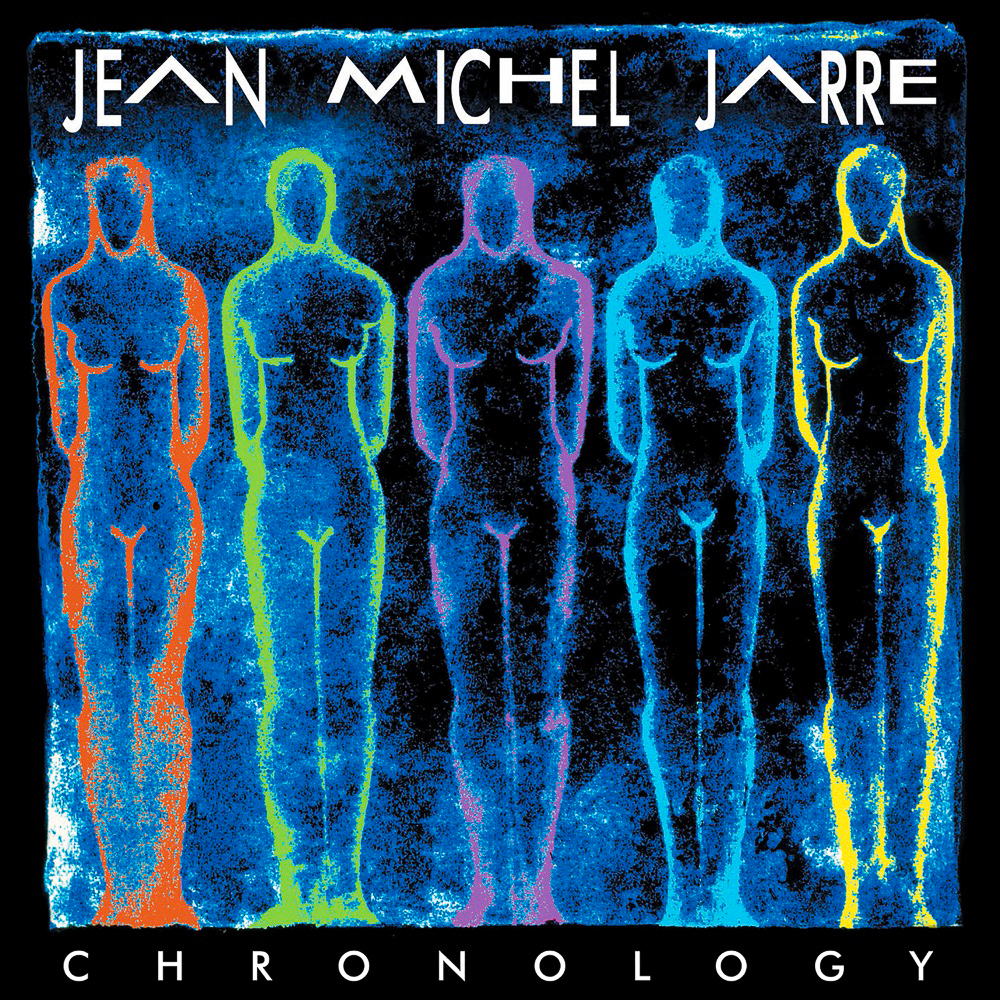
Released in 1993, Chronologie marked another significant chapter in the musical evolution of Jean-Michel Jarre. Arriving three years after Waiting for Cousteau, the album saw the French electronic music pioneer embrace a new generation of electronic sounds while revisiting the melodic and atmospheric qualities that had established his reputation of years past. The result was a fascinating fusion of analogue synthesizers, contemporary dance rhythms and classical influences, creating an album that looked simultaneously towards the past and the future.
At the heart of Chronologie was an exploration of time itself. Inspired in part by physicist Stephen Hawking's celebrated book A Brief History of Time, Jarre wanted to create a musical interpretation of the mechanisms and evolution of time. Rather than simply describing historical events, the album explored the cycles of life, the passage of generations and the relationship between the universe and human existence. It was an ambitious concept, providing the foundation for an eight-part musical journey.
The album, recorded over a period of 18 months in his home studio in Paris, seemed to represent not only a subtle history of Jarre's musical career but also a further step forward for one of the world's most avant-garde composers.
The first question to ask, why Chronologie?
Jean-Michel Jarre explains, “For a long time I have wanted to work on the theme of time and to do a sound and light show to tell the story of time. This is something that has fascinated me for a long time.
“If you read the dictionary definition of chronology, it is certain you will find something like a series of dates or historical events that happen in time. But my definition of chronology, which in my opinion, is much more interesting, is that since the beginning of time, life is a series of events, sequences made of seasons, days, years, generations, chromosomes, births, heartbeats.
“They may not be events that could figure in history books, but they are in themselves, the chronology of our lives.
“All of these clichés are easily overlooked, but during the past minute, 800 children were born in the world. Our hearts beat many hundreds of thousands of times, and we are ruled by a sequence of events, a chronology of events which, at the end of the day are the heartbeat of modern life. That is what I want to demonstrate through my music and concerts and the music is a kind of poetic evocation of these cycles.”
Therefore, the inspiration behind the new album is rather broader than the strict dictionary definition of the word chronology. The album is a musical evocation of what Jean-Michel sees as the "rhythm of life", the complex patterns and sequences behind the life force. From DNA to chromosomes, reproductive cycles, heartbeats, generations - The Chronology of Our Lives.
Jean-Michel explained that Chronologie deliberately forms a cycle, “The album in itself is a kind of cycle - the last sound is bringing us back to the beginning of the album.”
Jarre numbered each track rather than titling them, a reflection of the seconds, minutes and hours that make up a day, “There are no titles except Chronologie itself. I always found a bit artificial the fact that when you have songs with no lyrics, you have titles that could be evoking any kind of personnel things but that could evoke something else for other people.
“In other words, when you have a global concept, I think the notion of movements or parts within this global concept, for me, makes much more sense.”
Recalling the composition process, Jarre explains, “Before I even started composing, I prepared a palette of sounds based on the different atmospheres I had in mind, as well as the transitions between tracks. They flow into one another without any gaps of silence. The album can actually be played on a continuous loop: it has been designed cyclically. The final track ends with a countdown, followed by sounds that reappear at the beginning of the first track.
“I initially worked on Part 4, the first single, which I had already partially written the previous year. Once it had been mixed, I developed all the other tracks simultaneously. This was the first time I had worked in this way.
“For me, the middle of an album is more difficult to create than either its beginning or its end. By starting there, when I began working on the opening tracks, I knew they had to follow a progression that would ultimately lead to Part 4. It's a little like a novelist writing a book starting with its conclusion..."
Jarre worked with a number of collaborators on the album, Jarre explaining how the recording sessions worked, “In a very unusual way. The collaborators recorded at home, which has all sorts of advantages. Working in familiar surroundings, at your own pace, often produces better results. I sent them the basic material in the form of tapes, MIDI files or MPC60 files.”
Once completed, the album was mastered in the US by Greg Calbi of Sterling Sound, Jarre commenting, “The diversity of musical styles and the number of albums that pass-through Sterling Sound are impressive. What's more, in the United States, mastering is considered a genuine stage of the production process, just as important as mixing.
“The mastering process took three days and three nights, which is relatively long for a mastering session. Many albums take no more than half a day. Greg Calbi, the sound engineer, did a really beautiful job.
“One advantage of not trying to complete everything in a single day is that you can take a DAT tape away in the evening, listen to the results outside the studio and refine things the following day...
“On some tracks, we used a valve converter inserted between the two-track tape machine and the digital mastering console. It's a device that adds a particular colour and warmth to the sound.”
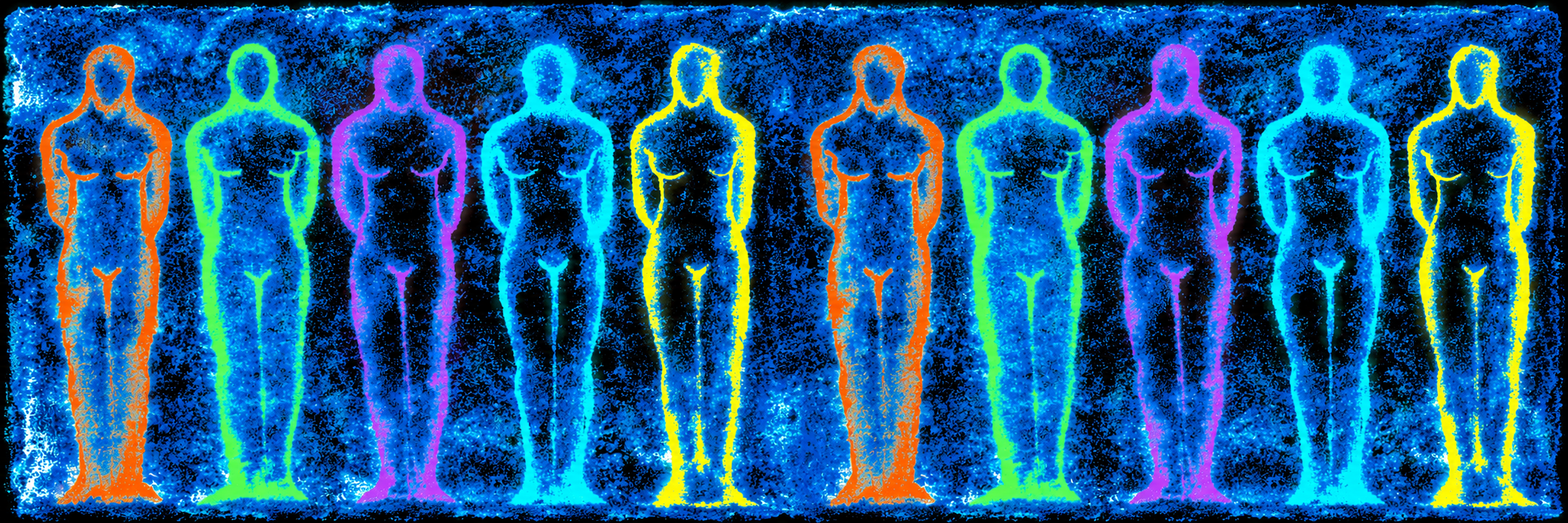
The cover artwork rekindles Jarre’s collaboration with the artist Michel Granger. After providing memorable covers to Oxygene, Equinoxe and Rendez-vous, Michel Granger has provided a distinctive piece of artwork that Jean-Michel Jarre has a clear vision as to what he wants it to represent.
“The cover you see is linked to this theme of Chronology and which is going to follow me around for the coming year,” he explained.
“Going from the idea that these sequences of events are set in motion by women, by women of different colours. This comes from Greek mythology which says that the sea, storms, passion, disintegration, illness and death are all female and this is what time is. I think that, as Einstein said, life is a series of events, some of which come off and some of which don't.”
The Chronologie painting, titled "Desire", was created specifically at Jarre's request, without Granger having heard any music beforehand; he considers it better that way, since music shouldn't directly generate the image. That painting was later computer‑adapted, for the cover and also concert use.
The two videos to accompany the first single release from the album, Chronologie Part 4, could not be more different. Entitled Time and Space, both have been produced by the same American director and the first especially, is possibily the best promotional video yet produced for Jarre. JJarre spoke of the first set of videos and why there are two versions.
“I thought about having two videos, totally different on the same piece of music and probably also remixes of those two videos for the remixed versions. The first, called Time is about a series of events that will be developed from the beginning of the video until the end.
“The second one has been shot in Brazil and is more time-linked with a notion of space, of movements through time, a kind of voyage through different aspects of time.
“Jon Klein is the director of those two videos, and he is a brilliant American director who has created a lot of the sound and visual style and look of MTV-Europe. He has done a lot of other videos for other people and I'm a big fan of his work. I think he's also able, because he's also a musician himself, to cope with the difficulty of having images and visuals on a piece of music with no lyrics. The big danger of doing a video on a piece of music with no lyrics is that suddenly the music can appear as a kind of background on any kind of scenario. So, he took a great care from the beginning of this work of the pace, the rhythm, the sound and to try to keep a constant link between the sounds and the visuals.”
Chronologie also sees the work of talented young French hard rock guitarist Patrick Rondat brought to a higher public stage. Listing his influences as Al Di Méola, John Maclaughlin and George Lynch, Rondat released his first album The Elements in 1986. After the release in 1991 of his second solo LP Rape of the Earth, he was unsure of his next step forward but a chance meeting at an Extreme concert provided the answer. Patrick Rondat, 23 at the time, spoke of his collaboration with Jean-Michel Jarre earlier this year whilst putting the final touches to his parts on Chronologie.
“I had been giving in to pressures around me and thought that a group project was the only direction in which my career could go. Then, after a discussion with Jean-Pierre Sabouret, one of the first people who really believed in me, the Jean- Michel Jarre idea was created. We each saw Jean-Michel Jarre at Extreme's Zenith concert and I decided to contact him. He called me back three weeks later (I've kept the message he left on my answerphone!). It's very difficult for me to talk about Jean-Michel Jarre as I think of myself still in some ways a novice but also because he is so famous, I sometimes feel as if I'm using him in some way.
“This new album was conceived with a specific place for the guitar - I hope I can discover new aspects of sound and enlarge my field of expression. It will be up to me to present a rich palette of sound. It's a fantastic experience from which I can only gain benefit and Jean-Michel Jarre gives me large margins within which to work. I don't go in and say, ‘Hello Boss, what am I doing today?’ - it's very open, intelligent and mentally artistic, which is partly because Jean-Michel Jarre has to consider the integration between his music and his spectacles. You either like what he does or you don't, but you can't deny that there is an artistic richness and quality in his work.
“Jean-Michel Jarre adores guitars and is a rock music fan, so it's an opportunity for me to learn a huge number of things and make music of great breadth using means that only Jean-Michel Jarre can provide. I've always been a solo artist, solely in charge but it's not at all bad to have someone at your side who gives opinions on your work, especially when it's Jean-Michel Jarre!
“Essentially, what you hear on the new album is Patrick Rondat's hard rock style, even if it is a bit diluted - I hate the ‘family’ aspect of hard rock. To me, music should satisfy a passion, I should be able to work with whoever seems right at the time - sincerity should be there from the start.”
A various of young acts were commissioned to remix some of the tracks, Jarre explaining the process, “I supplied them with copies of the 24-track master tapes so they could extract individual elements, as well as premixes of sequences, rhythms, themes and other material intended for sampling.
“Each group approached the remixes in its own way. Praga Khan replayed the melody using a piano sound and added instruments, vocals and other elements. In contrast, some of the Sunscreem mixes don't feature the main theme at all. Instead, the sequence elements are brought to the forefront, giving the music a much more rhythmic character. It's very much in keeping with the current British scene.
“Black Girl Rock, on the other hand, used all my Vocoder and Vocalist tracks, including some that don't appear on the album, and made them the central element of the track.
“Other completely atmospheric remixes, without any drums at all, consisting entirely of sequences and sustained sounds in an ambient house style, will be released later in the year...”
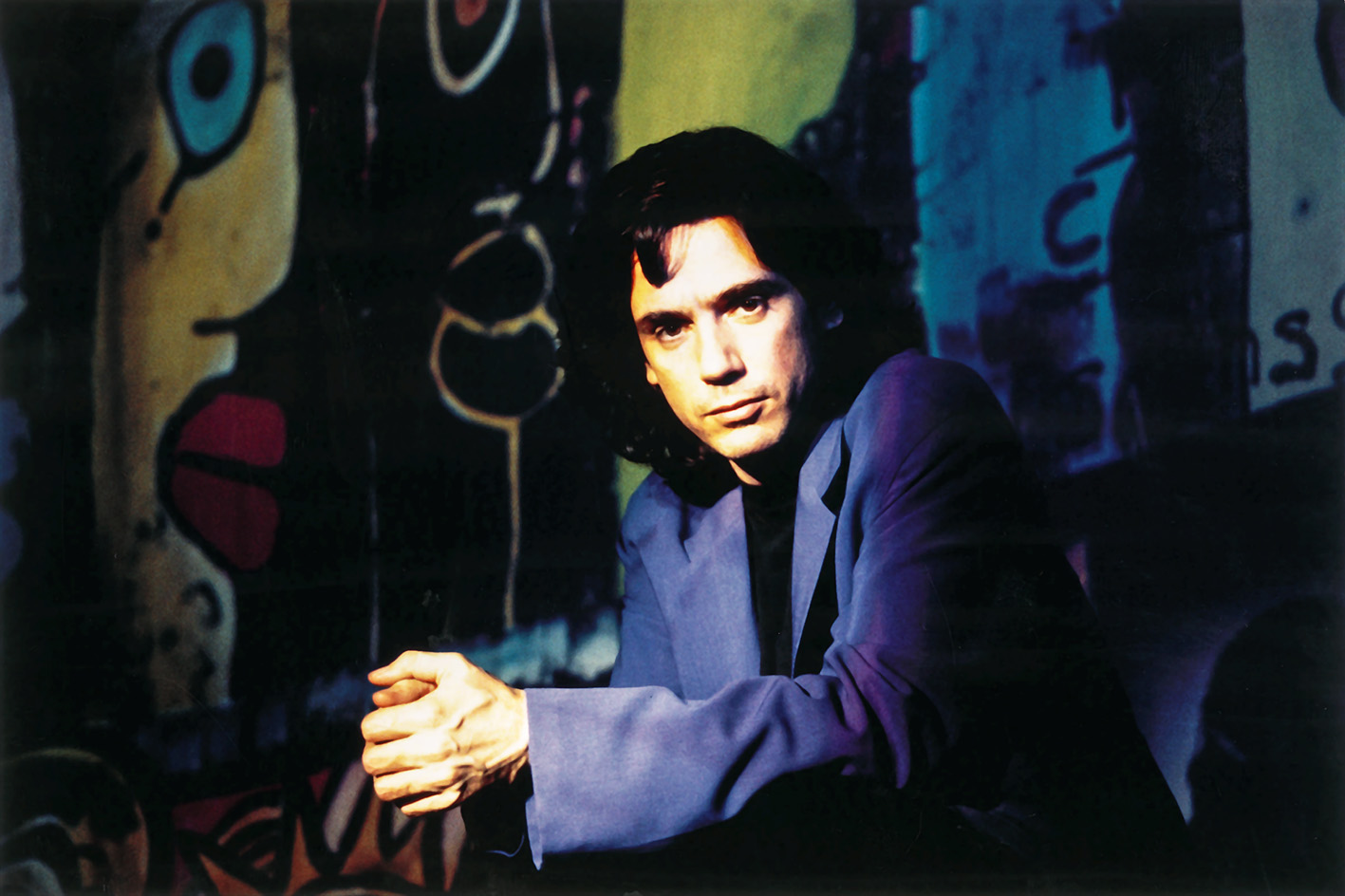
We’ll leave it to Jean-Michel Jarre to reflect on his happiness with the album, “Chronologie is closer to Oxygene and Equinoxe than anything in-between, and it completes a kind of cycle, in the way the music is constructed and in the use of old analogue gear. There is '90s technology, too - digital loops done on the DJ70 – mixed with the melodies and harmonies from the JP8 or the Oberheim, for example. I'm happier with this album than with any other for a long time.”
02/Interview
Jean Michel Jarre
Chronologie I seems to show a return to a certain lyricism and a certain spontaneity ...
“This is one of the most original tracks on the album - I worked for a very long time on it. I found it hard to decide how the track should develop, as I did not want it to be too structured.
“I started with two basic sounds, one from the JD-800 and a sound like a 'tired whale', somewhere between an animal sound and a human scream. This was developed intuitively and I am sure I could not do it again. I entered it all into the MPC 60 sequencer which I love and know inside-out.
“However, there are many parts played ‘live’ in this album and I returned to analogue sounds which I love, with the Eminent, Synthex etc and a Revox for echoes. These past few years, I have experimented with digital echo effects, but I have always come back to the Revox, creating echo through playing the varispeed. Chronologie I owes much of its sound to this effect which gives a warm reverberating sound.”
In Chronologie II, there is a sound that is very reminiscent of your work before Oxygene, from your first single in fact, La Cage / Erosmachine ...
“This rhythmic loop was recorded on 1/4" tape. Originally it was the sound of a nail-file slowed down from 38 to 19 cm/second, with sounds of knife blades played on piano cords which I organised in function of the tempo. I can still see myself measuring out the notes and sticking the bits back together. I wanted to use some old sounds in Chronologie as the old technique with magnetic tapes gave a very different result to those available from a sampler. I am beginning to realise how much we owe to Pierre Schaeffer. The fact that without him we would not have a large part of today's music is almost totally forgotten.”
Chronologie IV appears to be emerging as the Oxygene of the 90's.
“A hit single is the key to getting a piece of instrumental music listened to. One has to accept that there is a general rule which says that a single must be made from an album. Sometimes it is nice to break away from convention; on Waiting for Cousteau, I made a 40 minute track. Many people complained about this, even though a section of the public enjoyed my approach.
“Chronologie IV is perhaps the track which will be heard from the album, although there are other tracks which could well be played on the radio out of context. I wanted Chronologie IV to give a feeling for the rest of the album - the symphonic dimension, the analogue sounds, the choirs, the sequences, the link in with time and finally a dramatic, yet optimistic feeling.”
As the album progresses, particularly Chronologie V, there are very different emotions being expressed...
“Very few people realise that the 'rave' track Chronologie V was composed right at the beginning of the project, before any other. There are two directions in the album, the rhythmic side and a very open, airy side.
“At the beginning of the century, one lived time instead of carrying it on one's wrist. Life followed the great cycle of existence, the phases of the moon, seasons, events of life. Today in the 90's, our life is governed to the millisecond by computers, time codes and digital technology. Music has obviously been influenced by this new way of living.”
In comparison to raves, the timings of some pieces on the album are quite short ...
“I did not want to make the album too long. I want to do longer versions on stage, perhaps twice the length, in order to use different sounds. At the last moment, I took bits out of the album, one instinctively knows when a track is too long. For example, part 7 was four minutes long, but I took out one minute and twenty seconds. It's like the length of a film. Often nothing bothers you, but by taking out a bit, it could be even better.”
The album also contains some very beautiful atmospheres with the transitions between the pieces...
“The transitions are perhaps what I was most pleased about. These days on synthesizers, the tendency is to press a preset and the track starts but without linkage. In Chronologie, I wanted the transitions to be polished elements of the album.
“One of the other particularities of Chronologie is the position of the sound sources within the sound stage. Many sounds reoccur throughout the album, but they never come across in the same place. There was a lot of work that went into giving the sound width, depth and height. I used a Cyclosonic ES-1, a piece of Japanese equipment which is far superior to its competitors. An identical sound, for example, will not become boring because it never seems to come from the same place.”
03/Feature
More Remixes
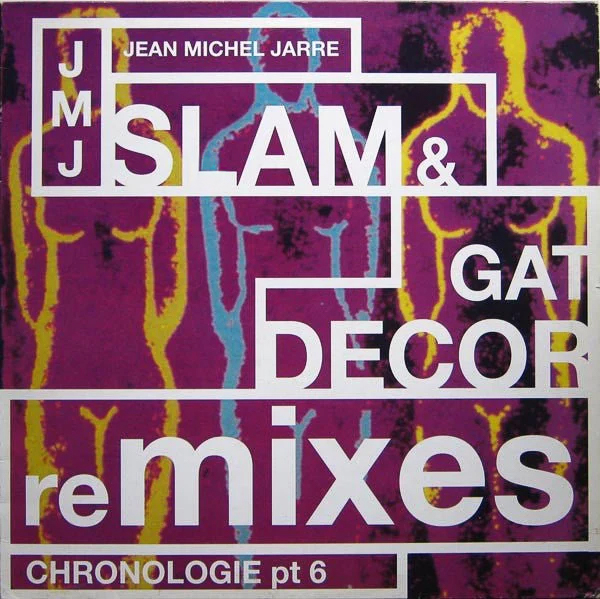
Slam and GAT DECOR Remixes
Jean-Michel Jarre invited many of the leading artists on the dance scene to remix the Chronologie tracks. As a result, mixes by Sunscreen, Praga Kahn and Black Girl Rock were all released in various forms of Chronologie IV.
In a second wave, Slam and GAT DECOR remixed Chronologie VI and instead of the normal release to the public, the mixes were pressed onto two 12" singles and given free to clubs throughout the UK. They were greeted with great critical acclaim (even from the hallowed NME newspaper) and were a highly sought after release.
As a result, they were eventually released commercially on a mini-album, a first for Jean-Michel Jarre, in the UK only, at a cost approaching that of a full price album.
Critics and club-scene love them, reaching number 30 in the album charts. Jean-Michel Jarre himself has a very positive opinion on the remixes that Polydor have released, commenting, "I love the Slam remix even if it's so far away from the original it's like their own record.
"Dance music is very spontaneous and has a fresh attitude. There's a musical and sensual approach with dance music - it's linked with body language and physical attitudes. It's the link between the 70's and the 90's. When they first came out we were using synthesizers to create our own sounds. It's the same in dance music today."
Raves have been cited as being inspired from the style of concert that Jarre has given in Houston, Paris, Lyon and London's Docklands with Jarre being some sort of Godfather to the scene. Jarre can see the link but is non-committal over the inspiration.
"If people consider my work the inspiration of the rave movement, that's fine with me. It's obvious there is a link. I tried to create events that people considered one-offs. People are isolated in front of the TV and listening to walkmans, those events were more convivial environments for people to get together. The rave movement was following the same idea."
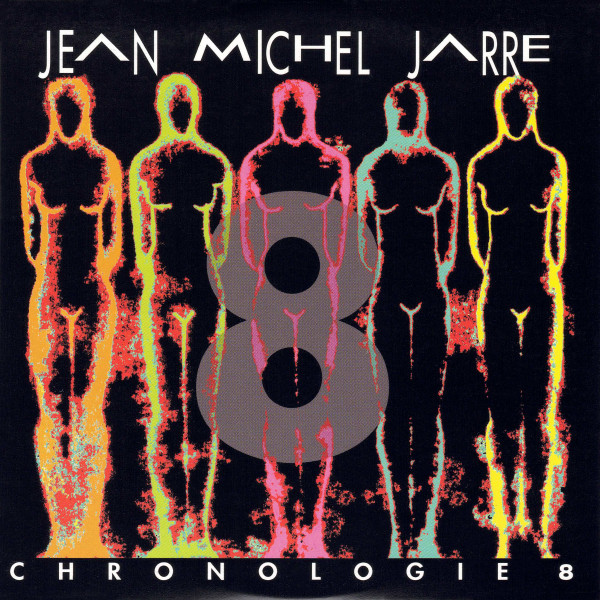
Geiss VIII Remix
With a superb remix by Michel Geiss and Jean-Michel Jarre, Chronologie VIII was released on a promotional CD single in France (FDM 3749-1). It was initially intended for commercial release but ultimately was made a promo-only release.
Although the track has the same structure, the final track from Jean-Michel Jarre's Chronologie album was revitalised with many superb additions. With a playing time of 3'37, it was backed with the album version of Chronologie VI.
This piece is about