
Access All Areas / By Mark Gidley
Swiss Alps 1992
With a nod to Christo, a unique show in the village of Zermatt, set against the natural splendour of the Alps.
01/Feature
An Alpine Setting
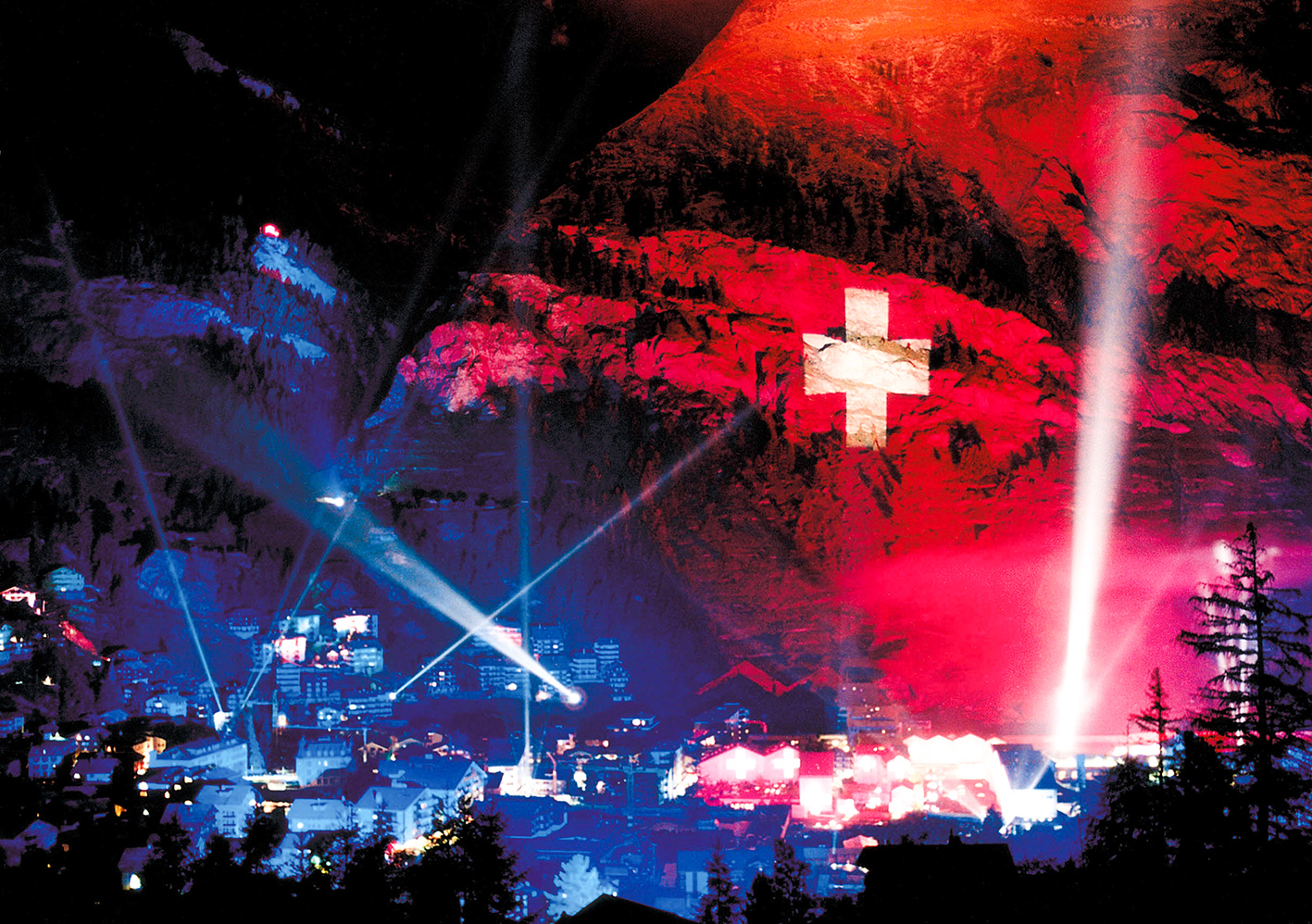
With a nod to Christo's environmental installations, this was Jean-Michel Jarre’s turn to interpret the natural environment of the peaks of the Swiss Alps, with architectural fabric wrapping, far removed from the city centres of Paris and Houston. The stage was Zermatt, the backdrop the mountains around the Matterhorn, the occasion ‘Swatch the World’. The Master of modern electronic music created a new spectacular which fused together lights, lasers, images and fireworks against the natural splendour of the Alps.
So, what exactly was ‘Swatch the World’? Not a designer globe, but a celebration of the plastic timepiece that has rolled off the Swiss production lines 100 million times in under ten years. With the centrepiece of the Jean-Michel Jarre show, the event was staged to salute the people who have made Swatch so successful.
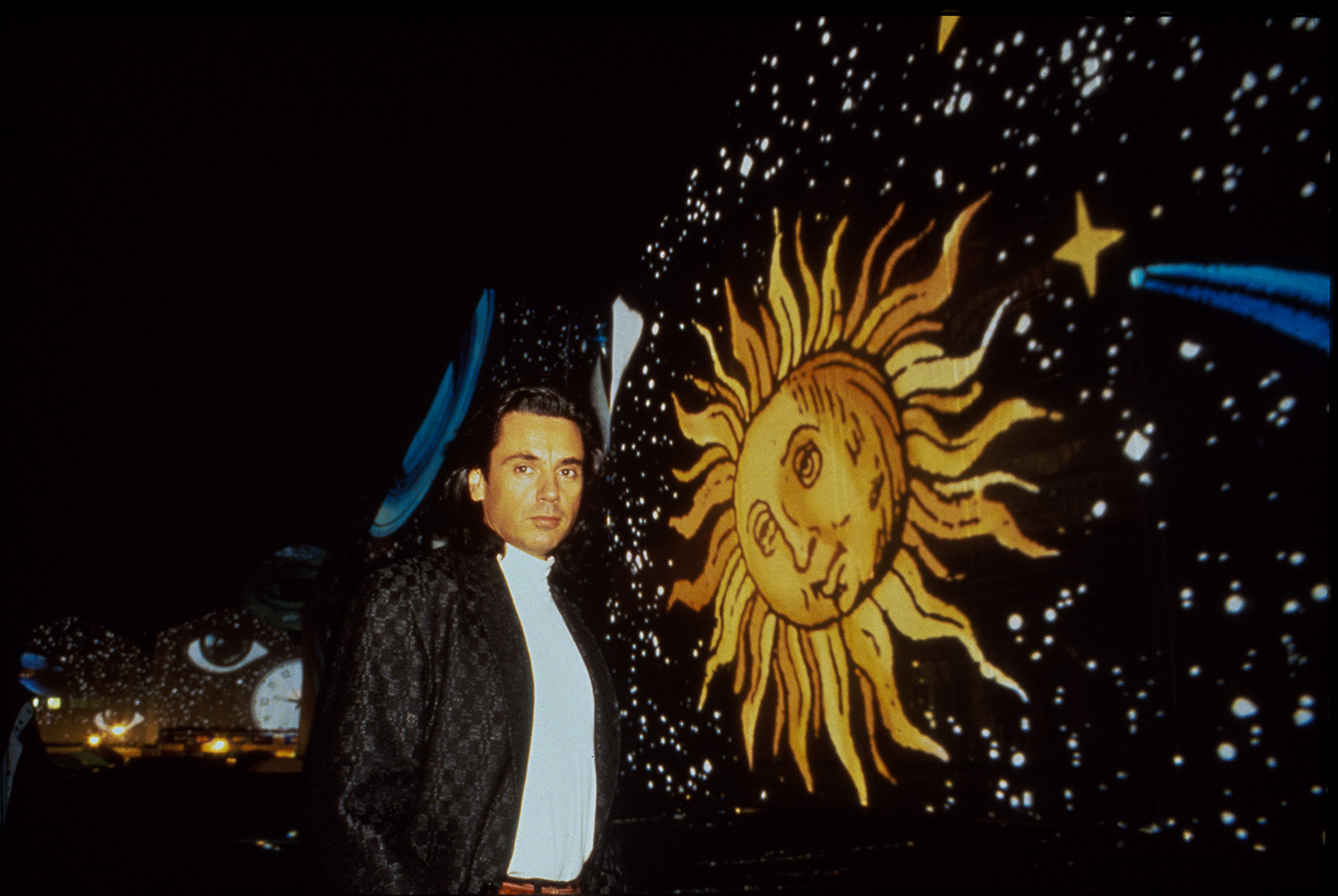
Not surprisingly, the inspiration for the concerts was the timepiece itself and the centrepiece a brand-new piece of music, composed especially for Swatch and incorporating sounds associated with the marketing phenomenon.
“Swatch has restored the tick tack to the modern watch,” says Jean-Michel Jarre. Starting with the very tick tack that once brought the Swatch such harse criticism, and adding to it the noise of a Swatch factory, Jean-Michel Jarre created his own rhythmic theme, entitled ‘Une alarme qui swingue’. To this the creator of multi-media total art added phrases from his own international hits to produce a completely new blend of sound.
It was the first time Jarre had staged a show outside of a city. “My concerts are not planned, in a conventional sense,” said Jarre before the event, adding “I will not myself be on stage. Rather, I shall allow the production, in this fantastic alpine setting, to speak for itself. Anyone who just wants to see Jean-Michel Jarre had better stay at home.”
September is normally a quiet period for Zermatt, with the summer season only just finished. However, this weekend was an exception - Swatch collectors, Jean-Michel Jarre fans and the media had besieged the village for three days.
Zermatt is located in southern Switzerland, ten kilometres from the Italian border and in the shadow of a crescent of spectacular 4000-metre-high peaks, the most famous of which is the Matterhorn. The village under the Matterhorn has become one of the most renowned resorts in Switzerland and since no motor-driven cars are permitted, the whole atmosphere is tranquil.
Surrounded by mountains, Zermatt is full of chalet-style hotels and buildings, with forests of evergreens covering the lower hillsides, below the snow-capped peaks. The setting was not ideal for a concert, but when Swatch approached Jarre to perform a concert, the challenge was there. For starters, the mountainsides upon which the projections would fall were not flat and there were no immediately obvious buildings upon which to throw other projections. Screens couldn’t be hung on the mountain so would the projections be bright enough? The most obvious place to launch fireworks were the mountainsides but how could they be installed? In fact, Swatch had come to Jean-Michel Jarre suggesting Zermatt and Swatch chairman, Nicolas G. Hayek explained why he had chosen this beautiful but difficult location.
“We decided to locate the party in Zermatt last year when we knew we were going to be producing our one hundred millionth Swatch.” he said, “I wanted a symbol of monumental all-Swiss Alp authenticity, and I personally decided I wanted Zermatt. Many people thought we wouldn’t be lucky and the people of Zermatt wouldn’t accept this, but I counted on their very open-minded international thinking and their strong-minded comprehension of the Swatch message. I wanted this very beautiful symbol - a place that will be our city for two days.”
“The meeting between myself and Nicolas Hayek was more than just a meeting with a watch company,” Jean-Michel Jarre told us, “It was an encounter with an artist and creator with whom I immediately felt at home. The first time that we met he said, ‘I've finally found someone as mad as me’. And I realised in the days which followed this initial meeting that he was in fact quite right.”
All the problems to stage the shows were conquered and resulted in a performance unlike anything that Jean-Michel Jarre had staged before. There were two concerts, one on Friday 25th September 1992 and a repeat performance the following evening, together with rehearsals on the Thursday night.
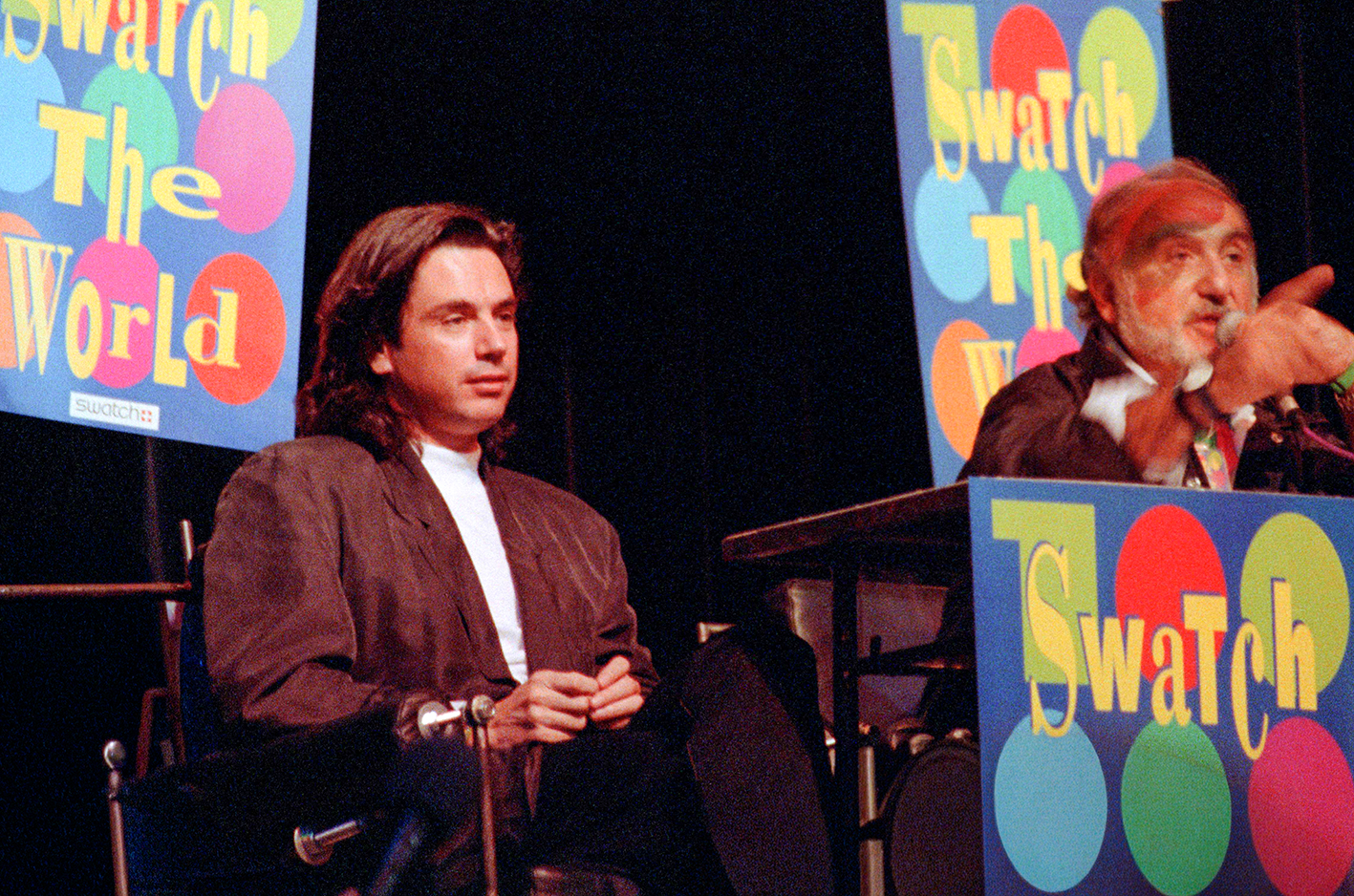
At a press conference held in Zermatt’s cinema the day after the first concert, Hayek spoke of his delight of the involvement of Jean-Michel Jarre, commenting, “I think we have seen yesterday evening a real performance of high art. It is the first time that Jean-Michel Jarre has been doing something like this in an enormous mountainous situation. I found it absolutely marvellous.”
One journalist followed on by asking the usual question of the logistics for the shows, specifically how many fireworks were ignited.
“That you should ask to the technicians responsible for it.” Jarre replied, continuing, “I would like to thank the people of Zermatt because this project could never have happened without them. The fireworks for instance, have been installed in very tough conditions on the mountain. For the people who were already in Zermatt will know that we have had very heavy rain three days ago and very strong fog two days ago and the whole installation of the lighting equipment and fireworks has been done in a very difficult and acrobatic situation on the mountain. People have actually slept on the top of the mountain last night. About 80 people were involved in this project, plus I would say, the whole of Zermatt. This project was rather special for me because I am usually performing the music on stage.”
Asked about how much the entire party had cost, including the two concerts, Hayek refused to play ball, remarking, “The budget? It’s not quite as heavy as you may imagine. How much? I’m not the accountant of Swatch - I’m only a creator.”
Welcomed by applause from the journalists, he added with a smile, “We’re both artists. You don’t care about money and I don’t care either.”
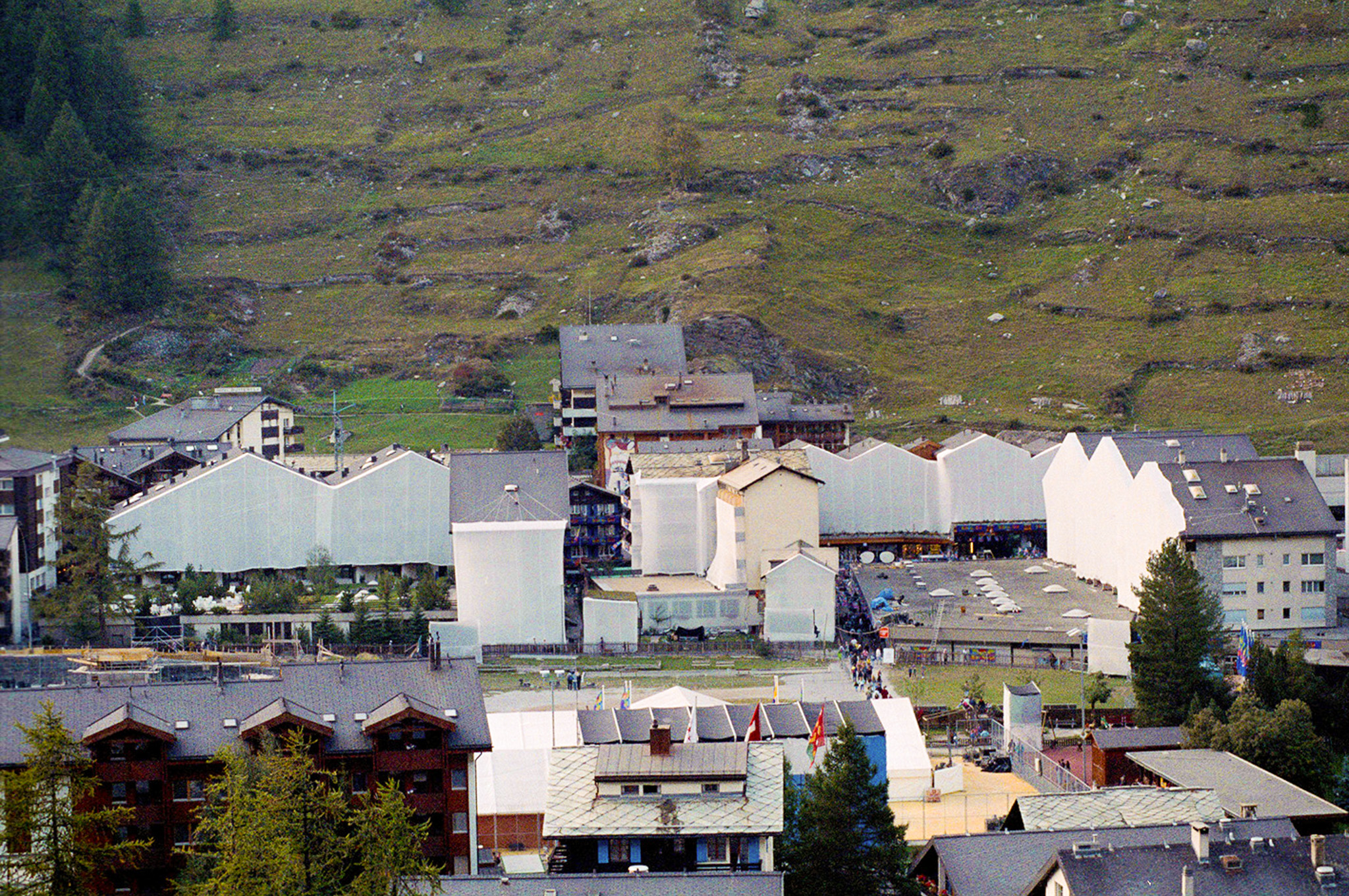
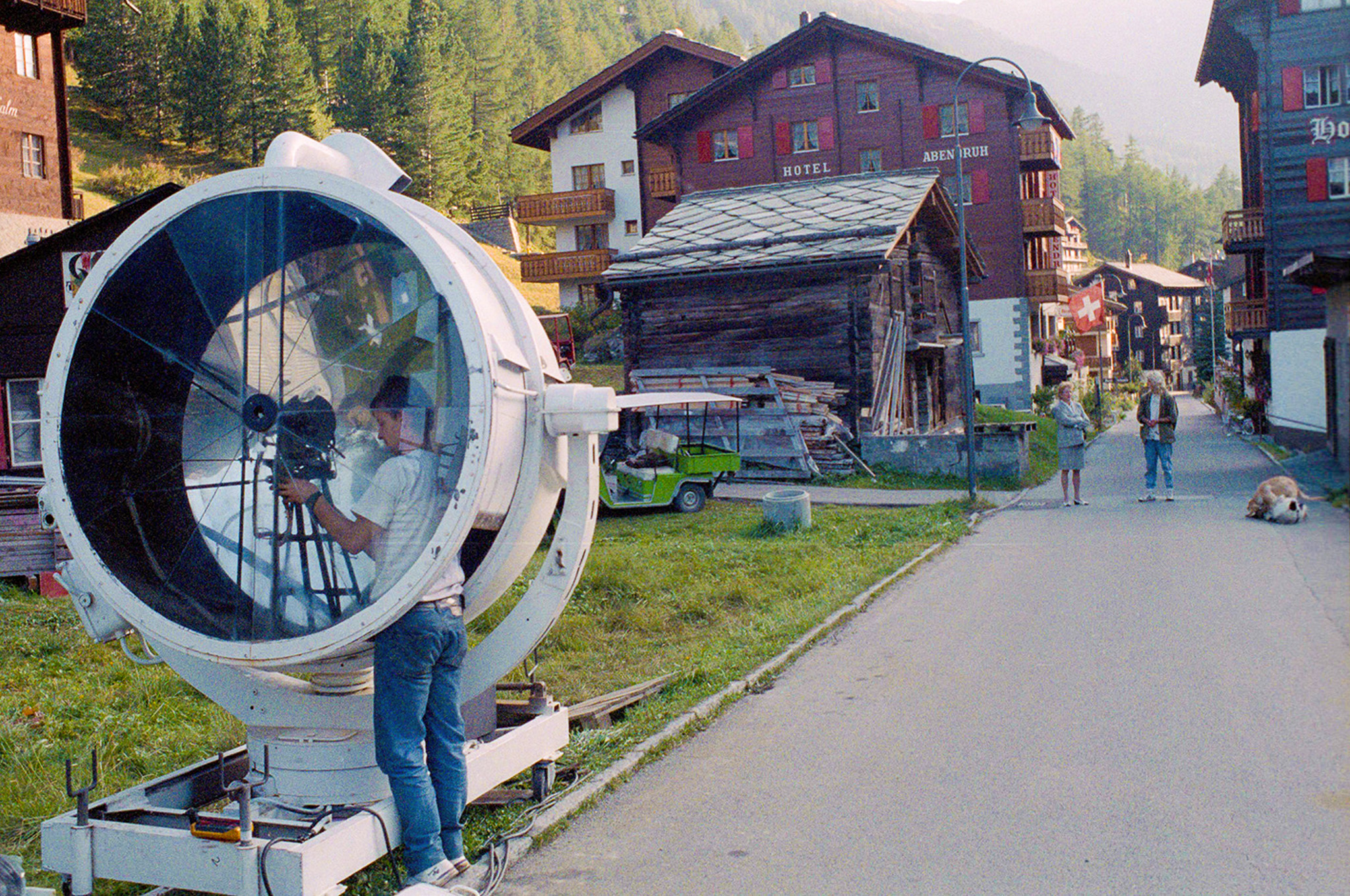
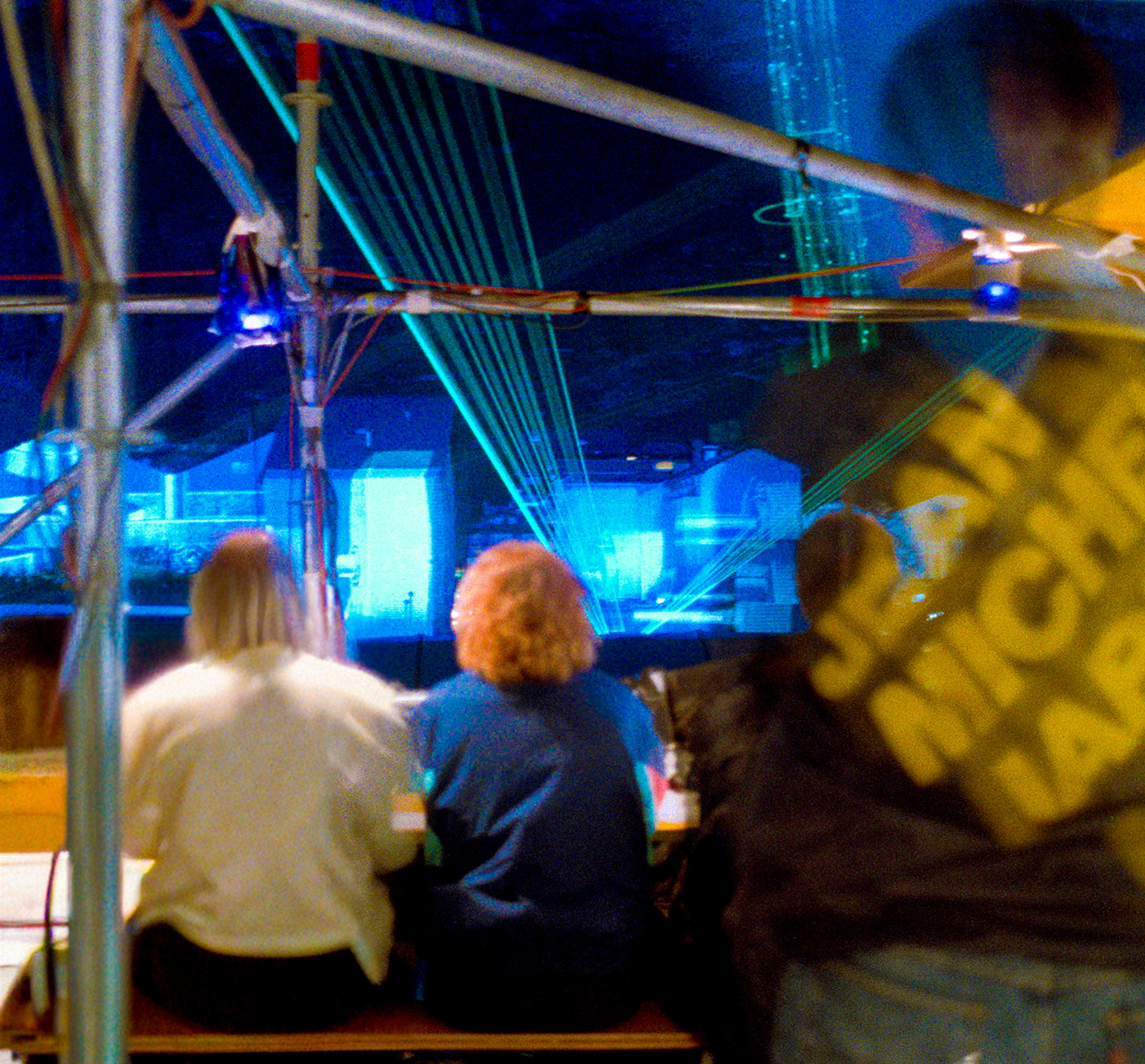
One of the intended areas for the crowd to congregate was just off the main street of Zermatt, near the train station. It was here that the buildings had been draped in the now familiar white screens - hotels, local shops and houses alike. Certainly not on the same scale as Paris but seeing them is like bumping into an old friend. The area was quite small, a lot being taken up by the main Swatch tent, around which towers were set up, two holding the expensive laser systems and one much larger one, the control area. It was from here that Jean-Michel Jarre would direct the show with his colleagues (including artistic director Bruno Tric and Pani designer Marie-Jeanne Gauthe) as well as from where the sound was monitored, the six Contre-Jour projectors were housed and also from where the concerts were partly filmed. Stacks of speakers were dotted around the site, as well as the inaugural searchlights, skytrackers and other lighting effects. In front of the buildings were the other powerful projectors and sited next to the control area was the control for the fireworks, from where fireworks genius Daniel Azancot would direct the pyrotechnics, in isolation for some reason from the rest of the crew.
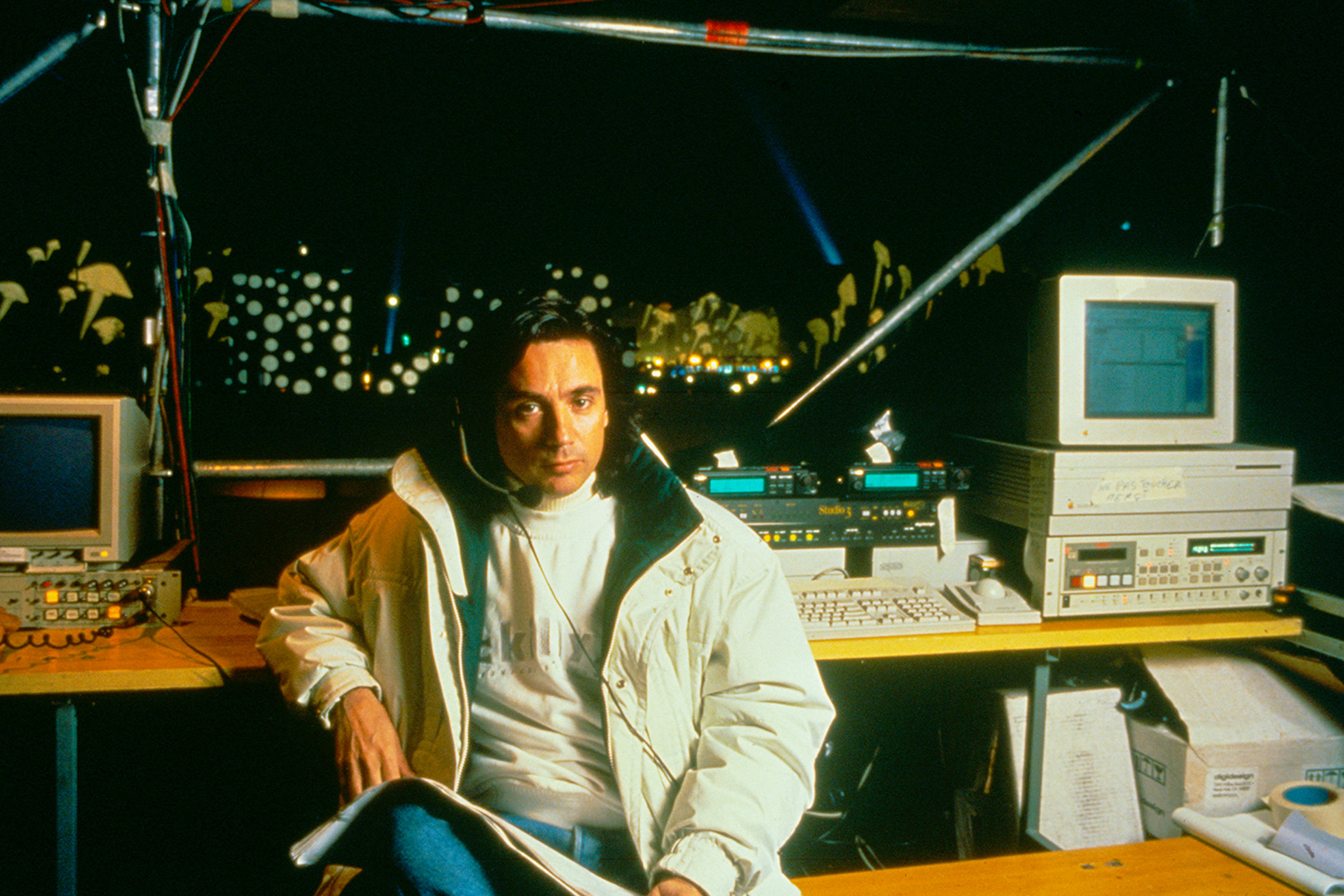
These concerts were certainly unique. Jean-Michel Jarre was not performing. Instead, he would direct the show from within the control area, but it was still necessary for personal contact with the audience. This was achieved by a platform positioned just in front of the Swatch tent, upon which Jarre stood each night at the beginning and end of each concert. As well as introducing the show, he introduced the audience to the various effects that they could expect during the show. For example, the lasers, the lights, the projections and the fireworks, three rockets exploding one after another with an enormous thunder in the sky above. Illuminated by a powerful skylight, Jarre announced, “And now the music ...”, before darting back up to the control area to take charge.
My concerts are not planned, in a conventional sense ... I shall allow the production, in this fantastic alpine setting, to speak for itself.
02/Interview
Jean Michel Jarre
Jean Michel Jarre reflects on the concerts that he performed in Zermatt back in 1992.
"The concerts that I did in Zermatt and also later that year in the Lost City in South Africa, I would describe as “side-projects” but projects that were very important for me for the future. Zermatt was linked with Swatch and I was in contact with Nicolas Hayek, who was at that time the head of the company. He asked me to stage a special event in Zermatt, not a concert as such, but a project that would link music based on sounds of watches with a land-art installation on the mountain side around the Matterhorn. It was a Christo-type intervention on the village, in that it involved wrapping some of the chalets and buildings with screens and also using some of the mountain face as a screen.
"The whole link with Swatch gave the event a very visual theme and very in keeping with the way that I approach my concerts. The concert was also a homage to the mountains. What I was trying to do was to link both ecological and technological elements represented by the art-de-vivre symbolised by Swatch. I feel the event was also close to my environmental message given that it was in such a rural and natural environment."
03/Feature
The Show
After viewing the first night’s concert from high on the mountain side, Jean-Michel Jarre kindly invited us to watch the entire second night’s concert from the control area which was a unique experience. Projectors, sound equipment, banks of monitors, spare radios, and cue-sheets filled the scaffolded tower, with people dashing around, albeit quite calmly, to make sure everything went smoothly.
Jean-Michel Jarre sat in prime position in the middle of the front of the tower, overseeing the whole production, although his view of some of the projections was slightly obscured by the top of the Swatch tent below. From here, equipped with a headset linked to all of the crew, he was able to issue instructions and suggest on-the-spot amendments to the show as it progressed.
In fact, after the first night, some of the effects had not turned out quite as expected and the second show was altered accordingly. For example, fireworks had been set into the side of the mountain to produce a fountain effect as seen in Lyon (during Ron’s Piece) and Docklands (during The Emigrant) but against the side of an enormous mountain.
For the second show, he had a few problems in getting his speech the way he wanted with only minutes before he was due to go down to deliver it. Standing near us was one guy who radioed to a colleague, saying, “Jean-Michel Jarre should be down in a minute”, only to be gestured by Jarre’s assistant that it may be a little longer. Eventually though, Jarre was happy with his words and was led down the steps, through the darkness of the Swatch tent and onto the platform. It was strange to be following Jarre around that night, none more so than down the steps to where he was to give his short speech, near to where his family sat as guests of honour, including wife Charlotte Rampling, just returned from the film set of her new movie, starring alongside Max Von Sydow.
The show started with the inaugural countdown, starting from nine, enormously projected onto the side of the mountain in white light. Each number was echoed in a deep voice as the sampled word ‘SWATCH’ was repeated countless times, at different pitches. Cockerel crows, bird songs, chimes and frog croaks accompanied the countdown and on reaching one, a female voice called out ‘Give me back my Swatch’ followed soon after by ‘It’s a Swatch darling’, with the ticking of a time piece fading in.
The awaiting audience, crowding the town and surrounding mountainsides, some in chalets, some subjected to the harsh chill, gasped as the whole of Zermatt was bathed in blue light from a bank of lights high in the mountains. As the countdown reached zero, the music started with the new piece composed by Jarre for the Swatch concerts, entitled Une Alarme qui Swingue.
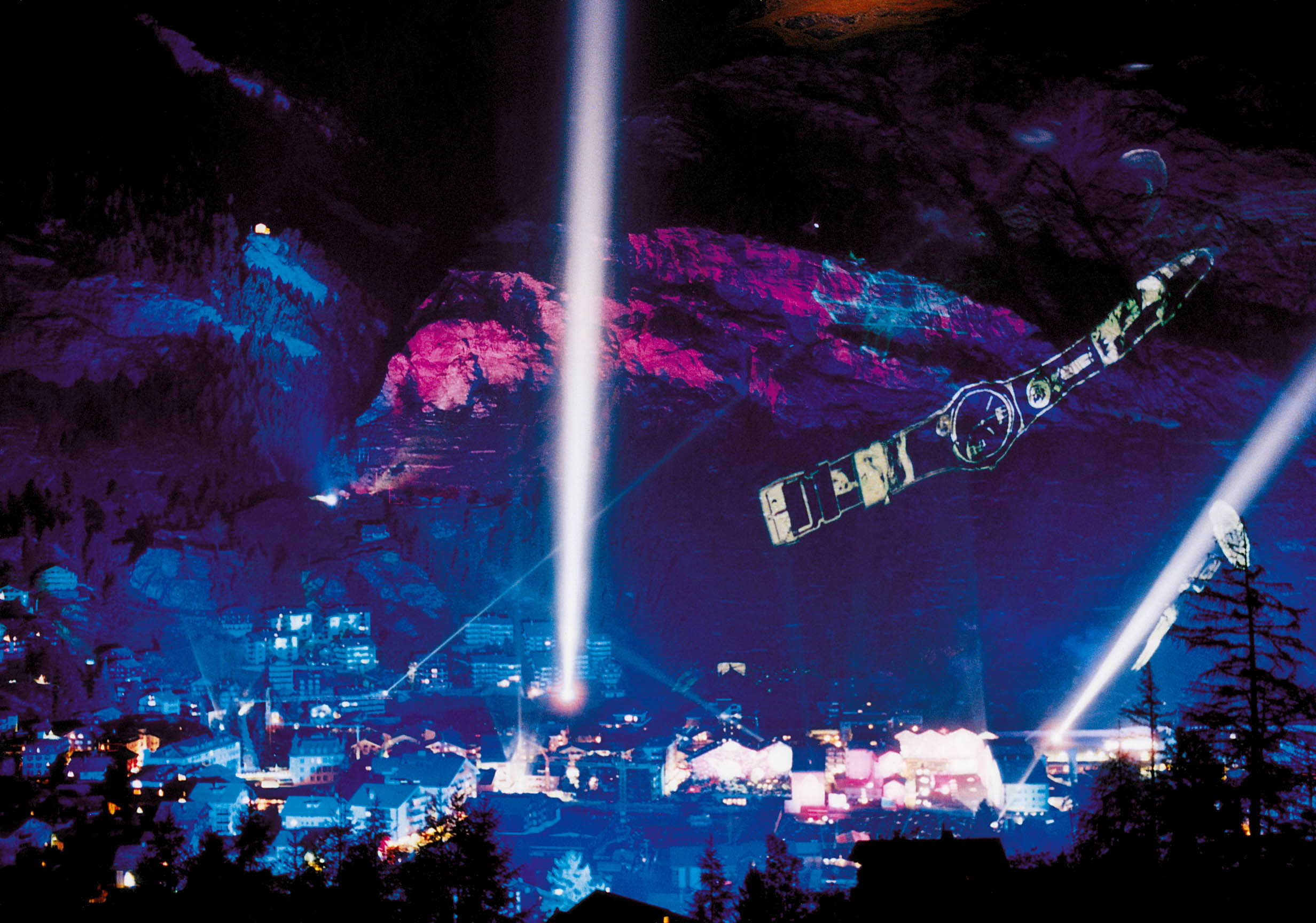
The track, destined for the long-awaited next album, is truly superb and set to become a classic when released. The first part, subtitled Overture, was accompanied visually by the letters of SWATCH projected onto the main buildings, the working mechanism of a watch beamed to an enormous magnitude onto the mountainside, reminiscent of the Docklands overture. The digital ticking of a watch initiated the piece and continued throughout with a superb stereo effect, accompanied by a heavier-than-usual bass line. Perhaps influenced by the charts, Jarre has incorporated a similar dance beat to the current popular ones but still retained his own more refined style. It’s wonderful, not since Calypso 3 has Jarre produced such a striking piece.
Moving with the rhythm of the track, breathtaking animated laser projections of robotic arms filled the mountainside whilst a multitude of clocks and dials were also projected to join them. As the track gained momentum and the catchy melody took over, the Swatch the World logo was projected high onto the mountainside and back and forth between the buildings and crowd. Laser beams shot out in various directions, sky-trackers illuminated the night sky with the aid of a variety of other skylights and the robotic arms transformed into swirling Swatch watches. With an abrupt end to the first piece, leaving only the electronic ticking of the watch still playing, the audience showed their appreciation with a deafening cheer. As was said the following day, you don’t appreciate the scale of Jean-Michel Jarre’s concerts until you have experienced one with your own eyes.
Until the finale, the remainder of the show used compositions from previous albums/concerts, some old and some relatively new, the first of which was Equinoxe 4. The buildings filled with the familiar Granger Equinoxe artwork and laser projections of the Equinoxe faces danced upon the mountain sides. Since these were not flat, no screens could be attached and hence many of the laser projections appeared quite dim in relation to those seen at Paris. However, what they lost in intensity, they made up for in size and imagination. Turning this way and that, transforming in and out, splitting up into pairs and then back into one, it made you wonder what would come next to better it. Again, watches featured heavily in the visuals, from the laser images to the projections on the mountain and buildings, with further projections of the Equinoxe faces moving with the rhythm of the track as in Paris. The buildings flashed in a variety of colours to bring the second piece to an end.
The Paris-version of Revolutions followed and was one of the best segments of the show visually. With the familiar beginning, the buildings were transformed, depicting famous monuments in a dazzling array of colours. Meanwhile, circles of lasers expanded around the mountainside until the word STOP flashed up and the vocal REVOLUTION screamed out into the air. Whether or not it was the reverberation of the town, the vocals within the track sounded different and maybe had been toyed with since the Paris recording. An amazing laser-projected head, seemingly Aztec or Roman, spoke the word and then split into two and continued by rotating in three dimensions around the mountain - one of the most stunning effects of the night and a personal highlight. This had to be seen to be believed. In the control tower at this point, all the monitors in front of the crew went haywire, the screens rolling for no apparent reasons. Some looked around for a clue as to what had gone wrong, but Jarre appeared unmoved, calmly continuing his directional role, apparently unconcerned by one commando-like technician climbing around the outside of the tower in front of him, furiously checking leads and connections. The show continued, the crowd oblivious to the problems. More watch projections and laser images followed and an impressive split-laser effect from one of the systems in front of the buildings was another highlight of the track.
Another observation to make here is the number of different images (both light and laser) used during each track - seemingly far more than at the Paris concert in 1990. It makes it difficult to give a clear idea of each track but really did mean that whilst watching the show you were constantly scanning the sky, trying to absorb the multitude of visuals being thrown at you.
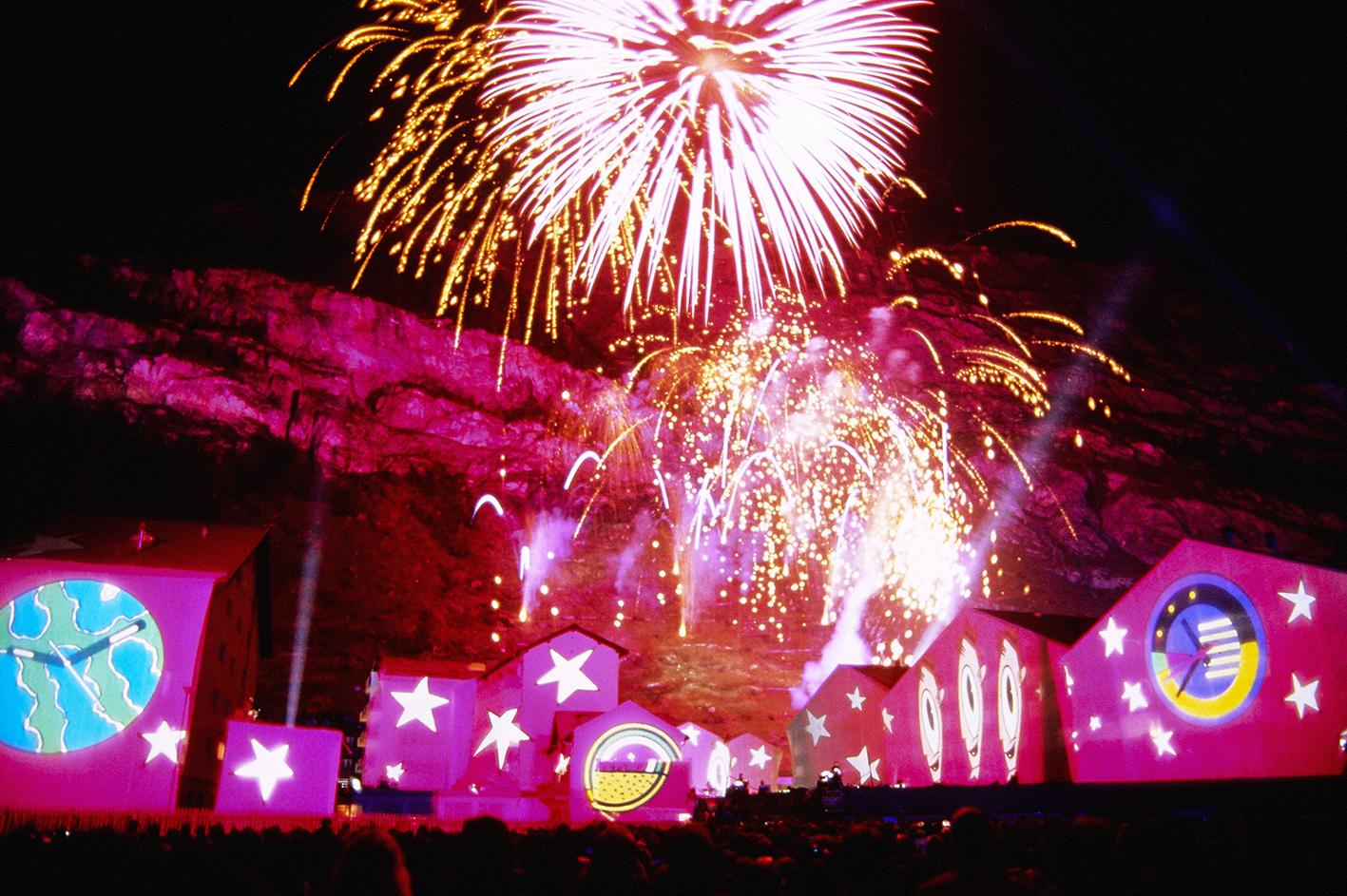
The closing notes of Ethni-transition introduced Zoolookologie, with the buildings alive with the images of suits and ties in a crazy variety of colours and styles. The buildings flashed up with leopard skin covers and a multitude of animals, ranging from kangaroos to giraffes, flew around the buildings and mountain, rotating as they went their merry way. The kangaroos were repeated as laser images, bouncing around the mountain, just as the penguins had done in the previous track. Splendid bouquets of fireworks erupted repeatedly from an arch of sites just above the chalets of the town, illuminating the gasping crowd to bring the track to an end.
Many of these projections, as well as on the familiar static slides, also scrolled up and down to great effect, more obvious than those seen at Paris. This was evident throughout the next track, Oxygene 4. Preluded by the sounds of the ocean, this was the track that rocketed Jarre to fame and it showed by the number of people who recognised the familiar tune. The screens filled with white dots, scrolling upwards and changing colours whilst all over the mountain, laser images of the now familiar penguins and sea horses played. Another astonishing effect was that of drips of water, created by lasers, falling down the mountain and producing ripples at the bottom - well received by the awe-struck audience. Projections and laser images of fish ended the track, swimming over the mountain and buildings alike.
Magnetic Fields 2 was introduced with giant laser-created cobra snakes menacing the crowd from the side of the mountain a-lá-Paris and for the final ‘attack’, merged into one giant image before darting towards the audience. Butterflies fluttered in from all directions, onto the screens and the mountains and before the thought of an identical performance with the laser-created swaying plant stalk, the buildings filled with stunning images of bronzed wheat. Yet more watches continued to float around the whole natural environment, the hands turning as the clock faces moved - seen before at the Lyon concert in 1986. Fireworks, creating a beautiful green bouquet of light, exploded in the night’s sky with a further appearance of the ground lasers, creating a laser harp effect. It was within this track that the image of the Equinoxe face, gas-masked with a polygonal face was first introduced - what will they think of next!
Once again, Rendezvous 2 was interpreted live. The setting of the mountain side matches beautifully with such a classic composition. Preluded by the sound of high-pitched excited childrens’ voices, the ground laser system beneath the buildings opened with a fan-like effect creating the extending harp strings over the audience. Swirling circles encapsulated the whole area from the onset, with swooping birds, used previously in singular during Calypso 2 in Paris, playing on the mountain. As the track progressed, flags from many nations filled the buildings’ screens, Greece, Germany and France were all represented as well as the E.E.C’s flag, displayed on the main screen ready for next year. Each was created to fit exactly to the shape of their designated building, as were all the other show’s images, totally transforming the architecture. Each was eventually replaced by the traditional Swiss flag, resulting in a resounding cheer from the native audience, everything awash with red, including the mountain that was bearing down on us all - breathtaking.
With Jarre usually adorning his asbestos gloves at this point, it was made up by being treated to the familiar falling-man sequence, only this time he had a lot further to fall and had increased in size somewhat since his last appearance in the French capital. Each of the buildings were transformed into houses, drawings of which you would normally see pinned to the walls of an infant’s school. All were created in a beautiful array of colours, windows positioned randomly with doors to match and even some of the roofs were transformed into red-tiled scribbles. To complement this newly created cartoon world, cars straight out of a child’s picture book swayed around the mountain as well as images of a child’s portrayal of their mother, complete with stick-like body, crazy hair and gloved hands - bizarre, totally weird but brilliant all the same.
The laser-created screaming-head, used previously during Ethnicolor at the Paris concert two years ago, appeared late in the track, followed soon after by a stunning new laser-projected fully detailed rotating globe, accompanied by the famous rotating stars on the screens and mountain side. The track may have been performed live on numerous occasions but with a multitude of fireworks to finish off, it will never lose its magic.
In the control area, they were now preparing for the finale of the show. Jarre delivered the final few instructions to his crew through the headsets, personally counted down the track and then sped off down the stairs, ready to thank the crowd and bid them “bon nuit”. The second part of Une Alarme qui Swingue, subtitled Rappel (Repeat), completed this extraordinary show. With the digital ticking picking up where the previous part had left off, an unusual but very welcome addition to Jarre’s compositional repertoire was a heavy guitar section, performed by fellow French man, Patrick Rondat. It really does give a magnificent kick to the end of the track, as did the saxophone to end Rendezvous 4 at Lyon, with the beautiful melody still in there. It was simply breathtaking. The screens and mountains ablaze in colour, as well as the sky from a plethora of fireworks and light, all seen during the rest of the show but the second time around, they dazzled even more. Strange as it may seem, more laser images of watches on the mountains and the word SWATCH on the buildings were the final images projected, left playing for some time after the show. This final piece had to be experienced live.
The whole feel of the two tracks is a progression from the piece composed for Cousteau's film The Last Refuge and Jarre for the 90‘s really is a positive progression.
So, perhaps the question that should be answered is, how did these shows compare to the previous city-centre son-et-lumieres? It would be easy to say that each is unique in their own context and difficult to compare but, however true this may be, some comparisons can be drawn. The audience, unlike Paris where the show was presented mainly as an image in front of them, were part of the show, within the arena in which the concert took place. All the effects were immediately overhead or of such a scale as to be completely breathtaking. An advantage of this show and hopefully will be continued in the future.
These shows were shorter than the previous concerts, Paris was around 90 minutes and Docklands well over that. However, of what did happen in the 50 minutes, it felt far more intense than, for example, the Paris concert. You were never wondering what would come next because there wasn't time. As soon as one image was stunning you, another was up on the mountain, on the buildings, in the sky, dazzling the imagination.
The photographs you see here can never capture the full splendour and magnitude of the two shows. The fireworks, projected images, laser images and lights all performing to the music were breathtaking. The well-used phrase of ‘you had to be there to see it with your own eyes’ can be just as well applied to these Swiss concerts as to Jarre’s previous spectaculars world-wide.
Zermatt will never be the same after being transformed by the magic touch of Jarre and his team, and the people of the small Swiss town will keep the memory of those two nights with them forever.
04/Feature
Swatch Musicall
There were several reasons for the get-together in Zermatt on September 25th-27th, between Swatch and Jean-Michel Jarre. Environmental protection was one : Jarre's last studio album was dedicated to the French marine biologist and oceanographer Jacques-Yves Cousteau. Likewise, Nicolas G.Hayek has given his support to the Earth Summit in Rio de Janeiro. He is also the man behind development of the Swatchmobile, with its "alternative power" system.
And if Jean-Michel Jarre is considered one of the pioneers of electronic music, it is Nicolas Hayek who has revolutionised watchmaking with the Swatch. There is also common ground in the fact that the creations of Jarre are increasingly heard in the street, rather than in the concert hall - and that's where Swatch looks for its audience.
As well as the two concerts, Jean-Michel Jarre has collaborated further with Swatch, venturing into digital compositions in the form of a new Swatch.
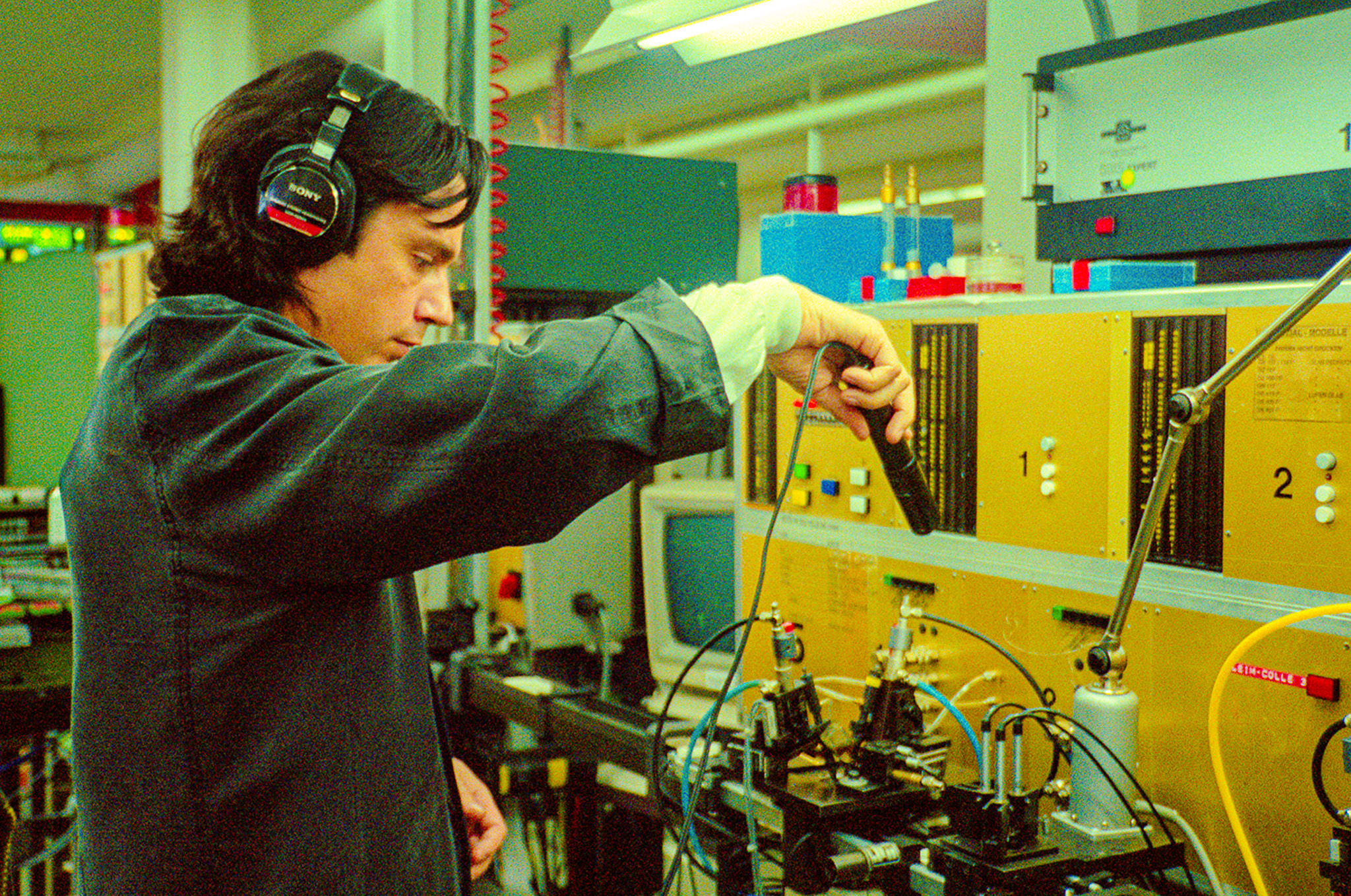
For the concert compositions, Jean-Michel Jarre visited the Swatch factory at Grenchen, Switzerland and recorded the sounds made by the machines and presses and conveyor belts when producing a Swatch. “Astonishing sounds you cannot hear elsewhere”, he says. When he played back the tape recordings to the workers confronted daily with these sounds, their surprise was complete - take something from daily life out of context and suddenly it acquires a different significance. Using these sounds and mixing in the ticking of different Swatches, Jarre turned them into the composition for Zermatt.
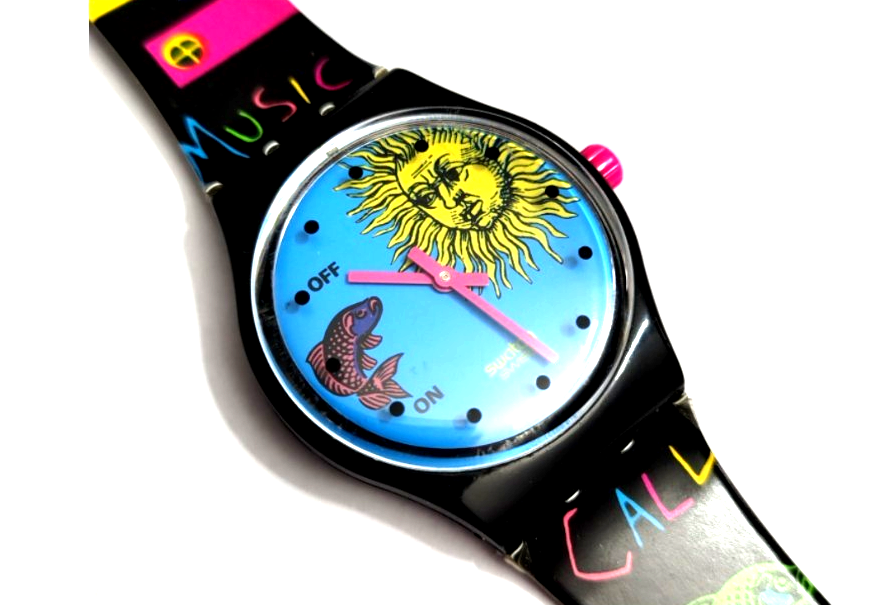
For the watch, the sound produced was more simplistic, but equally effective. Hayek announced, “We are making a musical Swatch, a Swatch Sonor. It is a watch that is going to have part of the music that you heard yesterday that Jean-Michel Jarre has made especially for Swatch. I have the first prototype here and it is going to be a waking alarm system but at the same time, it will play the music all the time. It is the music that Jean-Michel Jarre has given to Swatch that we are going to use. We are launching it in July, August or September next year because we must have enough to launch them, but I am going to give the first one to Jean-Michel Jarre.”
Jarre, a keen collector of Swatch watches, was clearly delighted with this new part of his collection and spoke of his involvement in the project. “A lot of artists have been involved with Swatch during these past years, but they were mainly painters, designers or graphic artists and it seemed to us that it could be interesting to link and to try to think about what could be the sound of Swatch, avoiding a kind of ‘jingle bells’ kind of concept.” he enthused, adding, “Whatever you do, you can’t have compact disc quality in a watch because the quality in rather poor. The exercise for this first watch was to try to do something with two notes and fifteen pulses - a very minimalist concept! I think a lot of things have been done in the past to try to develop a kind of alarm-concept. The idea was to try to do a rhythmic sequence rather than a melodic one and to try to get something that could be like a swinging swatch rather than to try to find a tune. This sequence could be part of an orchestration or development for other projects.”
One journalist asked if we could hear the tune, to which Hayek responded, “I don’t know if you can hear it, you could hear it if you were seated about five metres from us. If we made very loud watches, nobody would buy them.”
Handing the Swatch to Jean-Michel Jarre, Hayek joked, “We warn you that he has two bodyguards waiting for him in this room. Nobody should try to cut his arm off and take the watch!”
05/Gallery
Photography
The night as it was photographed, from the arena and from the front of house.
This piece is about