
Access All Areas / Words Mark Gidley
Concert for Tolerance 1995
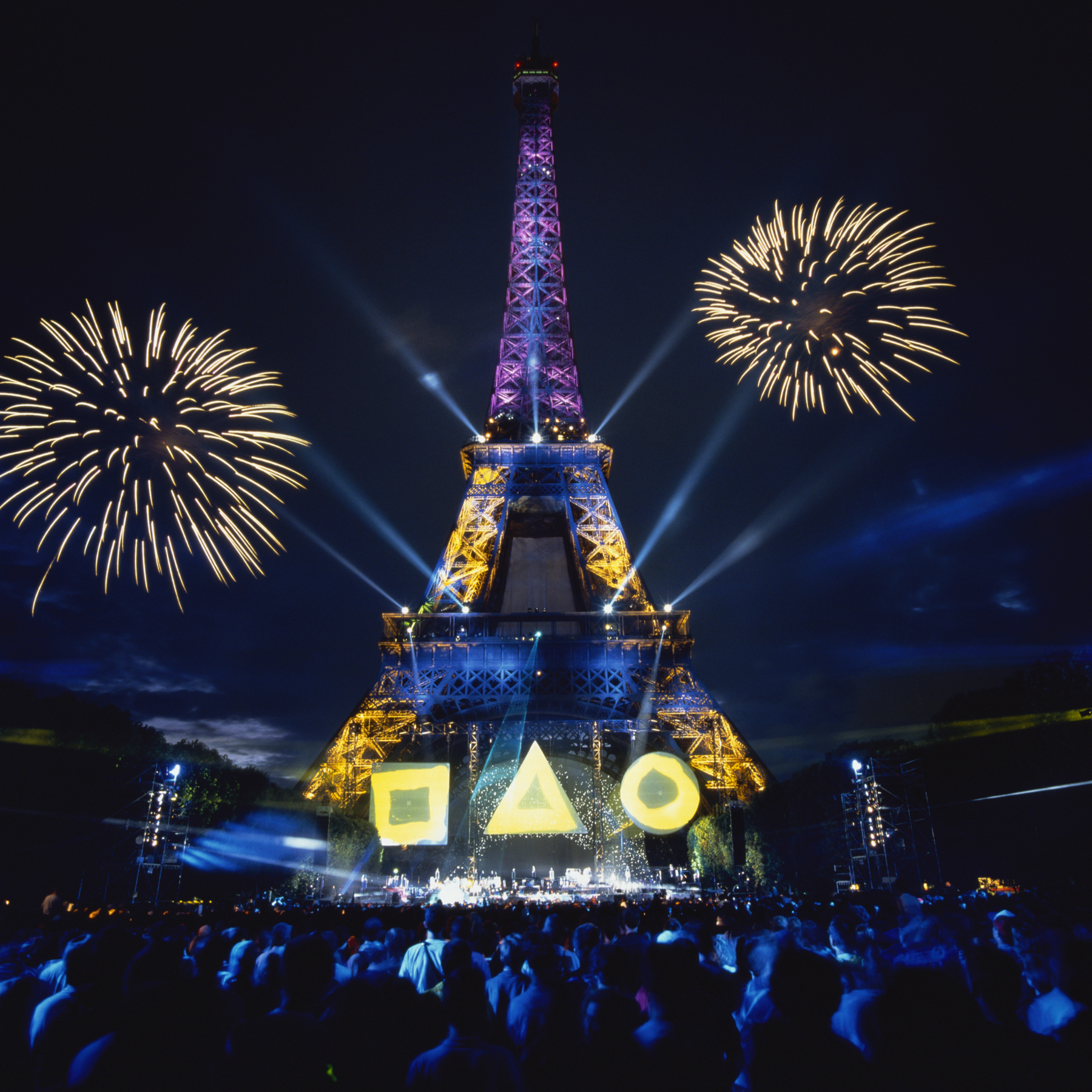
Jean-Michel Jarre staged the spectacular Concert pour la Tolérance at the foot of the Eiffel Tower in Paris in 1995, attracting an estimated 1.25 million spectators to celebrate Bastille Day, UNESCO’s 50th anniversary and the Year of Tolerance
01/Feature
Concert for Tolerance
Together with Frédérico Mayor, the President of UNESCO, the idea of performing Concerts for Tolerance had been with Jean-Michel Jarre for over two years, since being awarded the honour of becoming a UNESCO Ambassador.
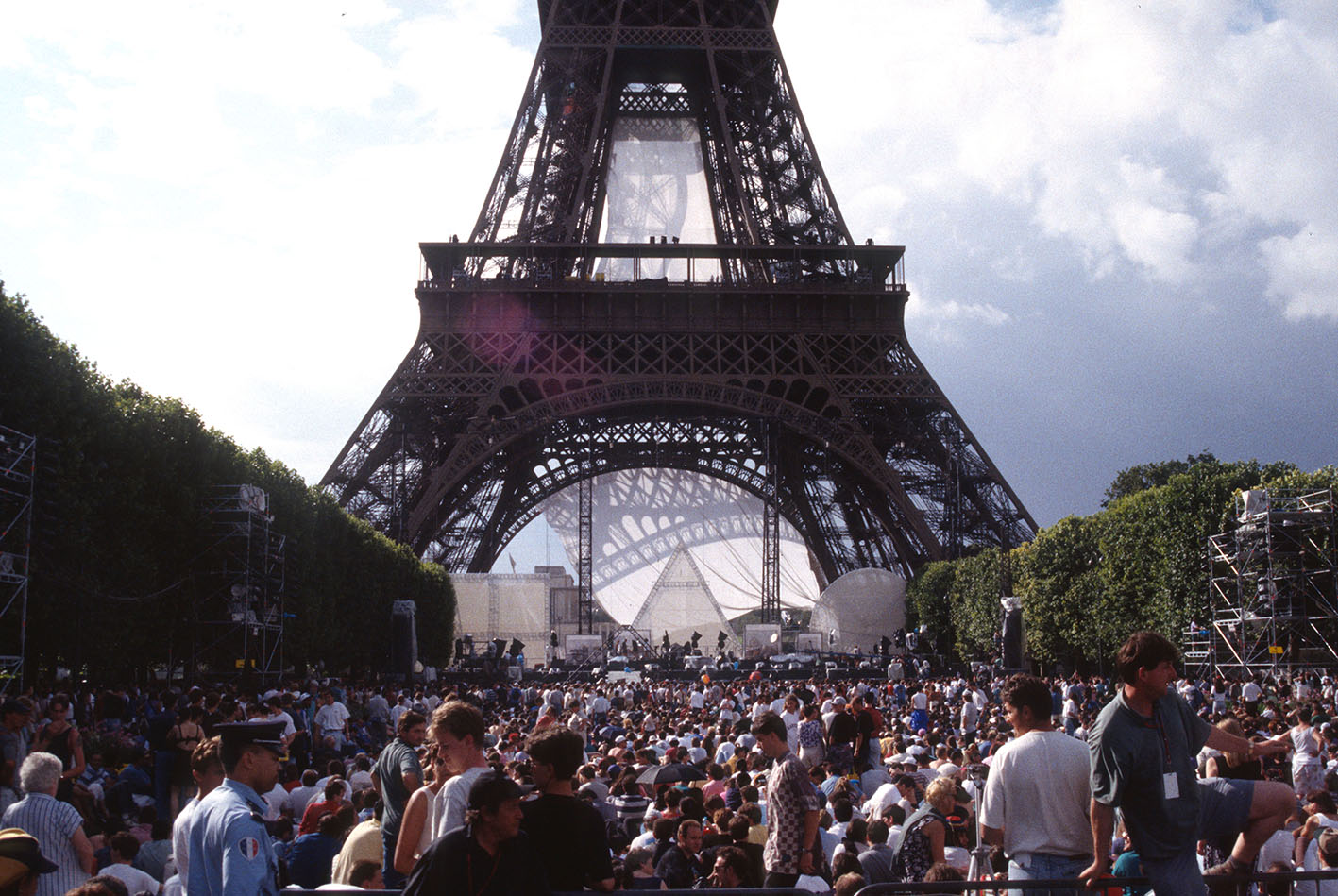
Jean-Michel Jarre is renowned for his record-breaking audiences and the Concert for Tolerance was no exception. An estimated 1.2 million people gathered that evening around Champ De Mars and along the banks of the Seine. It was a celebration of not only tolerance but also the creative genius of an artist famous for transforming environments with lights, images and music.
The whole concept of Jean-Michel Jarre’s show certainly corresponded to the ideas of Liberté, Egalité, Fraternité - Freedom, Equality, Brotherhood.
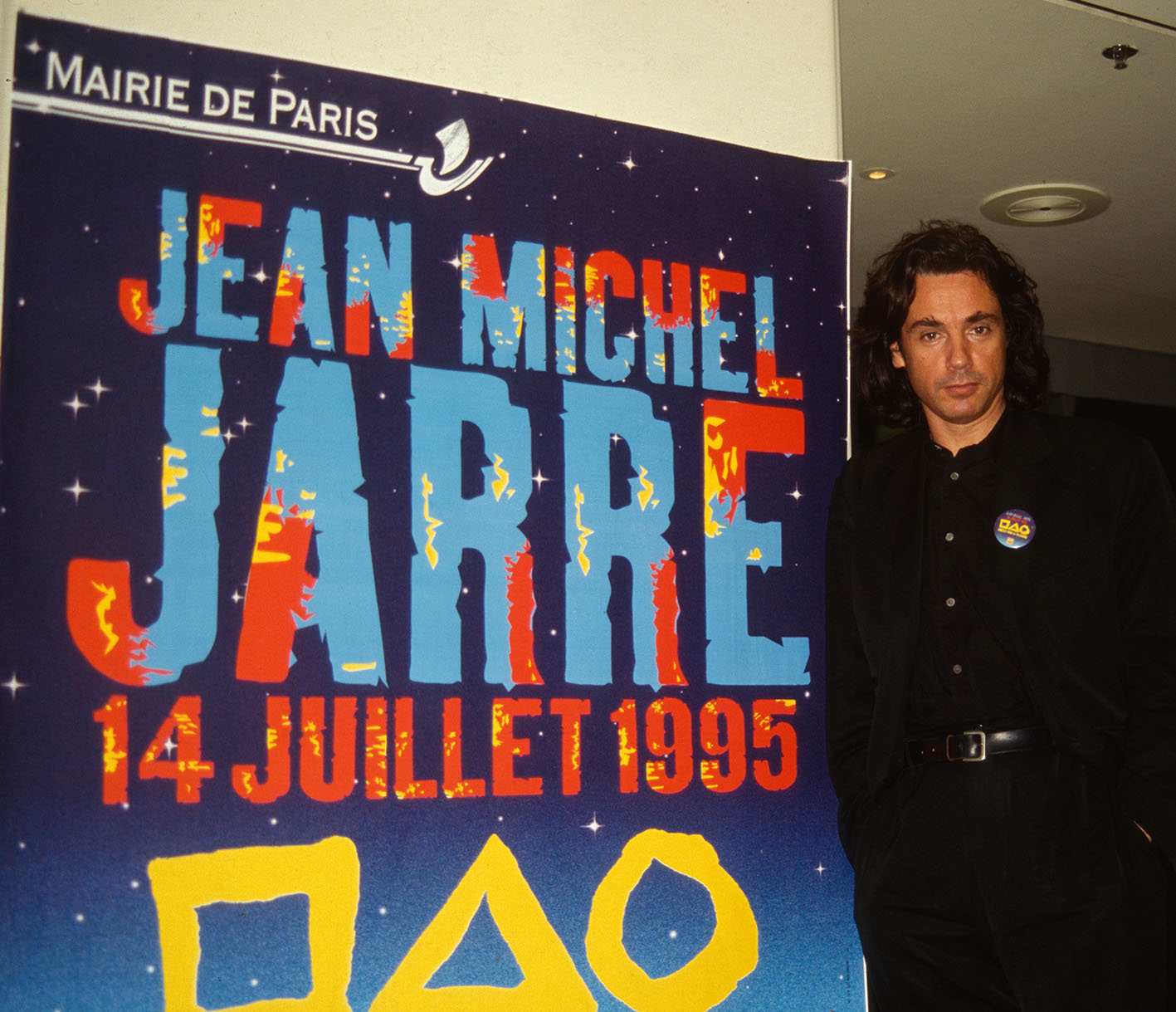
Jean-Michel Jarre launched the Concert for Tolerance at the Eiffel Tower in central Paris on Monday July 3rd 1995, in a conference room in the FNAC Place de Terne and it was here he granted an exclusive interview. He explained his reasons for supporting UNESCO’s Year of Tolerance, his plans for the first concert.
Photographs throughout by Christine Ferreira, Mark Gidley and Christian Kellerhals
Tolerance
“Paul Claudel once declared that there are homes for tolerance. After what has just been said, and given all that we see in the news, we realise how urgent it is to bring tolerance into the open and that’s what I will try to do with many artists over the forthcoming year.
“As Frederico Mayor has said, images of war and violence are real money-spinners and are more exciting, whether on TV or in the cinema. Paradoxically enough, these are images which are attractive. Images of peace and tolerance seem invisible or at least they are less eye-catching.
“The aim of the Concerts for Tolerance is to have fun, in a dynamic way, with as large an audience as possible. Indeed, in view of current events taking place in Bosnia, Chechenia, Rwanda and Algeria, one realises that every possible kind of alliance designed to keep the right to survive going is important. I think that the role of all artists and my own role as artist and UNESCO ambassador is to try, through my activity and particularly through that project, to celebrate a concept that people are not used to or find difficult to express, because as Frederico Mayor pointed out, peace and normality are invisible. Actually, what we should stress is normality.
“As a whole, we should be able to celebrate tolerance and differences in a dynamic way. To do so, we encourage the largest audience possible to walk down the streets in the evening of the 14th of July and to gather together on the Champ De Mars Esplanade at 10pm in order to, and this is the gist of the project,, celebrate with family, friends or foreigners in the most enthusiastic and enjoyable way as possible. This is, all in all, the aim of that concert.
“With all that is happening today in Chechenia, Rwanda or Algeria and which nobody talks about any longer, but where people are still suffering, I think that images of tolerance have to be magnified and that there is a real point in expressing tolerance in the most dynamic and spectacular way as possible.
“We hope, together with the UNESCO’s General Secretary, that the Year of Tolerance will be extended. If we succeeded in making tolerance the catch-word, and to maintain it as such, then we will have achieved our objective.”
The Concert
“Bastille day is a day which, as the Minister for Culture already mentioned, traditionally celebrates our National Day as well as the ideas of Freedom, Equality and Brotherhood. It was thus logical to relate this year not only to the traditional Bastille Day, but also to the Concert for Tolerance.
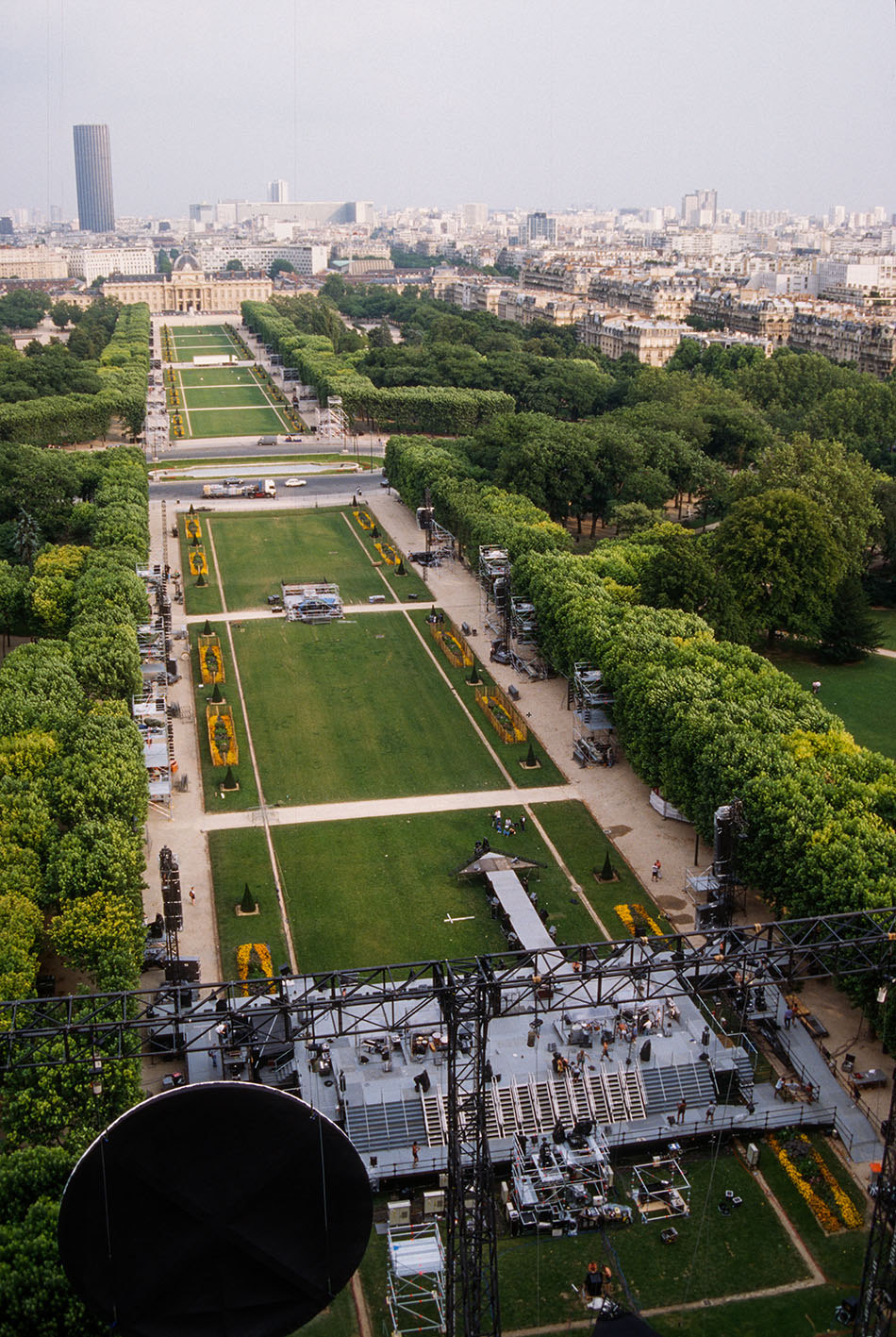
“This concert will take place on the Champ de Mars esplanade, at the foot of the Eiffel Tower. One of the technological and artistic challenges of this project lies in the metamorphosis of the Eiffel Tower - to make it change colours according to the scenography. And at the bottom of the Tower, behind the main stage, there will be three mobile screens (one square, one triangular and one circular), which, incidentally, make up the logo of these concerts. These forms will symbolise the coexistence of differences.
“I’ve chosen the most elementary figures: square, triangle and circle, because they embody the coexistence of sciences, it is also the primary alphabet which everybody can recognise. And when it comes with UNESCO, education and culture, one could argue that the square represents education, the frame in which we all grow up together, the triangle would stand for research and science. The circle epitomises the overall culture of all generations.
The Artists
“As for the stage, apart from my usual musicians and myself, there will be numerous amounts of other artists, for the main idea of these concerts is to involve local people as much as possible, above all children and artists.
“There will be a traditional Arabic orchestra, the choirs of the Ile de France region, the Algerian singer Khaled, singers and percussionists from Africa, a hard rock guitar player-Patrick Rondat, giant puppets from the Caribbean. Also present will be a military band and the Ile de France orchestra.
“Among the surprises, you will have a five-metre tall Diva who will perform around the end of the show...but, well, I won’t tell you anything...”
The Logistics
“Behind the stage, which will be at the foot of the Eiffel Tower, there will be three moving screens: one square screen, one triangular screen and one round screen. They will subsequently appear and disappear in synchrony with the music.
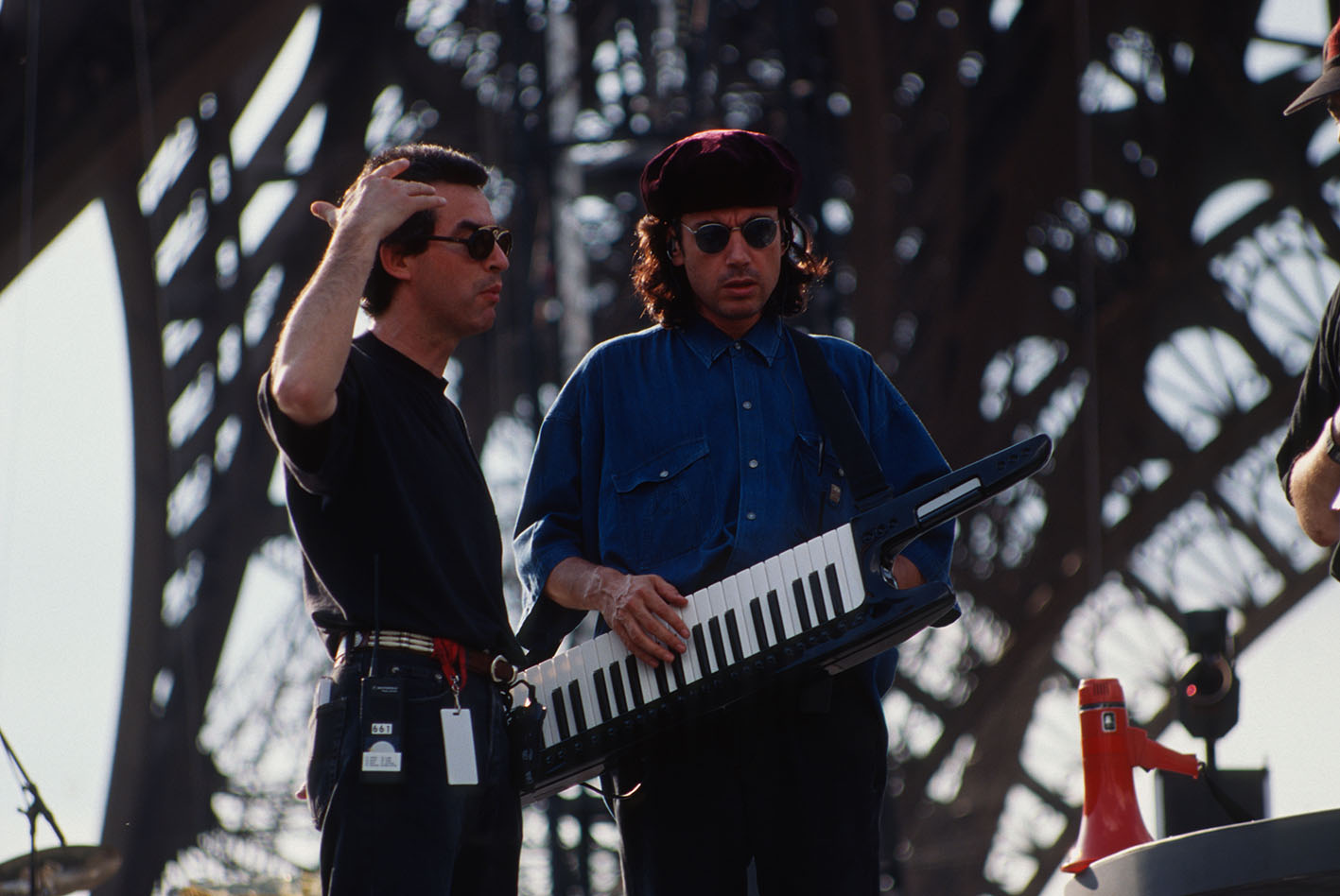
“The idea will be to have small video screens for the audience to see the stage and technologically for the Eiffel Tower, will be to install some special lighting equipment that I have used for previous concerts and to be able to change the colour of the Eiffel Tower. That’s a real challenge because we have just two weeks to install all the equipment from top to bottom.
“We will install the stage next weekend. The installation of the lighting equipment on the Eiffel Tower should have started last week so I hope tomorrow morning or tomorrow night, if the Police agree, or Wednesday night. During the day there are too many tourists so they can only work during the night on top of it.
“We are trying to install two screens on the Eiffel Tower, one under the first floor and another between the first and second floors. Also, I have three movable screens, a square, triangle and circle behind the stage - this is still a secret because they will be down before the concert and they will appear during the concert !
“They are three-times the size of Pink Floyd’s screens. It is going to be quite exciting if it works.”
The Music
“Quite different because I’ll include songs like Magnetic Fields 1 but for musical reasons I had to shorten it. I will play a different version of Revolutions, done with Khaled, the Algerian singer.
“Some other musicians may be there, like Marcus Miller but he also is trapped in America so I don’t know yet. Calypso will be played not with steel drums but a different version with African percussionists.”
The Audience
“I’ve never been interested in breaking any records but what is important is that this concert is the Concert For Tolerance and this carries a lot of other roles than just doing a concert and I hope that the maximum number of people will attend. What we have this time is live transmission so obviously it gives far more potential of touching and being in contact with even a much wider audience than before.
“The concert will be live on TF1 in France, Channel 4 in the UK, RTL+ in Germany but not live. Also throughout the Middle East, in Africa, Asia and also in America.”
The Future
“As a last word, I have decided, for the next two years, to devote my time to these years of tolerance and we do hope that tolerance will not be fashionable for only one year; instead, we wish to keep the trend going over the next year.
“Moreover, I think these concerts will help turn the spotlight on the countries involved so that teachers, scientists, writers and politicians can try and deal cross-alliances in order to rekindle tolerance where it is not alive enough.
“Thus, for the concerts after the one on the 14th of July, we are currently discussing the matter with countries.
“But we start with Paris for obvious historical reasons and for the fact that Paris is the home of UNESCO.”
02/Feature
Bastille Day of Tolerance
Three of the main people involved in the Concert for Tolerance spoke about the project in Paris in July. They explained why they felt Concerts for Tolerance were so important and how it would go some way to achieve UNESCO’s aims for the year.
Philippe Douste-Blazy, Minister for Culture, was instrumental in the sponsorship of the concert for Bastille Day. The French Ministry and the City of Paris were both heavily involved in the planning of the concert, without which the staging of the show around France’s most famous landmarks would probably not have been possible.
“The 50th anniversary of UNESCO is for myself and for the whole country, a tremendous event. The Concerts of Tolerance are underlined by these three themes: Freedom, Equality and Brotherhood, which are the very basis of the United Nations Organisation.
“May I say how glad I am to have Jean Michel Jarre by my side, because not only do I appreciate him very much myself, I also think that he is one of the most renowned French artists in the world. Besides, this concert is the starting point of five other concerts worldwide, all based upon the theme of tolerance.
“However, with all that is happening today, not only in our country but also elsewhere in Europe, with what we learned yesterday in Sarajevo, with the Europe we want to protect, the Europe of human rights, the Europe we cherish, with its blend of races and cultures, the Europe that gave birth to temples, churches, mosques,and all kind of religions and cultures, I think that that evening will represent a powerful symbol indeed.
“As Minister for Culture, I am aware of the fact that one fifth of the world’s population possesses four fifths of the world’s wealth - which makes it imperative for us to awaken tolerance. This is why I am glad to have taken part in this meeting this morning because it makes sense to do this in 1995.
“I’ll add just one word. President Jacques Chirac has been interested in this concert from the start. We have talked about it before. He has helped in its preparation from the beginning. This Bastille Day, which is also the first Bastille Day of the President’s term of office, will also be the Bastille Day of Tolerance.”
Frédérico Mayor is President of UNESCO, based in Paris. He takes the view that the international community has reached a watershed in co-operation and it is time for a ‘state of intellectual alertness’.
“The charter of the United Nations, as you know, has a main motto which is: We the people are decided to protect the future generations from the horrors of war. Sadly enough, we have failed in this regard. We have failed because we proved unable to apply the rules of the United Nations and of the constitution of UNESCO to the constant problems caused by the international co-existence and the peace of the various cultures and religions.
“Our task consists in dealing with these differences and unity, our driving force, is something we have forgotten all too often.
“As the Minister said, we have not shared enough. I think that this unwillingness to share is the core of many conflicts. Right now, we have to prepare a better future. This vision of the future, as I mentioned in my latest book, is the better solution. I mean a future for our safety, the safety of our children. It is also important to apply the promise we have made in order to avoid war. War remains the worst of all solutions. Giving our lives is the irreversible toll we have to pay.
“We don’t realise that tolerance is the answer given to us by the constitution of UNESCO. To try hard to know each other every day is a challenging task. But mutual understanding is something we all have to strive for.
“Nonetheless, conflicts still exist everywhere. I must admit that I don’t agree with nearly 80% of what happens throughout the world today. However, we haven’t stopped making peaceful settlements, and this is made possible by making alliances.
“I am very glad to greet representatives of the French government. I am also grateful for the Minister of Culture, Jean Michel Jarre and the private sector to be here, because all these people represent democracy.
“The people have to take the reins of society which used to be dominated by an omnipresent and all powerful state.
“Here you have the four pillars which support that future of peace and of tolerance. And it is only just fair for UNESCO to participate, for two years, to this visible act and may I stress this point, because being a teacher and a scientist, I know that invisible prevention is unpopular. When people do things leading to peaceful settlements, the latter are not passed on to the media. The reason is that good health and normality are invisible as opposed to conflicts and diseases. War is much too visible.
“Thus, we are, with this alliance, binding together the UN, the French government, UNESCO, the representative of a big public concern and a great international figure, Jean-Michel Jarre.”
Jean Paul Giraud is Managing Director of FNAC, one of France’s largest department stores. FNAC were a key sponsor of the event and helped promote the event in their stores. Large banners were constructed outside the stores in Paris, they distributed 250,000 free badges during the week prior to the concert and throughout the actual audience and placed media advertisements.
“As you know, the event is to be on the Champ de Mars, 14th July at night, that Jean Michel Jarre, on UNESCO’s initiative, will be conducting a concert for tolerance. The United Organisation for Education, Culture and Science, whose constitutive act states : It is with the human soul that the safeguard of peace must lie; 1995 has been decreed the Year of Tolerance in order to call to mind that the values that unite us must overcome forces that tear us apart.
“At a time when ethnic cleansing and national preference prevail, it is essential to remind everyone that tolerance is not a restraint; instead, it is a virtue and a combat. It is true that tolerance has, depending on the context, different values and meanings, such as complicity, indulgence, respect and welcome.
“Now and here, in the face of totalitarianism and fundamentalism, confronted with the rejection of the plurality of cultures, we have to admit that tolerance is not at present a virtue, not even the minimal value of a relationship. Instead,it is a fight, because a democracy is neither weakness nor passivity.
“The FNAC, which sells cultural products, is aware that it has a responsibility to the people to be linked to the existence of two cornerstones of democracy : freedom of speech and respect of others, whatever his/her opinions, religion and culture.
“One - in countries where human rights are abused, do we find real book sellers or record dealers ? These areas of confrontation and of opening to the world, where spiritual works of art aim at meeting their readers or audience are always the victims of oppression, censorship and intolerance.
“Two - the fight against oppression is indivisible. There is no freedom without the spirit of tolerance, and there is no tolerance without mutual understanding, which is achieved through free conveying of knowledge and equal access to ideas conveyed by the written, aural and visual media.
“Three - by joining forces with the Concert for Tolerance on the 14th July, the FNAC thus not only expresses its solidarity with UNESCO for a just cause, it also shows its faithfulness to its commitments and its coherence to what underlies its reason for being.”
03/By the numbers
Show Facts
- Free
- concert to celebrate Bastille Day
- 250,000
- badges distributed around Paris to publicise the show.
- 1.2 million
- live audience
- 600
- crew members
- 120
- choristers
- 8
- marionettes
- 6
- principal musicians
- 8
- Patrouille de France aircraft for fly-past
- 7,000
- kilowatts of power
- 85
- trailers
- 20kms
- cables
- 150kW
- sound system
- 40 watt
- lasers
- 2,000
- police
- 0
- copies of Waiting for Cousteau (subsequently provided by audience member)
04/Feature
Live!
On Bastille Day, an artist hijacked the Eiffel Tower and proceeded to transform Paris’ most famous landmark with a graffiti born not out of the spray canister, but rather from a more ephemeral palette of light, lasers and fire.
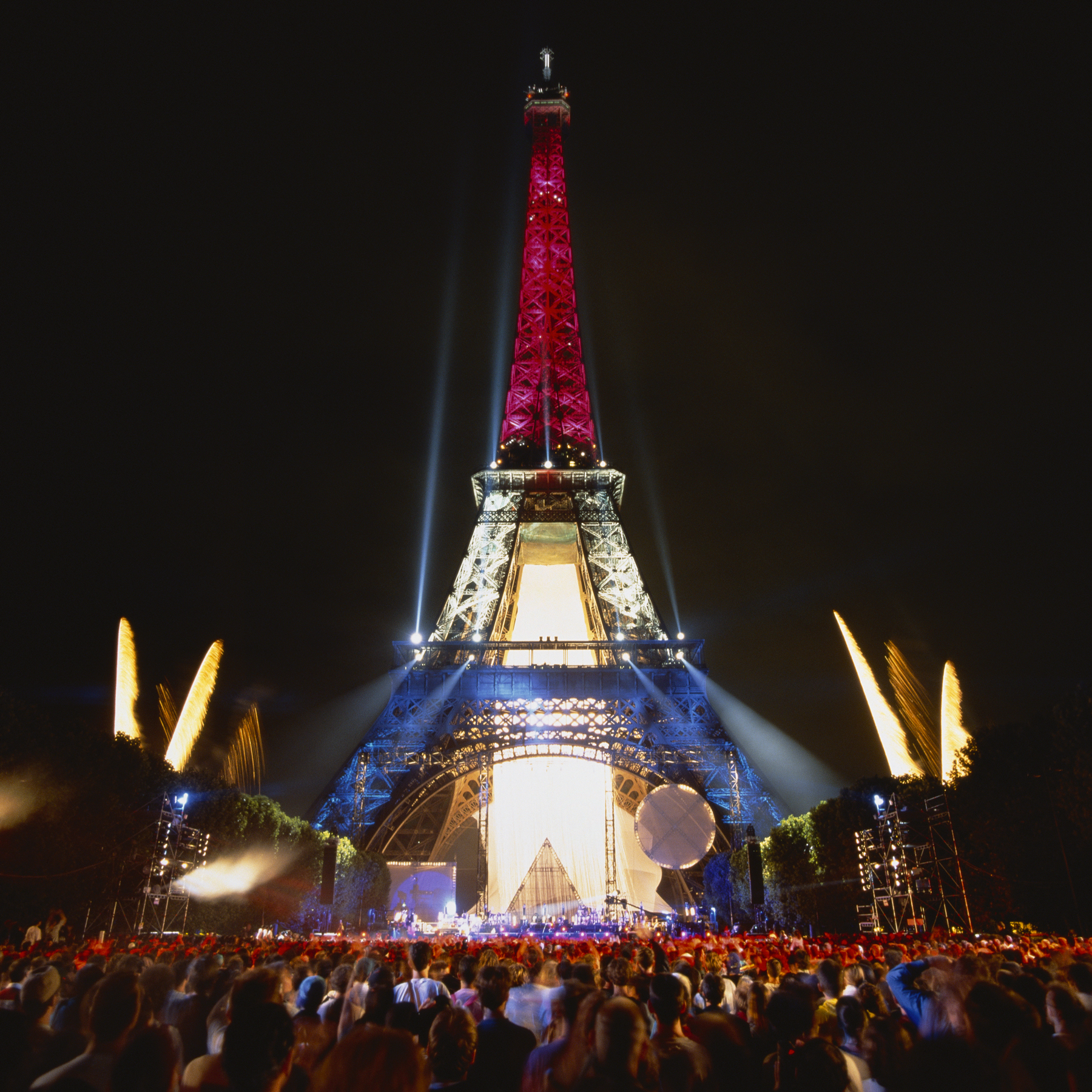
Giant images and tableaus depicting the diversity of mankind and of mankind’s precious inheritance, the Earth and it’s environment, danced upon vast white canvases draped from the structure. Tracker lights, floodlights and lasers probed the Tower’s lattice work and the night sky in a synchronised frenzy of colour and movement, transforming the Eiffel Tower into an awe inspiring steel chameleon of constantly changing illumination. Soaring shards of flaming sparks rose majestically like huge fingers of fire up the Tower whilst stars burst open to reveal enormous bouquets of sparkling kaleidoscopic pyrotechnics in the air. And the inspiration for this visual feast - the music - a symphony composed of many movements and created from many elements: from the human voice of a choir to the sequencing of the microchip, the haunting romanticism of the accordion to the piercing beauty of the laser harp.
Cultural Nomads
The artist was Jean-Michel Jarre and this breathtaking son-et-lumiere was entitled Concert for Tolerance.
From mid-morning onwards, the audience arrived, bringing with them hope and excitement, anticipation and expectation. Many had journeyed from far and wide across Europe and the World to participate in this spectacular phenomena, like cultural nomads answering some inner-calling which had drawn them to Paris and to the Eiffel Tower.
The festivities began with the customary throbbing heartbeat countdown which reverberated across the Champ des Mars like a tolling bell, stirring the pounding hearts of the audience as giant digits on the screens descended from nine to zero. Whilst the excitement intensified with each number, a realisation began to sweep through the audience and eyes previously transfixed on the Tower began instead to focus on the night sky behind, and in particular, on the eight bright dots of light zooming toward the Tower in formation. With the crowd roaring in approval the aircraft approached the Champs de Mars in an arrow head formation. On the heartbeat of zero, they soared high over the Tower and with their smoke trails still lingering in the sky, the Eiffel Tower, suddenly transformed red and blue, became host to sky-trackers and Chronologie 6 burst into life.
Musical Odyssey
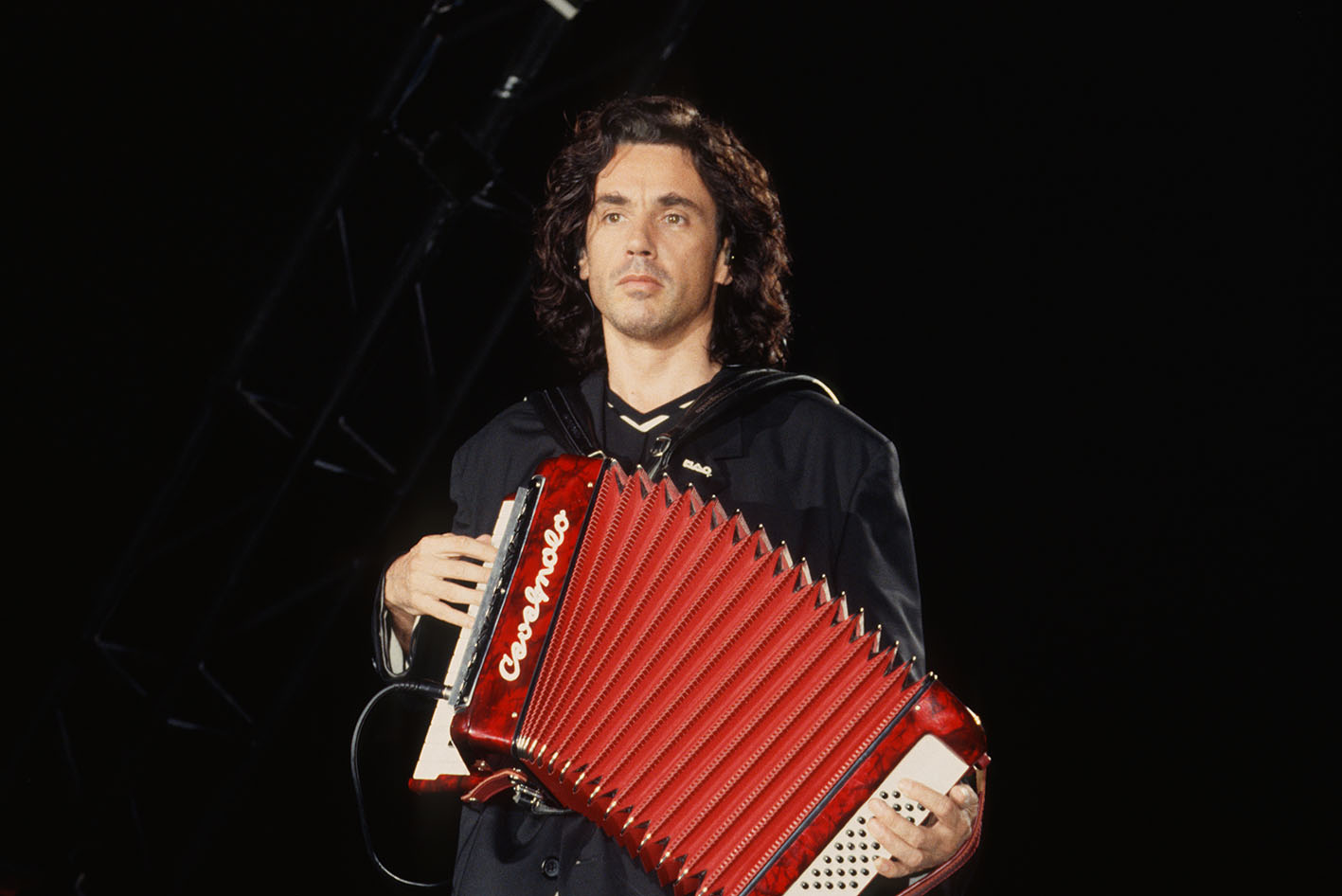
A mass of roman candles blossomed forth across the stage producing bubbling fountains of gold to accompany Faucheux and Mahu’s infectious drumming and percussion. As the melodious synths are introduced, v-shaped shards of sparks rise majestically from the stage and are in turn joined by glowing red stars as the 120-strong choir add a further layer to the track. The sky-trackers probing the night sky suddenly home down upon Jean-Michel Jarre, dressed in a black suit and beret, who has leaped onto the stage and is instantly entrancing Paris with the accordion. Jean-Michel parades across the front of the stage, serenading the audience with the romance of the theme, and as the music waltzes to its conclusion he moves back to the centre of the stage as huge red blooms of pyrotechnics open out high behind the Tower to breathtaking effect.
And so, with the pace rarely letting up, Jean-Michel conducts an exhilarating musical odyssey encapsulating tracks from every studio album from Oxygene onwards, including also the first live performance of Eldorado (as UNESCO’s hymn for Tolerance), likewise premiering Patrick Rondat’s stunning rock interpretation of Vivaldi, and a beautiful remixed version of Digisequencer. It is an unparalleled musical tour-de-force infused with a sense of urgency and a harder, more physical edge.
From the red megaphone of Jean-Michel inviting revolution to the threatening fist imagery inspired by the stirring Industrial Revolutions suite. We are treated to the more pleasurable locale of exotic belly dancers who become entrancing, whirling dervishes during the finale to Revolutions. Joined by Cheb Khaled, Jean-Michel’s vocals are reflected on the huge curved lower canvas, the frenzied climax leaves the audience mesmerised, and it’s only the second track of the evening !
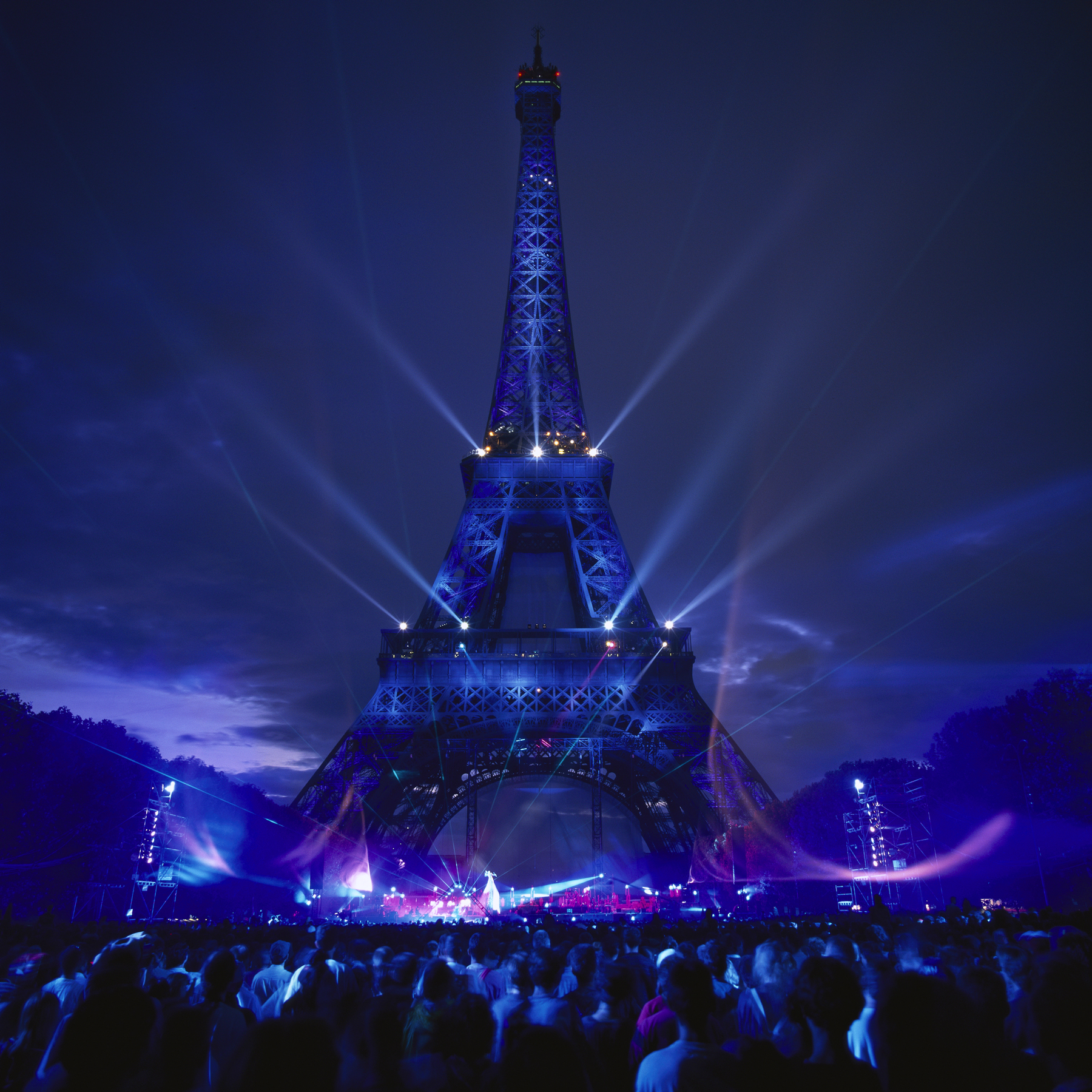
From the belly dancers to the surrealism of a six-metre high Diva and Chronologie III. Although actually sung by Richard Cross dressed like a stylish bullfighter, complete with cape draped over his arm, the eye is inevitably drawn towards the expressive mime of the lipsticked diva, resplendent in pearls and garlands, inspired by the film ‘Priscilla - Queen of the Desert’. The laser harp beams emanating from the stage reflect into the audience as Jean-Michel plays the familiar haunting notes, the track is pure theatre and even the laser harp shares in the theatricality, bowing out by nicely folding in on itself.
As the harp’s structure itself is lowered, a keyboard and stool are set-up in its place and the audience is treated to the unprecedented delight of Jean-Michel playing the unmistakable bass line opening to Equinoxe VII. The combination of hearing this classic track live once again, last played in London, mixed with the disarming intimacy of Jean-Michel to the audience proved a supremely memorable and poignant moment. It’s surely a testament to the man and his music that despite the customary spectacle and grandeur of his concerts, that even with the laser harp folded away and the pyrotechnics and projections momentarily silent, Jean-Michel can just as easily hold an audience spellbound through the unadulterated simplicity of a keyboard and the hands of a musician. Dry ice swirls eerily across the stage as the main theme is introduced, where upon a laser descends from the Tower enshrouding Jean-Michel in a laser tunnel effect, As the track explodes with Faucheux’s emphatic drums, three screens forming the shape of a square, triangle and circle ascend from stage-level with the momentum of the music.
I dream of peace
As the applause subsides after the end of the track, an ambient transitional piece of music floats up, punctuated by Jean-Michel lighting the keys of the semi-circular keyboard with notes reminiscent of the Fishing Junks at Sunset performed in Hong Kong.
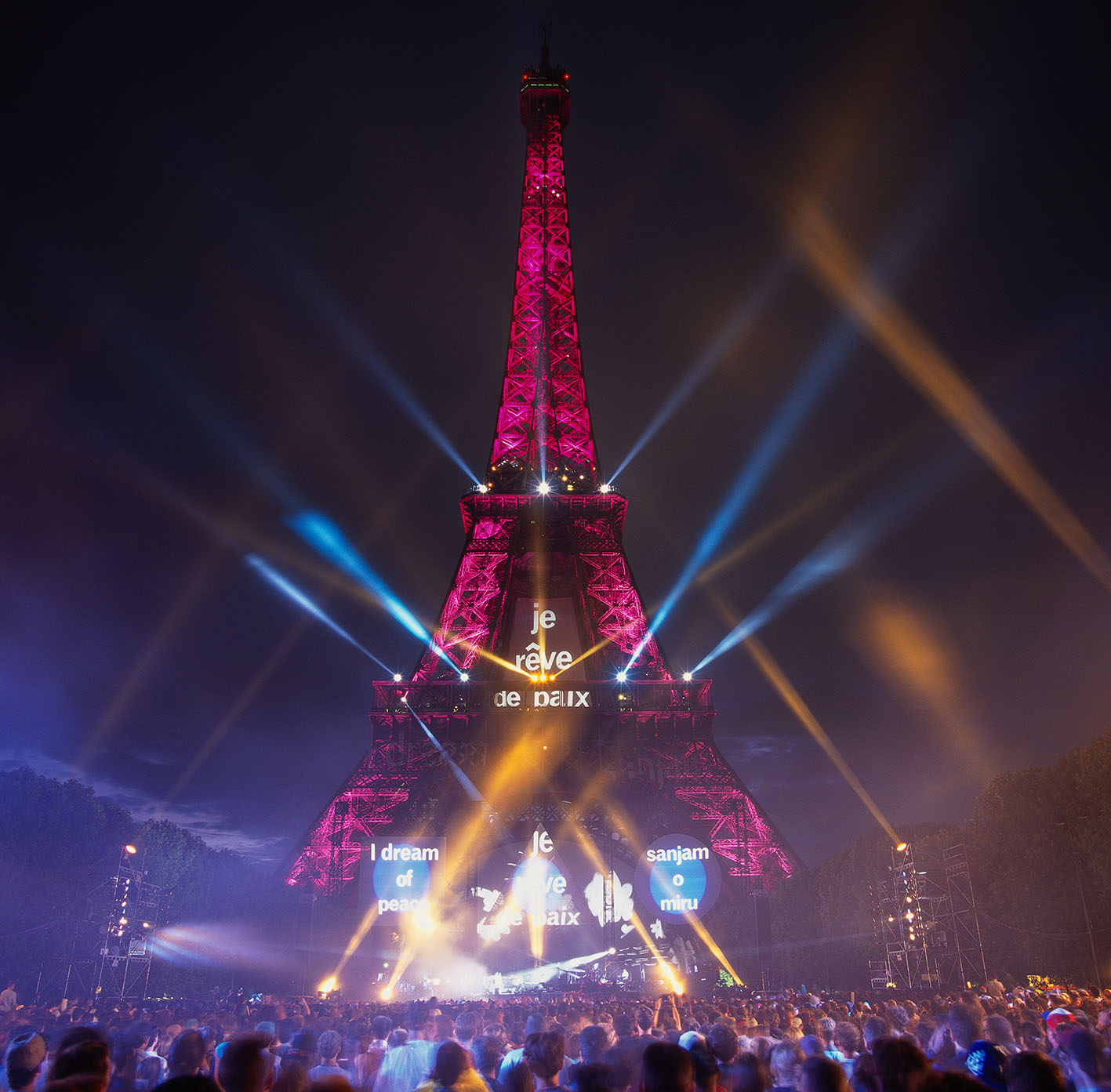
Golden spotlights criss-cross forming a cobweb of light as suddenly those famous Nikon clicks ring out and the moving Souvenir of China proceeds to weave its spell. The phrase, ‘I dream of peace’ appears on the square screen whilst its counterparts display respectively ‘Je rêve de paix’ and ‘Sanjam O Miru’. Such a simple statement yet it reflects the beauty and emotions of the piece perfectly. As Jean-Michel sits on the edge of the stage playing the portable keyboard, the image of a child lying with eyes closed in front of a clock face dominates the screens whilst on the backdrop, children’s depictions of the sun and clouds float dreamily.
The emotional impact of the piece grows with the contributions of a brass section and as the children’s drawings begin to reflect images of war, Patrick Rondat produces a glorious soaring finale on guitar. The lost innocence of the children caught up in the cross-fire of adult conflict is emphasised further by the notable absence of the customary gleeful yelps of the children on the soundtrack : the children now silent and haunted.
Chronologie IV’s unashamed positivism lifts the spirits however as the screens scroll through an eclectic array of images reminiscent of the Supermarket of the Century : Penguin, Handbag, Rose, Lemon, the list could go on ... Jean-Michel serves up a sudden contradiction when the scrolling objects change from a hamburger to a still face of a famine-haunted child from Africa. Consciences are suitably pricked.
With Jean-Michel playing the black portable keyboard amidst swirling smoke a dramatic transitional piece of music ensues as a laser generated sphere revolves. The real identity of the track removes its disguise to reveal a glistening streamlined Magnetic Fields I. A powerful green laser flicks across the Tower like a gigantic metronome as Jean-Michel pounds the circular keyboard. Three white geometric marionettes representing the three symbols of UNESCO’s Year of Tolerance join together behind Jarre. As the music builds in grandeur, huge soaring comets rise majestically in unison upwards toward the Tower, red and green waves of fireworks join in the breathtaking collage of fire from across the Seine and as the track eventually concludes, massive bombs explode high behind the Eiffel Tower, creating enormous clouds of sparkling stars. It was arguably one of the most creative illustrations of how pyrotechnics can complement and enhance a piece of music’s visual interpretation - the Eiffel Tower will never seem quite the same again.
Poetical Lyricism
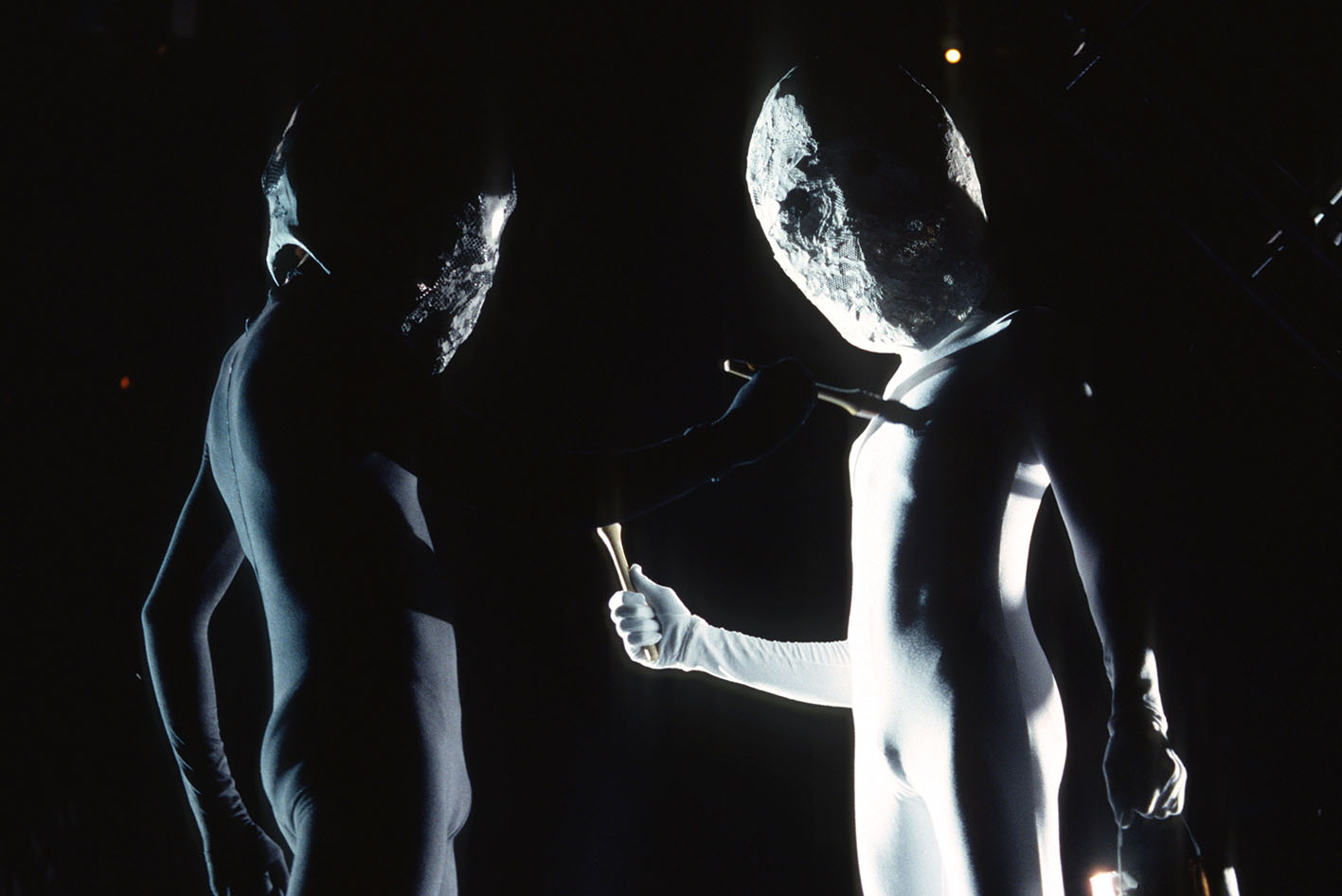
The conclusion of Ethnicolor is no less spectacular, with the horizon becoming a forest of golden rains as Patrick Rondat’s guitar solo soars high above the orchestra and masked-choir, hiding their human identity. Three masked-figures appear from all sides with billowing sail-like screens mounted on their backs, shaped as the three Symbols of Tolerance, with prism-like colours projected onto the material creating the illusion that the sails are ablaze with colour. As always, Ethnicolor proves a spectacular piece of music live and the Eiffel Tower positively embraces this audacious composition.
A composition from the past receives a startling treatment when Jean-Michel invites Patrick Rondat to produce a blistering rock interpretation of Vivaldi’s The Four Seasons. Lasers and lights furiously sear across the stage and into the audience as roman candles erupt on mass behind the musicians.
With Jarre adding chords on the circular keyboard, Rondat’s fingers lead a mesmerising dance up and down the guitar strings. The overall effect is bold and dramatic, yet it doesn’t betray the original composition’s poetical lyricism. It bravely blends classical music and hard rock together to produce a dynamic, potent brew which instantly intoxicates the audience.
With but a momentary pause the unmistakable hammer chimes of Industrial Revolutions’ Overture echo forth and the audiences’ delight at hearing this piece again is obvious. Inevitably memories of Docklands are stirred as this powerful track takes hold, memories of battles fought against bureaucracy and red tape. But Jean-Michel uses the Overture to portray a different kind of battle; the battle and conflict of racism, of man against man. As this magnificent anthem finally relinquishes its hold over the audience, the final image is of a grotesque wide-open mouth projected onto the upper screen of the Tower, uttering one final howl of ignorance and intolerance.
Jarre deliberately contrasts the weighty theme before with the playful innocence of a street barrel organ and the charming Band in the Rain. Beneath the Eiffel Tower, lit red, white and blue, Jean-Michel becomes a genuine Parisian street musician, albeit on an unprecedented scale!
The pyrotechnic rain effect fountains down to create a glorious backdrop, after conducting the crowd in their affectionate humming and clapping, Jean-Michel dressed in a black and white striped top and beret, once again has the audience in the palm of his hand.
Jarre turns his back on the audience and walks toward the circular keyboard for the start of Oxygene IV. With the waterfall of fire pouring from the Tower, lasers fold into triangles as the Earth’s image is projected onto the circular screen. Astronauts explore space as the backdrop features the Moon and the solar system. The timeless appeal of this track continues unabated.
As butterflies flutter prettily across the setting, the Sequencer Song unfurls - Digisequencer. Tracks react in time to Patrick Rondat’s intricate guitar solo whilst the actual structure supporting the three symbol screens reveal its own intricate lighting sequence. A beautiful haunting ambient theme runs throughout the piece, drawing ever onwards towards the startling finale. WIth Jarre crashing chords across the circular keyboards, flickering images of figures enacting the Karma Sutra on the background of love hearts play on the screens. And kissing nuns were deemed a touch controversial ?
Street Rappers and African Vocalists
Eldorado, the UNESCO hymn for Tolerance, set the scene for the final act.
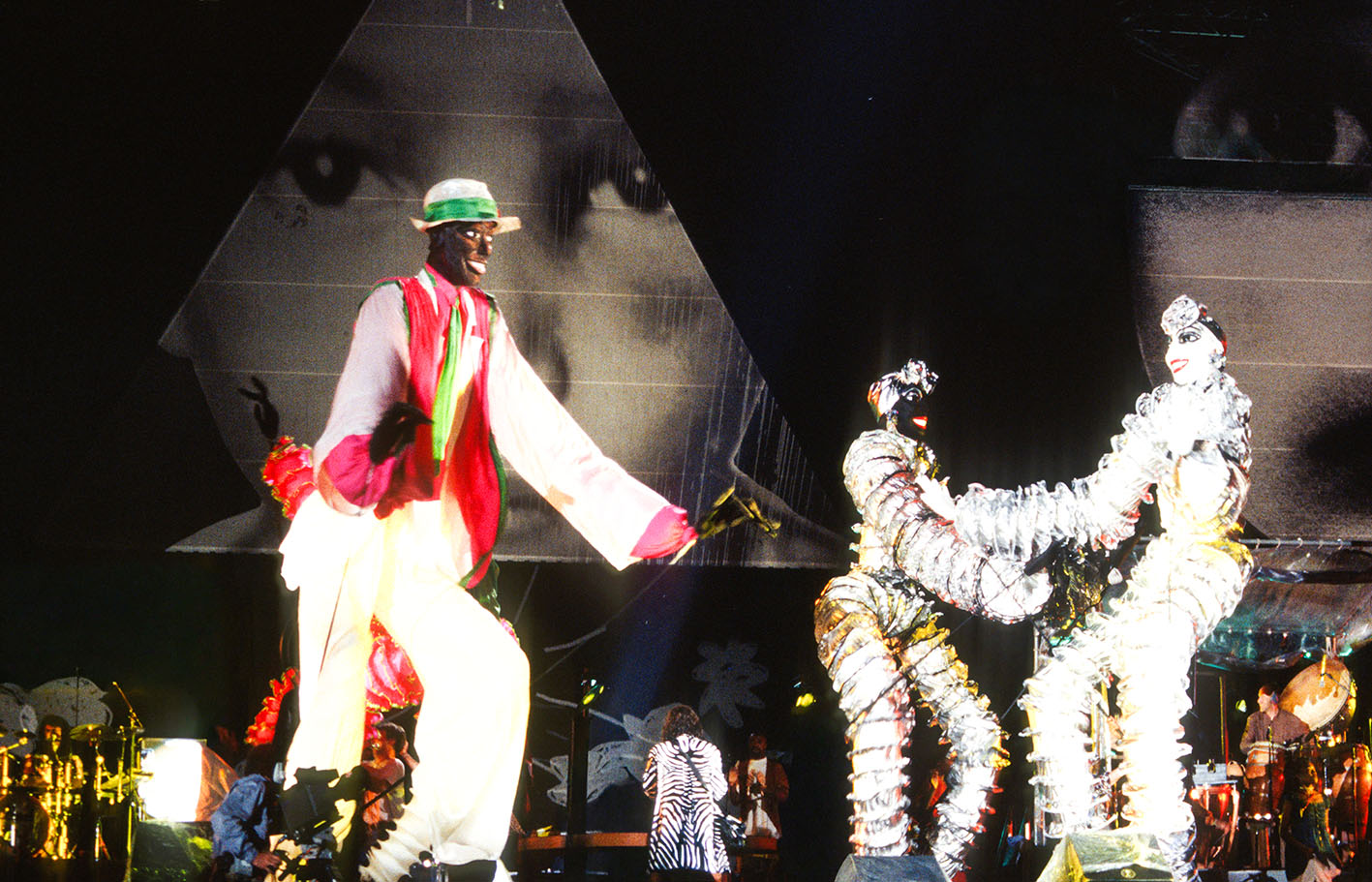
This quite amazing piece showcased three huge female silvery marionettes, described by Jean-Michel Jarre as his five-metre high rappers, with the stage lights reflected onto the puppets creating ever-changing colours. Projections of giant red lips mouthed in time to the singing of the African vocalists whilst Khaled returned to join in the infectious celebrations the track encourages.
The atmosphere is one of racial harmony and liberation with images of Ghandi, Malcolm X and Nelson Mandela representing the struggle against racism and oppression, and in particular the overcoming of apartheid in South Africa. The upper screen featured the most famous enigmatic smile, now the experience of seeing the Mona Lisa for the first time and one of Jean-Michel Jarre’s show could be combined!
Images of the Mona Lisa culturally altered (for example, with an Eastern face veil) were simply stunning, illustrating through this French cultural icon that despite a nation’s identity and fierce patriotism, our cultures are made up of many influences and backgrounds and we should embrace such elements for they enrich our lives.
The track is an instant success, its anthem taken up by the audience as Jarre and Khaled orchestrate the response.
Inevitably the end arrives, but before the joyfulness generated has a chance to diminish, Calypso takes over the reins. The marionettes are joined by a further two, the male dressed in a white suit, the female in purple blouse. As they cavort in time to the exotic rhythms, the stage becomes a fusion of light and movement. Jean-Michel dances around the marionettes as hands wave goodbye on the screens. Fountains of fire shoot up from the stage as trackers furiously pan the night sky. On the screens, in the midst of this incredible party, appears a Buddha, sitting cross-legged and perfectly at peace with himself. Huge pyrotechnics punctuate the night sky as this vibrant and life-affirming piece of music reaches its crescendo.
When the cheering and applause of the crowd eventually subsides, Jean-Michel greets the audience through the microphone, for the first time during the show. With the dedications and credits duly announced, Patrick Rondat’s screeching rock intro for Rendezvous IV signals the final track of the night. With on-stage fireworks, lasers, marionettes dancing across the stage and screens, Jarre runs towards the audience as for the final time the Paris night-sky is ablaze with fireworks. With a resounding conclusion, the audience is showered with confetti fired from canons at the foot of the stage, as the yellow square, triangle and circle symbols remain on the screens.
Bon Nuit Paris
The concert had lasted nearly two hours, yet with the sheer blistering pace and exhilarating barrages of imagery and spectacle it seemed to have swept past in a fraction of the time. As the audience reluctantly began to embark on the mass exodus from the Champ de Mars and into the streets of Paris, it occurred to me that we had all paradoxically witnessed a uniquely personal experience under the Eiffel Tower on this night. Despite the scale and magnitude of the event, each person’s perceptions and emotions would be uniquely individual. Different tracks, different images would have struck different chords with us all; from amusement to provocation; from joy to sadness.
The only common ground we would all share was the fact that we would never forget the first Concert for Tolerance.
05/Interview
Khaled
Vocalist
The show at the Eiffel Tower was unlike most of Jean-Michel Jarre’s previous concerts. Only Destination Docklands which included Hank Marvin, Jun Miyake and Setsuko Yamada, came close to having so many special guests appearing.
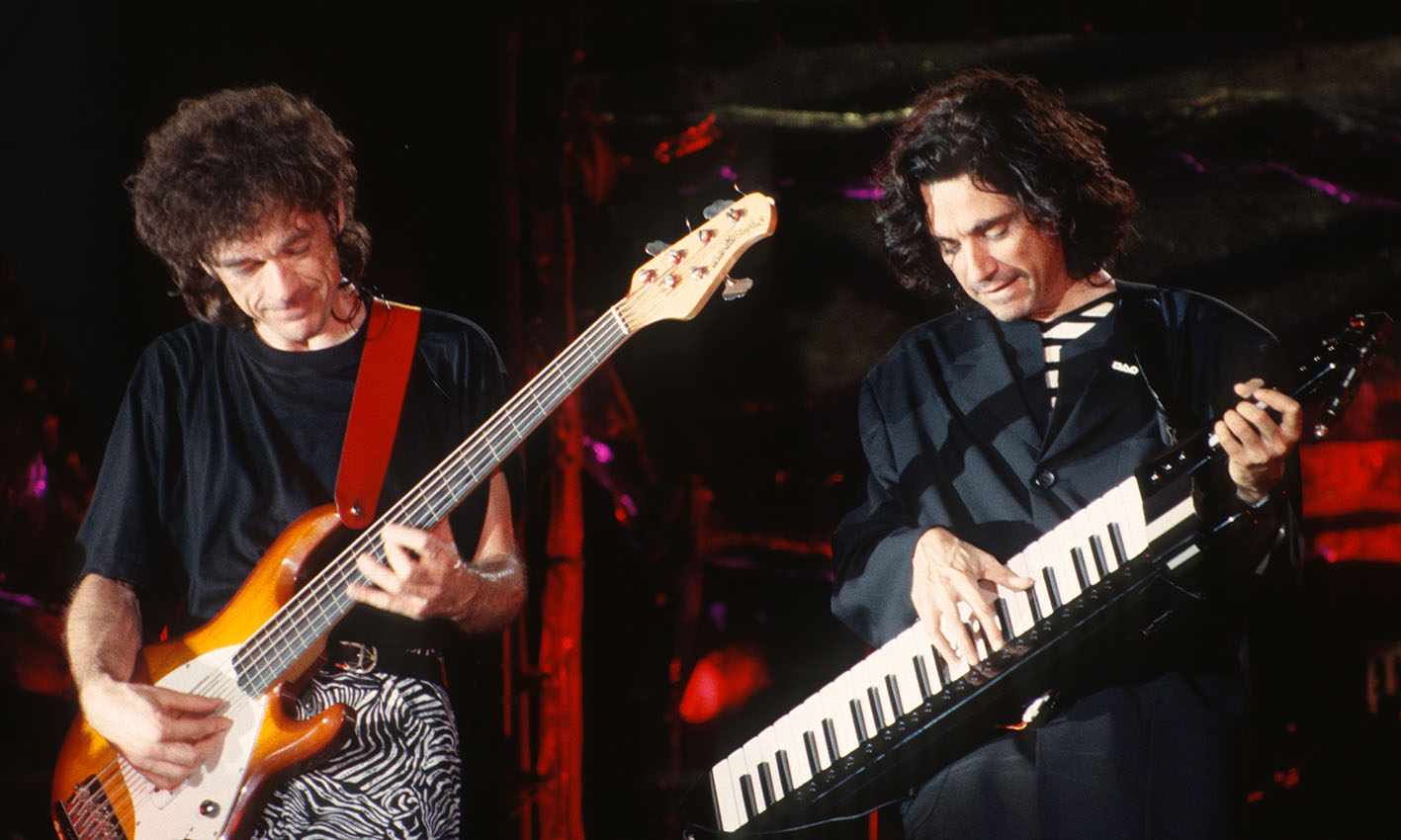
Of all the guests, the appearance of the artist Khaled in Paris was one of the highlights of the show at the Eiffel Tower.
Khaled’s performance with Jean-Michel on stage during Revolutions and Eldorado added great depth to these tracks. However, of all the artists performing, he was the one who spent the least time on stage practising!
Due to previous engagements, Khaled arrived on the concert site late on in the afternoon and had to leave within the next two hours. After a pleasant greeting from Jean-Michel Jarre, a full run-through of Revolutions was hastily arranged, microphone and all.
Cheb Khaled stands out as someone who is forever smiling. The great memory I have of him is as he left the stage is Paris as the audience were still applauding the fantastic performance of Eldorado. As he neared the steps, he threw his arms into the air for joy and you could imagine the huge smile that was across his face!
Despite Khaled’s busy schedule, he was kind enough to agree to an interview in one of the production offices to the right of the stage.
On the style of music that he sings.
“It is called Raï - Raï which means ‘opinion’ and it talks about love and tolerance and things which are forbidden to us as Muslims. Raï song talks of freedom in everyday life.”
On tolerance and whether he sees this spirit of the concert
“Well, yes and it is the spirit of Jean-Michel. When he called me to ask whether I would be prepared to appear with him, he said he wanted a song about tolerance and that is exactly what I sing.
On how they know each other
“We have known each other for a long time, almost seven years. He contacted me first in order to perform on Revolutions [at London's Docklands].”
The problem that seems to have kept the two apart until now seems to have been each other’s schedules never coinciding at the same times. First, Docklands and then La-Défense.
“I have been to the Croissy studio several times to work with Jean-Michel. I hadn’t actually sung live with him, but we did a lot of work on the piece together and we sent tapes back and forth to one another.”
The original version of Revolutions incorporated an instrument known as a Ney, a Turkish flute, used for Sufi rituals and Muezzin chants from Turkey, together with the distinctive Whirling Devishes. A new classical Arabic version was recorded for the concert in La Défense by Al Mawsili and Larbi Ouechni and renamed Revolution, Revolutions. On that occasion, Jean-Michel surprised a great many people by performing the re-arranged piece on stage with a stunning full Arabic orchestra.
On whether JMJ had himself changed Revolutions to fit in with his own distinctly different style of music.
“No, no, it was quite the opposite - I was the one who made the changes. Jean-Michel worked with a Tunisian singer on the album Revolutions and during the La Défense concert.
“I am from Western Algeria which means a completely opposite style of singing. I was originally asked to perform at La Défense five years ago but I was already performing on the 14th July that year, in Central Park with the Gypsy Kings. I really wanted to perform with Jean-Michel Jarre but I couldn’t.
“However, I did listen to the tapes with the Tunisian singer and I prepared my own song over the original melody. I recorded my version for Jean-Michel and I played it to him in the studio - a completely different vocal part to an original track.”
Khaled’s rehearsals for the show on stage were brief but took place in front of many people, some preparing for the show, as well as photographers and media. The French pianist Michel Drucker was also sitting at the end of the stage walkway with Francis Dreyfus and Charlotte Rampling.
On whether he had enjoyed the rehearsals, after all he always had a smile on his face.
“Well, I was a little intimidated during rehearsals - you know, I really am shy. Doing a sound check like that in the light of day and in front of all of those people was a bit off-putting! I have found it hard because I had so little time to prepare for today.
“I am also very busy outside this work. I am in the middle of a tour, I am working on my third album and I spend a lot of time working in cinema.”
On what exactly the song he was singing during Revolutions spoke about.
“It speaks of love. In the world today, everything is moving so fast that we need to take time out and remember love.”
06/Interview
Guy Delacroix
Musical Director
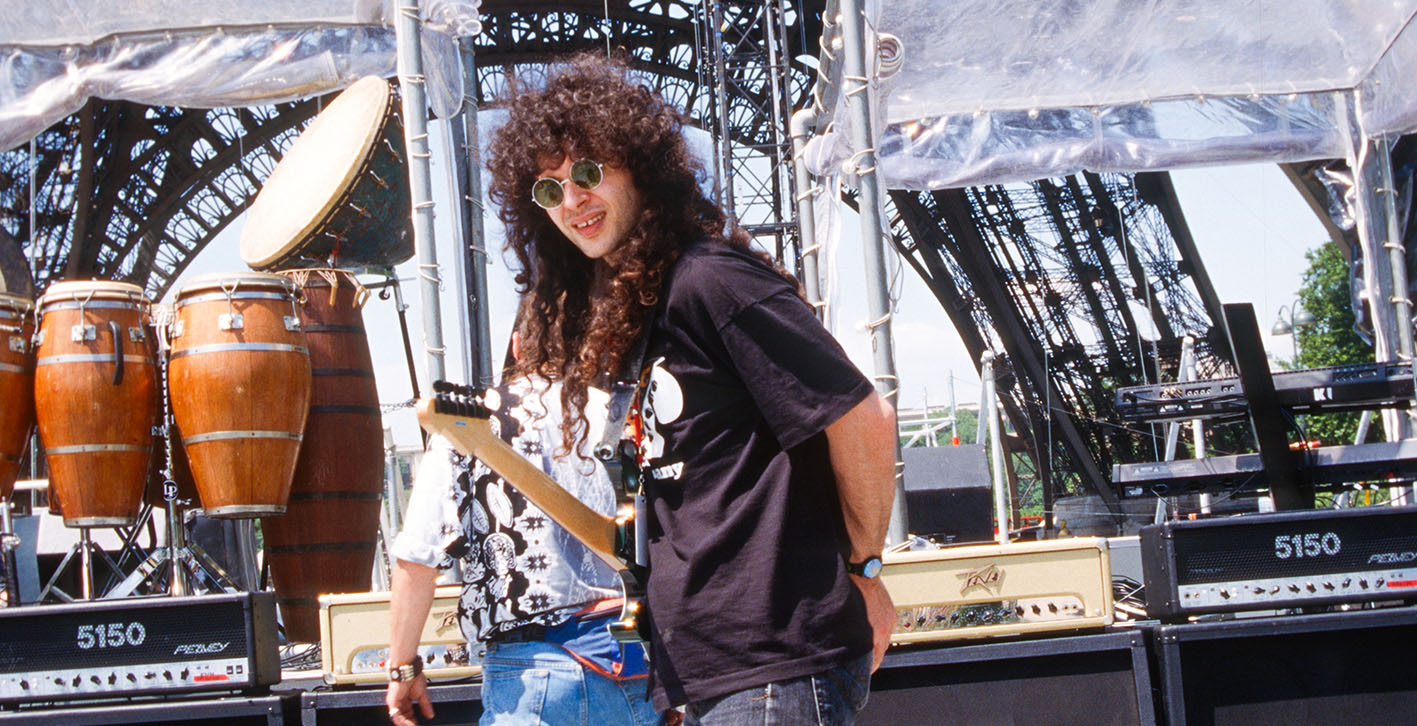
Guy Delacroix is one of Jean-Michel Jarre’s longest standing musicians and as one of France’s principal session bass players, is in great demand. We caught up with him in Paris.
When we met up with Guy Delacroix for the first time, it was under the Eiffel Tower on stage after he had just returned from a meeting with Jean-Michel Jarre and the other principal concert musicians.
In his bag, he had the finalised concert schedule and he was happy to talk about the plans and the various pieces that would be performed. Explaining that Jean-Michel would not be talking to the audience during the concert, nor performing an encore, he was clearly relishing his new role as Musical Director, in the absence of Sylvain Durand.
Guy Delacroix has worked with Jean-Michel Jarre since 1986. He was introduced to Jean-Michel through Michel Geiss who had seen him performing on stage with Louis Chedid. A subsequent meeting led to Guy performing on stage at the historic concert for the Pope in Lyon.
His career started in 1980 primarily as a bassist and he has worked as a studio musician for many of France’s most famous artists. He is, indeed, one of France’s most sought after session bass players, working on over one hundred albums for the last fifteen years, as well as composing music for films and advertisements. It was prior commitments to another artist that prevented Guy from joining Jean-Michel for last year’s concert in Hong Kong, where he was replaced by Michel Valy.
His most recent collaborations include albums from Alain Souchon, Christophe Deschamps (who played drums at the concert in Paris-La Défense in 1990), Jean-Jacques Milteau and Maxime Le Forestier.
On HIs new role in this concert
“Before the concert, I have the responsibility for helping Jean-Michel to choose the tracks that will be played. Next, I prepare the work for each of the musicians, be they operating acoustic, electronic or percussion instruments. This covers everything from the synthesisers to the choir and the various orchestral instruments.
“I have to prepare the music sheets, explain to the musicians what they have to do and also organise things like the rehearsals and also how the members of the group work together on stage.”
On the time to prepare for the concert
“About six weeks. We started off working in the Croissy studio, then we went and rehearsed in a room nearby, in Chatou for three or four days.
“This concert is special because we have new instruments to integrate such as the Arabian stringed instruments. However, these new instruments do not really pose us many problems to integrate into Jean-Michel’s music. There is always a common base and new sounds generally fit in well.”
The previous night, Jean-Michel and the musicians performed a single full run-through of the concert musically, including the burst of confetti at the end, as well as a second performance of Calypso shortly afterwards. However, due to time constraints, the visual team were unable to rehearse at the same time because Jean-Michel wanted to view the visuals separately. Therefore, at 2am in the morning, Jean-Michel was there to oversee a full rehearsal of the lighting and visuals.
On the rehearsals on-site and challenge of time
“Things are generally fine on that front, but the eternal problem is that we always wish that we had more rehearsal time. We really need to have a full run-through of the concert beforehand which just isn’t possible. Particularly, we have not been able to rehearse at the same time as the lighting and visual teams. What we really need to do is to build the stage somewhere else beforehand and have a week to practice properly.”
“We rehearsed Europe for Concert on a built stage at the aerodrome at Villaboublay. We could do with doing that each time, but it just isn’t possible. You have that option when you are on tour and you have booked the team for four months, but for a single concert it cannot be done, purely for logistical and financial reasons.”
On what to expect at the show
“The beginning is going to be spectacular if everything goes to plan. Also, different instruments on stage such as the performance of an Arabian stringed instrument. It should be fantastic!”
07/Interview
Patrick Rondat
Musician (Guitar)
Patrick Rondat is an important part of Jean-Michel Jarre's live musical identity. His electric guitar brought a harder, more rock-oriented dimension to Jarre'selectronic compositions, particularly during the Chronologie period and now the large-scale outdoor concerts. It was a pleasure to meet up with him again in the more open surroundings under the Eiffel Tower.
Four years ago, many people would have found it very hard to imagine Jean-Michel playing with a hard rock guitarist. Patrick has long been an admirer of Jean-Michel’s music, long before they started working together. However, it was a piece of good fortune that led to the two meeting up.
Rondat first met Jarre towards the end of 1991, following a concert by American rock band Extreme. He subsequently visited Dreyfus Music, Jarre's record company, and left a CD and press kit. Jarre telephoned him back approximately two weeks later.
Patrick, constantly accompanied by his assistant Michel who looks after his variety of guitars, had been practising his solo performance of Vivaldi’s Four Seasons all morning and this was obviously causing him an amount of anxiety.
Our first interview took place backstage the day before the concert.
On FIRST meeting JMJ
"I always thought that it would be good to get some rock guitar into his music. However, I never thought that he would like it. Then I met him at a rock concert and I thought 'ah, maybe he would like it!'. That’s why I sent him the CD and I’m still amazed now that he took the trouble to listen to it all.”
"He called me back two weeks later and left me a message. It was so incredible that I even kept his message on my answering machine. I was so happy I couldn't believe it! I always thought that a hard rock guitar could fit with Jarre's music, giving it more character and dynamism."
On the key musical differences between this show and previous
“Certain things remain the same. I am still doing the improvised introduction to Rendez Vous 4 for example. However, one new thing is from my new album and is a guitar version of one of Vivaldi’s concertos - that’s very new.
“I just have to think about my Vivaldi track because it is very difficult so I am under a lot of pressure.”
The performance of this track was a radical idea and a totally new concept for Jean-Michel Jarre, never before has he performed a piece of music that he hasn’t composed. As always, Jean-Michel Jarre was even more innovative, presenting the piece both on the hard rock guitar, combined with a high-tech synthesizer. However, saying that, it was clearly one of the most popular tracks of the evening.
On the idea for playing Vivaldi Four Seasons
“It was one of Jean-Michel’s ideas. I like to play around with quite a few tracks like that on the guitar just for fun, but he thought that it was an interesting idea and asked me to perform it live. He also thought that it represented the theme of the concert, i.e. being able to accept different interpretations of a track which is considered almost sacred.”
On Patrick's concert highlights he is looking forward to AND PLAYING WITH JMJ
“I think that the best thing will be the number of special guests who will be on stage. The theme of tolerance has led to some interesting fusions and contrasts of styles.”
“For me, it is like a dream. It was difficult for me - as a kid you learn guitar and you learn to play along. You can’t imagine that you will play one day in something like this. I think that he is the only man who could help me to do that. I look forward to each performance. The most important part is when I play solo because it is a big present from Jean-Michel to me. I am given a great responsibility.
Patrick, who is only 23, has experienced many concerts in different countries through his work with Jean-Michel. He has performed all across Europe and in Hong Kong and has the prospect of concerts in countries across the world over the next 18 months to look forward to. Patrick is still very grateful to Jean-Michel for giving him all these new experiences.
Since the concerts in 1986, Francis Rimbert, Guy Delacroix, Sylvain Durand (who will return for the next concert) and Dominique Perrier have remained core musicians. Since then, Jo Hammer has moved onto other projects and was replaced by Christophe Deschamps and then Laurent Faucheux. Since the start of Europe in Concert in 1993, the team of musicians have remained roughly the same.
On how the musicians get on.
“We are friends. It is different every time on stage. We work together for maybe two weeks so we become a very close team.”
Most guitarists form part of a band but for Patrick, he has his own solo career and performs only as part of a group for Jean-Michel Jarre. Patrick though, was adamant that he didn’t need the security of being part of a band to progress his career and thinks that even though he is a rock guitarist, he is not going to follow the traditional route.
On not following the traditional route of being in a band
“I am a rock musician, but I think that it is more original to play this style of music than to play in a rock band like thousands of others.”
As well as a congratulatory tête-a-tête at the after-show party, we spoke to Patrick again the day after the concert. The concert had been a great success, being broadcast worldwide with a massive audience both at the event and also on TV. Patrick was clearly delighted about how the concert has turned out, especially his solo Four Seasons performance.
At the after-show party, Jean-Michel Jarre, the television crew, the musicians and many of the crew watched the live edit of the concert film, three times over. A great laugh erupted at the start of Rendezvous 4 when it was clear that Patrick was expecting the cameraman to do something other than focus on him after his first burst on the guitar. He turned away with a smile
On JMJ's reaction to his performance
“Jean-Michel was very happy. There were a few details which were not perfect, but on the whole there were no major problems. There was just one problem with one of the cameramen who followed the wrong instructions during Rendezvous 4, but that was just a detail. The film was also excellent! There were a few errors in the editing but they were not important; that’s all part of a live event.
“I think the overall effect was better than the Barcelona video. I also prefer the guitar sound as it is on this recording compared to previous attempts.
“The idea of transmitting live, even with a few imperfections is good. The effect is not too artificial in this way. I find that you get a better idea of the atmosphere of the concert. Apart from anything else, it is good for Jean-Michel’s image that he gets some live coverage.
“For Souvenir of China, it was Dominique Perrier’s idea. He advised Jean-Michel to change it. As regards Ethnicolor, it was Jean-Michel’s idea.”
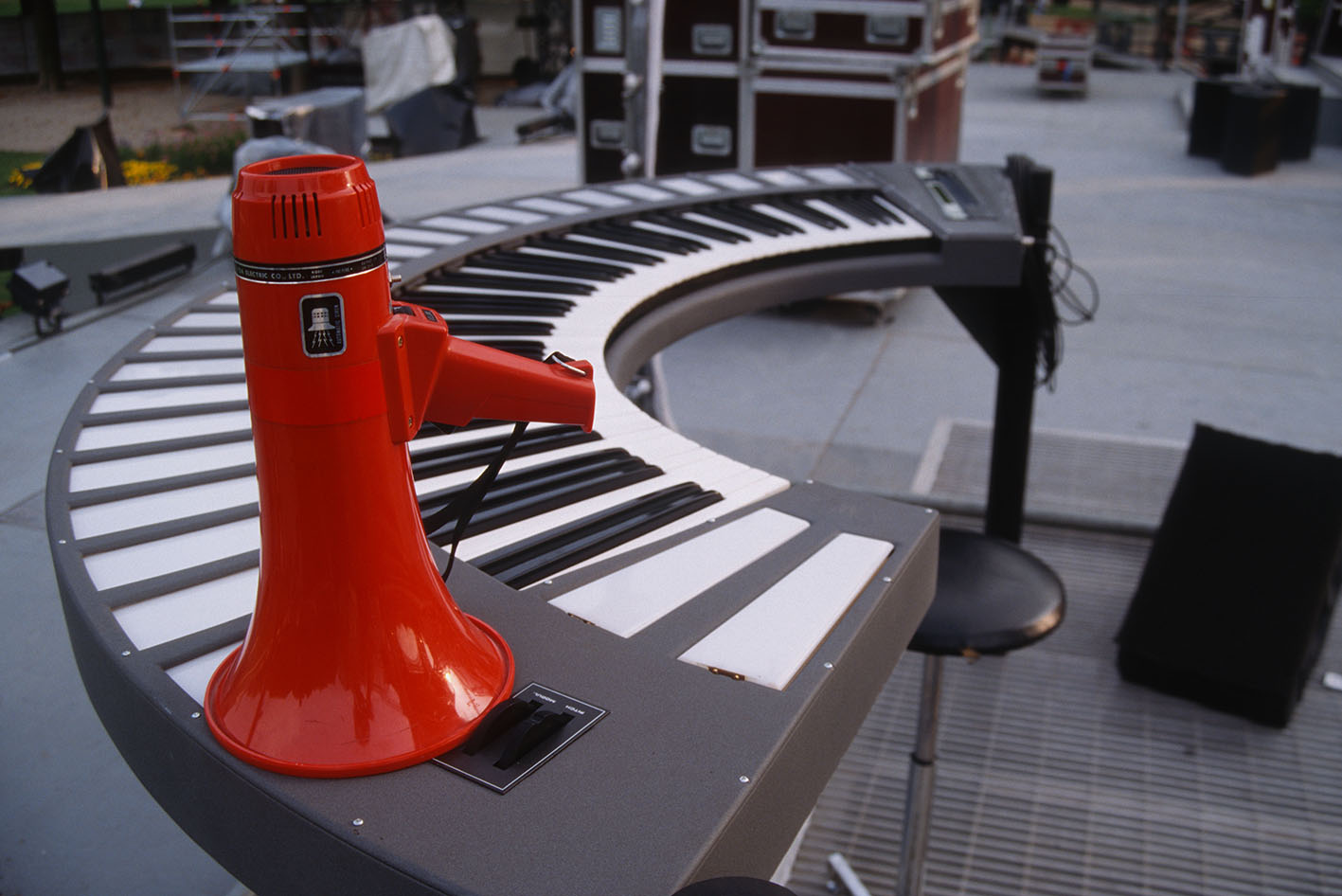
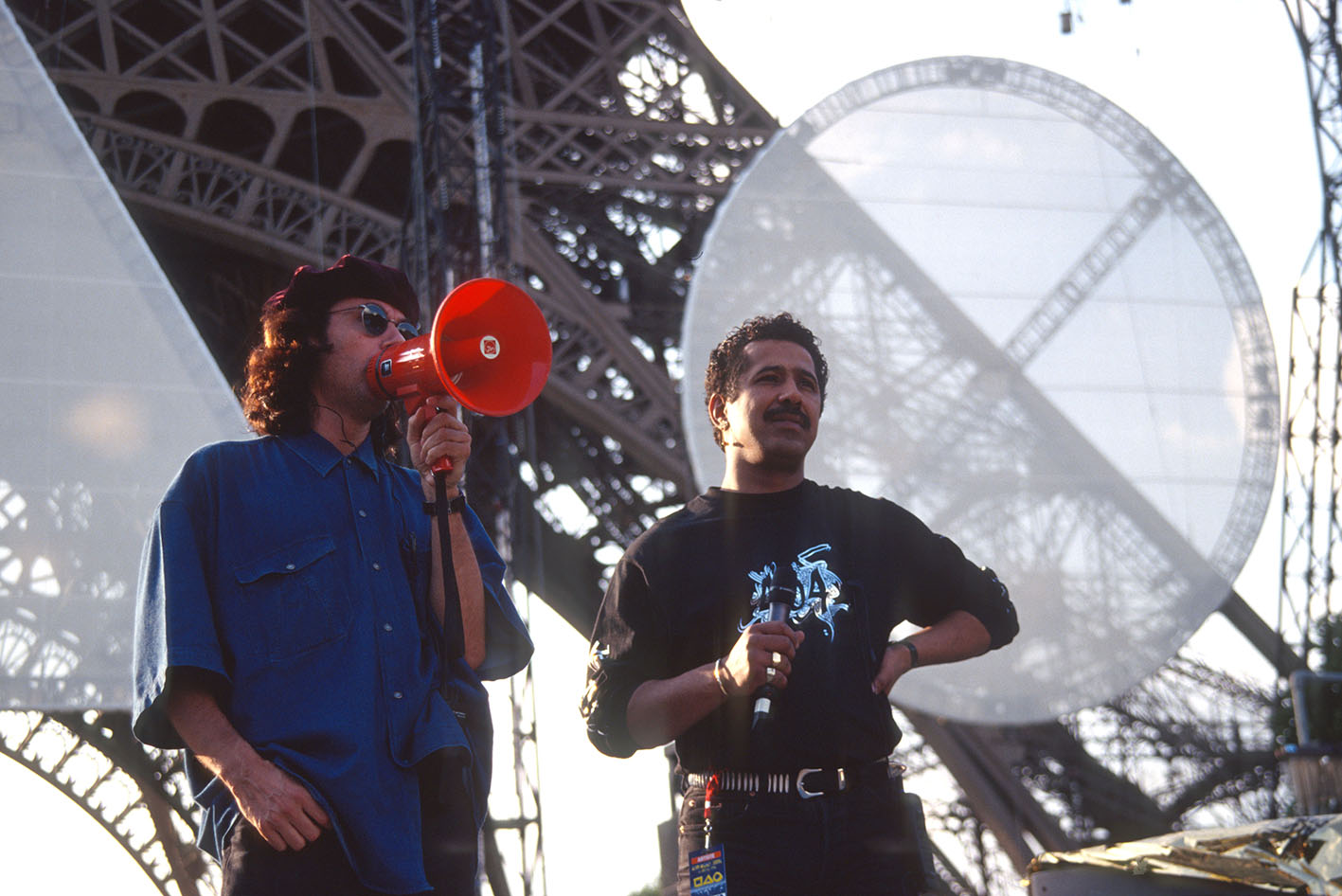
During Revolutions, Jean-Michel’s sampled voice was different to the one we are used to. Jean-Michel took great delight during the rehearsals, whilst testing the familiar red megaphone which he used for the effect, of answering questions posed to him by the crew through the megaphone. Digitized ‘non’, ‘oui’ and ‘d’accord’ were echoed around the concert site.
“Yes, the megaphone was connected to a microphone and the sound was then distorted. I liked the effect, it made the track a more rough live effect.”
On why no encore and the extremely large audience
“I think that it was linked to the fact that the concert was being transmitted live on television. The tracks had to follow on rapidly.
“The audience size in front of the Eiffel Tower didn't make me nervous. You don’t realise that at all. What gave us the most fear was rather that it was going out live.”
On Patrick’s forthcoming solo album, which has been produced by Jean-Michel Jarre, including Vivaldi’s Four Seasons and his own version of Equinoxe 4.
“The album is finished, it just needs to be mastered. However, we do have problems with the sleeve design as another group have brought out an album with a similar look. Jean-Michel has been a good influence on my work. He does not influence my style directly but is able to give me a good external view of things that he likes and others that he does not.“
“The Vivaldi track will be practically the same as regards the style and rhythm played at the Eiffel Tower. However, for the concert, Dominique Perrier had to sample a few parts which will be done live by guitar on the album. Also, the drumming will be a bit different as it is a hard rock guitarist who takes care of it on the album.”
08/Interview
Patrick Pelamourges
Technical Assistant to JMJ
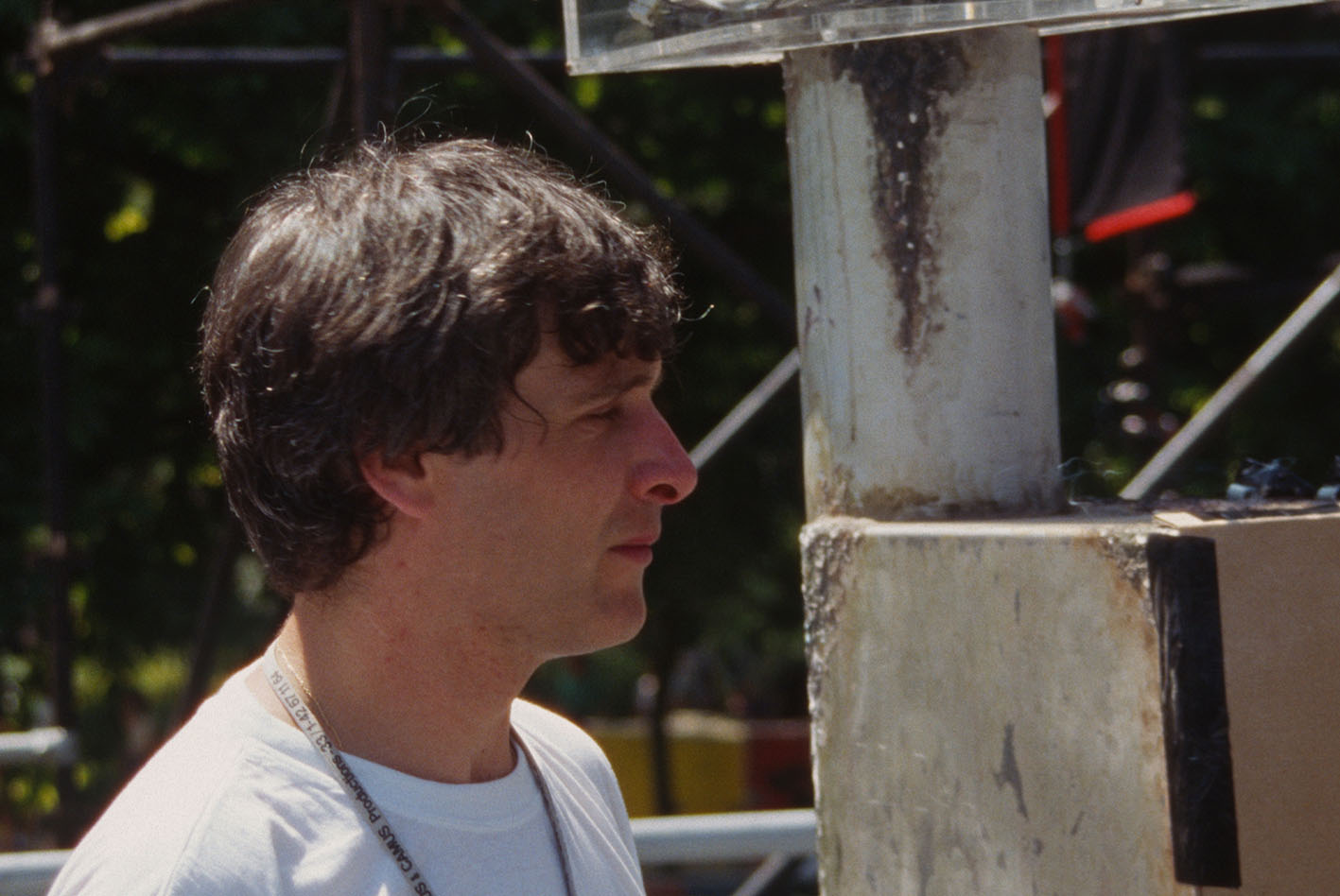
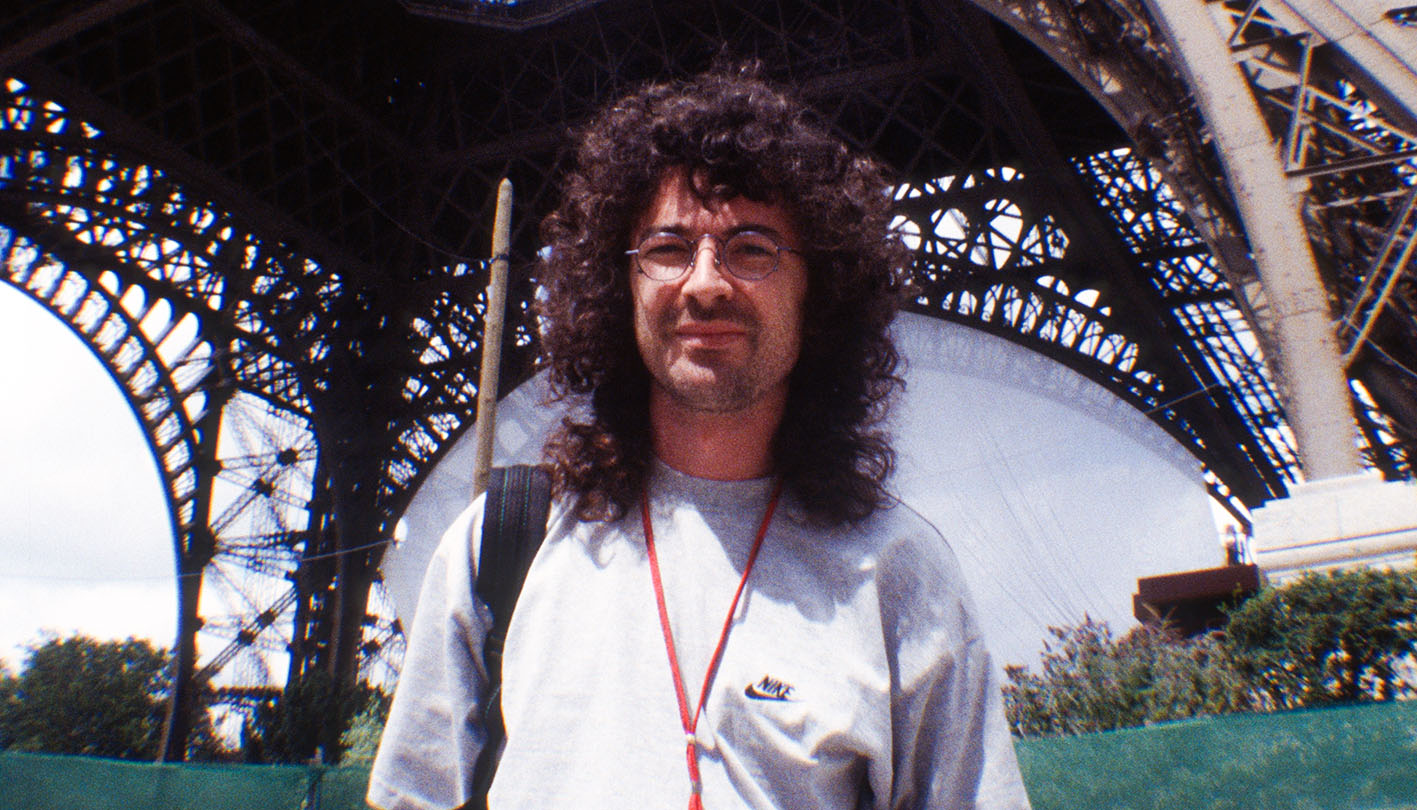
Patrick Pelamourgues has been part of Jean-Michel Jarre’s team for many years now and is always seen on stage before all the musicians, hurriedly setting up one of Jean-Michel Jarre’s instruments - be it the giant circular keyboard or the barrel organ. He has travelled all over the world with Jean-Michel, including Trinidad for the recording of the Calypso tracks on Waiting for Cousteau.
We spoke with Patrick on stage two days before the show, just as Laurent Faucheux was practising and the other musicians were arriving. We knew that problems were occurring with some of the instruments
On preparations for the CONCERT
“Everything is fine except for the radio signals between the cordless instruments. The transmissions are exceptionally bad because we are surrounded by so much ironwork.
“Otherwise, much of my preparation work has been carried out in the studio, preparing the instruments and sounds. The only real new toys that we have not used recently are the two sets of sensor pads used to trigger sound effects which we haven’t brought out since London. I had to do some repair work on them to get them ready for Ethnicolor here.”
On his responsibilities during the concert AND THE DIGISEQUENCER
“I look after all of Jean-Michel’s instruments - I have to pass them up to him, change the sounds and the MIDI patches. We have been working on this concert since the 15th June in Croissy. I have been busy working to get the samples on the various pieces of equipment ready for the concert.
“The Digisequencer only gets used in the one track which will be similar in structure to the version performed during Europe in concert. It is a piece of equipment which is mainly used for studio work because it is so fragile. It is very sensitive to both heat and humidity. Just a little humidity in the air is enough to create false contacts within it.”
On the weather and chance of rain during the concert
“It might rain... You don’t get anywhere in this business without being an optimist. You know, we played London! Docklands was worse than anything that could happen here - wet, cold and windy. Anyway, we got by.”
On who he is in contact with during the concert
“Nobody! It’s each for his own in that situation. I just look after Jean-Michel. The other musicians have assistants - for guitars and drums. I am the only one working on the keyboards for Jean-Michel and, well, Dominique has to manage on his own if he has any problems.“
On how he met JMJ and his work with outside of concerts
“I started working with Jean-Michel in 1979 when I helped in his first studio. After that I went off and did all sorts of different things like go-carting! However, he asked me back to prepare his second studio. I then went off to work for other people again until Jean-Michel asked me back in 1986. For concerts, I wasn’t there at Lyon, or on the China tour.“
“I have my own company. I work full time on Jean-Michel’s studio doing maintenance and other work, and with the company I work on other set-ups concerning maintenance and computers. At weekends, I spend my time repairing old synthesisers which is my passion.”
On old analogue synthesizers as opposed to the new digital ones
“Oh, it’s good to get them out again. The problem is that modern keyboards do not provide flexibility in the sounds that they offer. They are fantastic for some types of musician, but are not what Jean-Michel needs. I think that if he does as he has promised and records an album with such analogue equipment, it will be what people are demanding and will be more the authentic ‘Jarre’ sound. It won’t be a case of trying to recreate a new Oxygéne or Equinoxe, but just using similar analogue sounds. We can only wait and see !”
On audience size expectations tonight
“Nobody knows, which is what makes it exciting ! People will be everywhere around the Eiffel tower. On stage, you don’t have much idea of the number of people present At La Défense, I thought that there were only 500,000 people. I was wrong!
“There will be people on both sides of the Eiffel tower - we are installing screens and speakers on the other side so that people can enjoy the concert without seeing the stage directly. I guess they will see the projections backwards, but that isn’t too important. The fireworks are going to look amazing around the Eiffel tower, but only if you are standing far enough back.“
09/Interview
Laurent Faucheux
Musician (Drums)
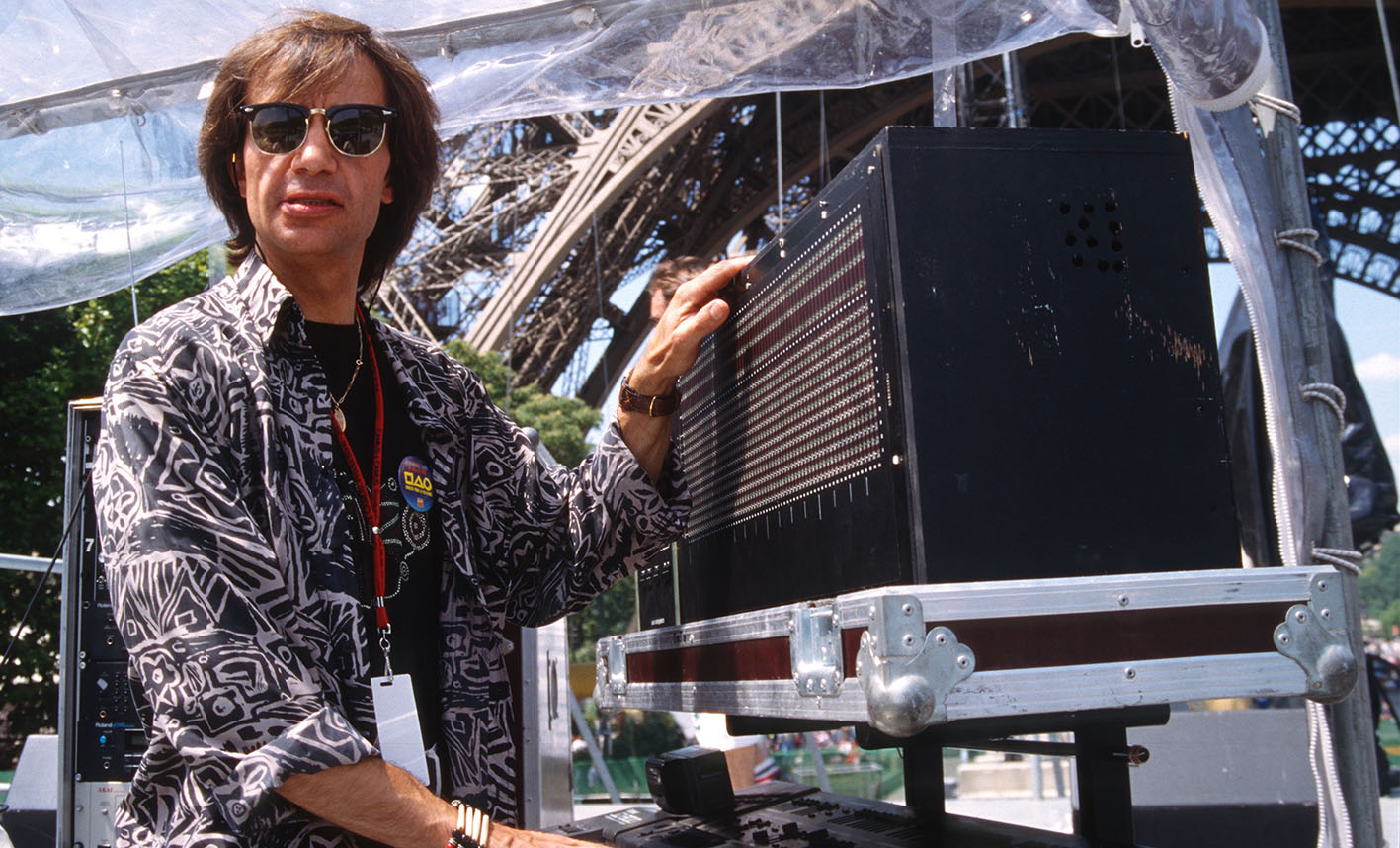
Laurent Faucheux joined Jean-Michel Jarre’s team of musicians with Dominique Mahu, in time for Europe in Concert. He has since become a key member, taking over from Jo Hammer and Christophe Deschamps as percussionist, travelling with Jean-Michel to Hong Kong and now Paris.
We spoke with Laurent the day before the concert after a rendezvous with him on stage.
On his stage set-up compared to Europe in Concert
“Things are a little bit different because it is the first time that I am playing with an acoustic drum set. Last time, we had a system based on electronic pads with only the cymbals being acoustic.
“Our aim at that time was to reproduce as faithfully as possible the sounds used on the albums. This did, however, mean that we had to simplify many parts of the tracks as there were too many program changes during the tracks. We had the ability to reproduce the sounds but it took too much effort to really make the use of it live.
“We have changed things now by keeping the electronic sounds for certain tracks where the percussion is an integral part of the track, but using acoustic drums for the rest of the tracks. There is no doubt that acoustic percussion is far more natural and sounds better live. We are not trying to reproduce original music exactly, but rather to play live interpretations of the tracks. The sounds are far more dynamic and the mix is far easier to do with drums than with pads.”
On how the collaboration came about, through an introduction by Michel Geiss
“It all started for me during the Europe in Concert tour, so that’s two years that we have worked together. We met when he was beginning to prepare the tour and we started by chatting together because Jean-Michel wanted to find out whether I was on the same wavelength as him and what my musical aims were. We found out that we fitted well together, so we got straight to work and rehearsed for about a month“
On memories of the concert in Hong Kong in 1994
“I have excellent memories of Hong Kong except that we didn’t stay long enough. As far as I was concerned, a lot of the work on the music had already been done for the European tour. Also, we had simplified a lot of the percussion material for the concert, and this helped us to make the final step for today of playing with an acoustic drum set. Hong Kong was very tiring and exceptional but I enjoyed it greatly.”
On working with JMJ
“Yes, I was only saying it to someone a couple of minutes ago. It is a great pleasure - he knows exactly what he wants and expects to get it, but his pressure is never negative. He is always receptive to our suggestions and takes into account the personalities of the musicians. Relations between the musicians are always excellent which is very enjoyable.”
On being ready for the concert tomorrow
“We’ll be ready tomorrow! There are always a few problems, but nothing that we won’t get sorted out for tomorrow. Being live on television puts a bit more pressure on you but at least Jean-Michel’s concerts have a lot of things happening at once, so small errors can be covered over !”
On working with JMJ in the future
“I hope so. I have no idea what his next move will be or what concerts he will do next. It all depends on all sorts of things like our mutual plans. When you are a musician you always have many things on at the same time - availability can never be guaranteed.”
10/Interview
Francis Rimbert
Keyboards
With the exception of Dominique Perrier, Francis Rimbert is Jean-Michel Jarre’s longest serving musician. Previously working for Korg and Roland, Francis now works for Ensoniq, whilst still maintaining close links with Jean-Michel through working on albums and preliminary work for concerts.
We managed to catch Francis backstage just before the afternoon rehearsals.
On his responsibilities before and during the concert.
“Well, my role is always similar in every concert. I’m a straight musician supporting Jean-Michel on stage. This time, however, you may have already noticed that we don’t have Sylvain Durand with us, but that’s just for this one occasion. This obviously gives me a lot more work to do as we have to take over Sylvain’s parts during the concert.
“Obviously, our first role is to try to reproduce on stage everything that we have done in the studio. For that, we have an enormous number of sampled sounds which we have prepared already. During the concert, this allows us to play on one keyboard with, for example, our left hand, whilst the right hand can trigger various sounds on a separate synthesiser.”
On whether having only two keyboard players are enough for the show, with the absence of Sylvain Durand
“Sampling can never replace Sylvain [Durand]. We are obviously forced to adapt our music for two keyboards instead of three. Let’s be honest, three keyboard players is only just enough for Jean-Michel’s work.
“Sylvain has been named the official piano player of the Paris Opera, which is obviously a very important role, hence his absence.”
On how much room you have on stage for improvisation, or is everything timed down to the last second
“I would say that improvisation is generally in function of the problems that we are having at a particular time. As there are always a great number of problems, this being a live event, improvisation is required! You always have to be ready to react to unusual situations.”
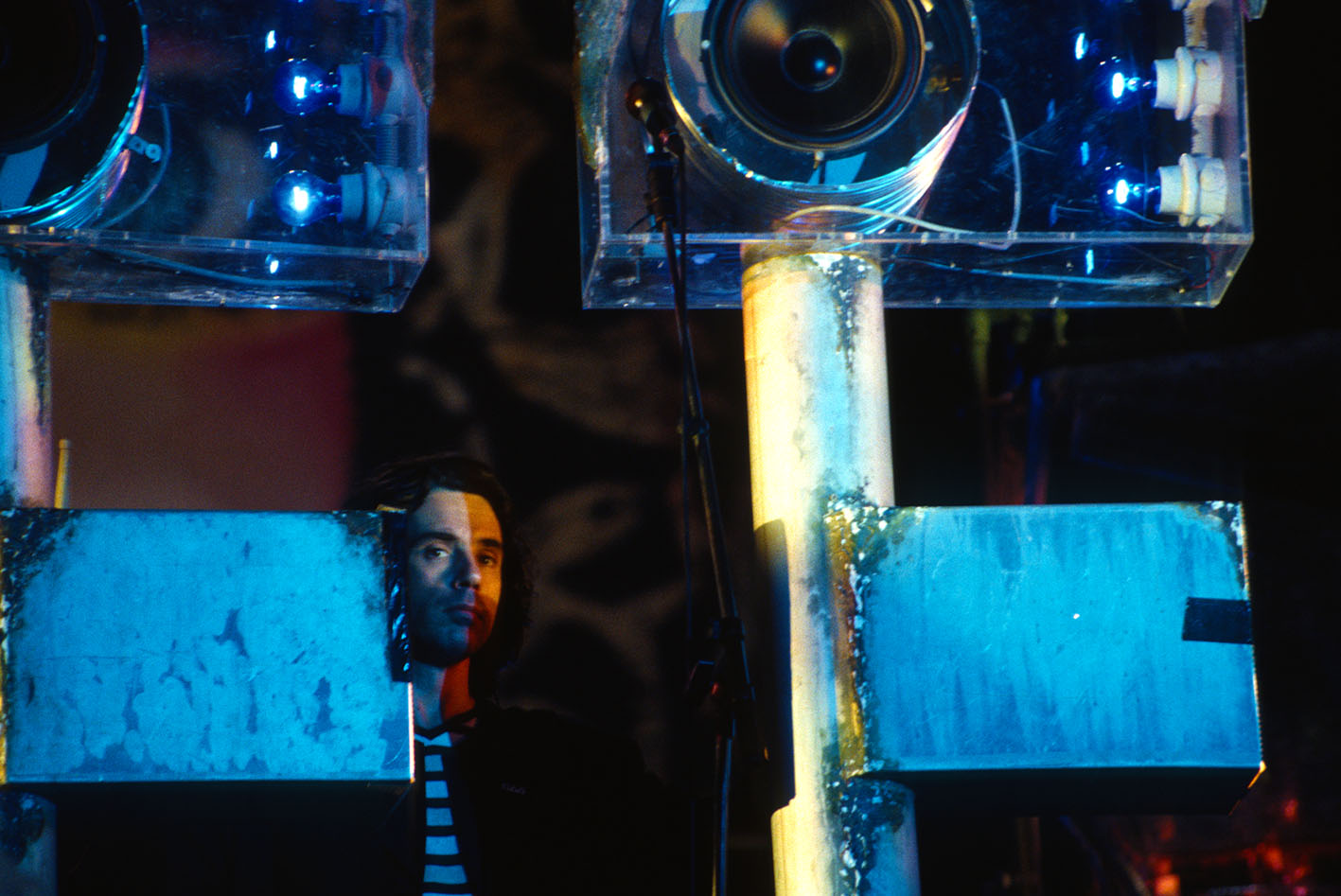
This was demonstrated during the concert when the Cristal Baschets, the touch-sensitive instruments stopped working. They had been working perfectly during the rehearsals, with the lighting strips around the speakers reacting to the taps from Jean-Michel. However, during the show Francis had to back Jean-Michel up from his keyboard.
On the concert preparation
“Everything has had to happen very quickly. Luckily, we have a wide musical base which is already prepared and which we can call upon for any concert. Such tracks always appear, and are just updated for different events.
“We have a lot of experience from Europe in Concert to prepare us for any concert which might be organised. This has all meant that the two weeks of solid rehearsals that we had were sufficient to prepare this Paris concert.”
On the change of location from Esplanade des Invalides to the Eiffel Tower, a more central landmark, late in June
“For us as musicians, the location change presented no problems. Our program did not have to change at all. However Jean-Michel has managed to work miracles. I have no idea how he managed it - in two days he had changed all of the plans and had developed the framework for a concert at the Eiffel Tower.”
On what other musicians Francis has worked with
“Er, Jarre Jean-Michel, Michel Jean-Jarre... No, I lie. We all have other things which we work on outside of Jean-Michel. At the moment, I am particularly interested in everything to do with multimedia and CD-ROM. I am currently working on the music for a multimedia cartoon CD-ROM for a small company called Ludimedia. I am fascinated by the possibilities of multimedia and it offers very interesting new opportunities for musicians like myself.“
“I am sure that Jean-Michel will work on a CD-ROM project. He would be able to bring out something really original, but what it would be, I haven’t a clue !”
The night before the concert, we were lucky enough to attend a private concert. In fact, it was the dress rehearsal of the concert but standing amongst a handful of people as the full concert was run-through on stage from start to finish, it was a privilege to be there.
On the dress rehearsal the night before
“Oh, so many problems but that is normal. We always say that when a rehearsal goes badly, the concert will be good. Our biggest problem is that we have only had the one rehearsal before the actual event. Even worse, the rehearsal was not done with the proper PA in use - we weren’t allowed to use it after 8pm. On stage when you can’t hear yourself think, everything feels very different.”
On meeting Jean Michel Jarre
“Everything started from one man who I always want to be mentioned when talking about Jean-Michel’s work, and that is Michel Geiss. It is thanks to Michel Geiss that I was able to work with Jean-Michel.
“Everything started at the Concorde concert. Michel Geiss came to me before the concert and told me that Jean-Michel needed some keyboards. At the time, I was working for Korg, so I had a lot of contacts in the industry. I lent him some keyboards and Michel Geiss put me into contact with Jean-Michel who ended up inviting me for dinner at his house !”
“Michel Geiss is not present today. As you know, he takes care of an enormous number of Jean-Michel’s things, not only the live concerts. For example, he prepared the television clip advertising the concert. Sometimes, he has so many different responsibilities that he cannot be everywhere, but even if he isn’t here in body, his work can be found throughout the concert.”
On working with JMJ
“It is funny answering such questions because I always feel like an actor who has just finished a film and who declares to the press that the team was wonderful etc.
“It is hard for me to say it but I cannot repeat often enough how wonderful it is to work for Jean-Michel. He is the only person I have ever met who will work and work and work on all sorts of problems - musical, lighting, authorization and administrative and will still arrive at the rehearsals with a large smile on his face.”
On what the future will bring for JMJ
“That is really a question for Jean-Michel. We are always surprised when he comes to us and announces what we are going to do next. He comes to us and says ‘We’re going to play a concert for the 14th July’. Then he says ‘of course, there will be a few new things this time...’ and it carries on like that. He surprises us each time.
“I cannot predict what Jean-Michel will plan next, but it’s true that there has been an enormous change in the concerts that he has performed. Originally, our aim on stage was to reproduce as nearly as possible the music as it was on the albums. We then decided that it was not necessarily the best way to do it, as the concert can become a bit dead, so our aims changed and we modified everything for the different concerts.
“I think that we will continue in that direction re-inventing Jean-Michel’s original tracks.”
11/Interview
Richard Cross
Vocalist
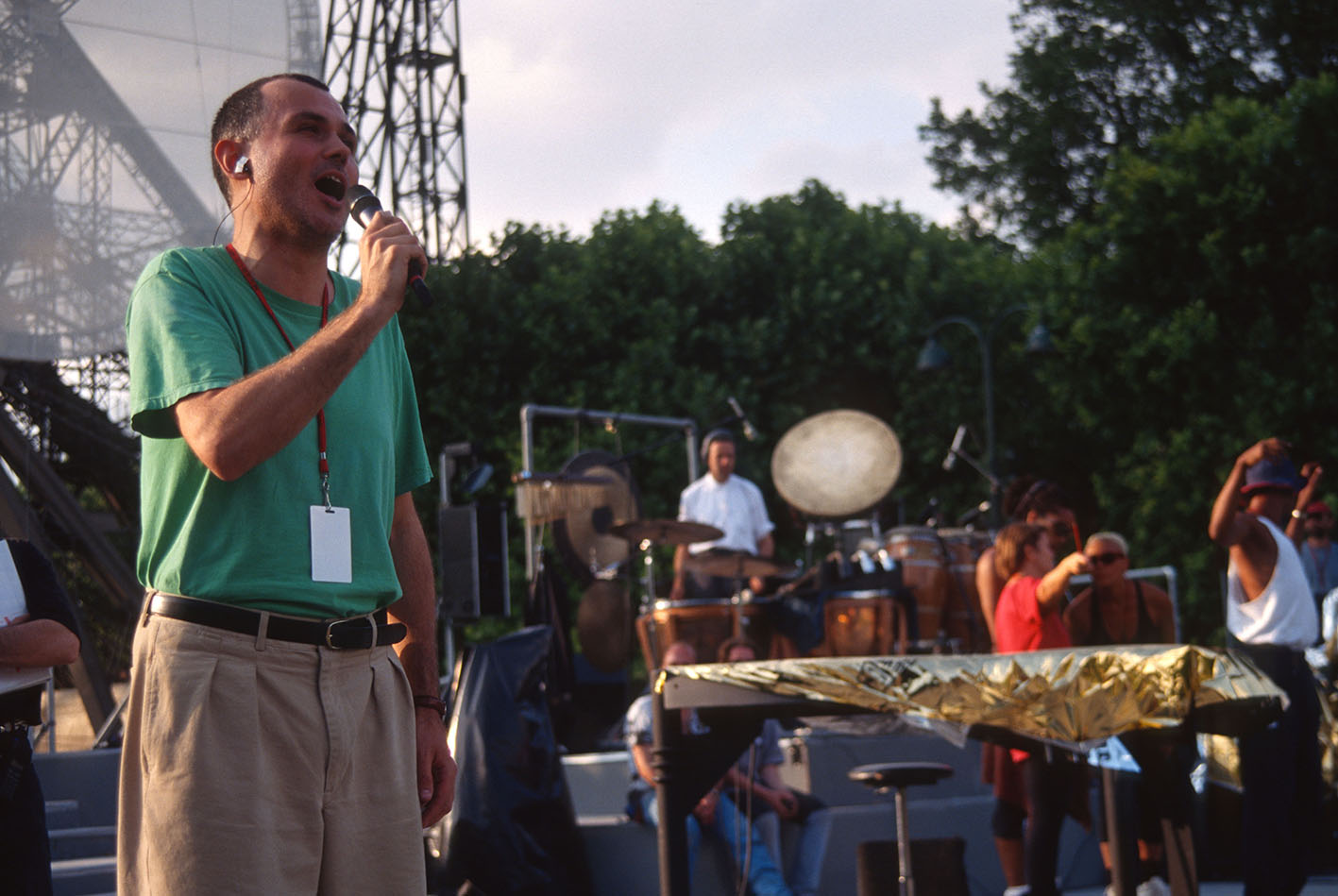
Joined by an amazing six-metre high opera diva, described by Jean-Michel Jarre as a ‘militant for tolerance’ and inspired by the Australian hit film Priscilla, Queen of the Desert, Richard Cross had the unenviable task of singing the live vocals on Chronologie 3. Preceding Khaled with a live rehearsal during broad-daylight, Richard was keen to watch the rest of the rehearsals, standing on the walkway off the stage.
Whilst he was waiting to rehearse, we took the opportunity to ask him about his performance and how he got to work on the concert.
On his career background
“The first big thing that I did was to work with the Eurythmics. At the time, I was playing in the opera and I met Annie Lennox who asked me to become her singing coach. I have been teaching singing for the last ten years and I’ve become involved with coaching a large number of musicians. That’s how Jean-Michel got to hear of me.”
On Julie Lecrenais' version of Chronologie 3 during Europe in Concert and his unique interpretation
“I’ve met Julie and of course, the sound is different, but that’s the whole idea - to be different from the original. This version will only ever be a unique live one.”
“I love it. I enjoy all styles of music. Recently I was participating in a jazz fusion concert and now this. Jean-Michel has based this concert around unusual things to shock the fans and to be out of the ordinary. Having myself as a singer, the two people painting each other. It’s the coexistence of differences that he is trying to illustrate.
“The amazing thing is how quickly everything has come together. Jean-Michel only asked me to perform ten days ago and now we have got everything ready for the performance in that short time.”
12/Interview
Renaud Letang
Live sound mix
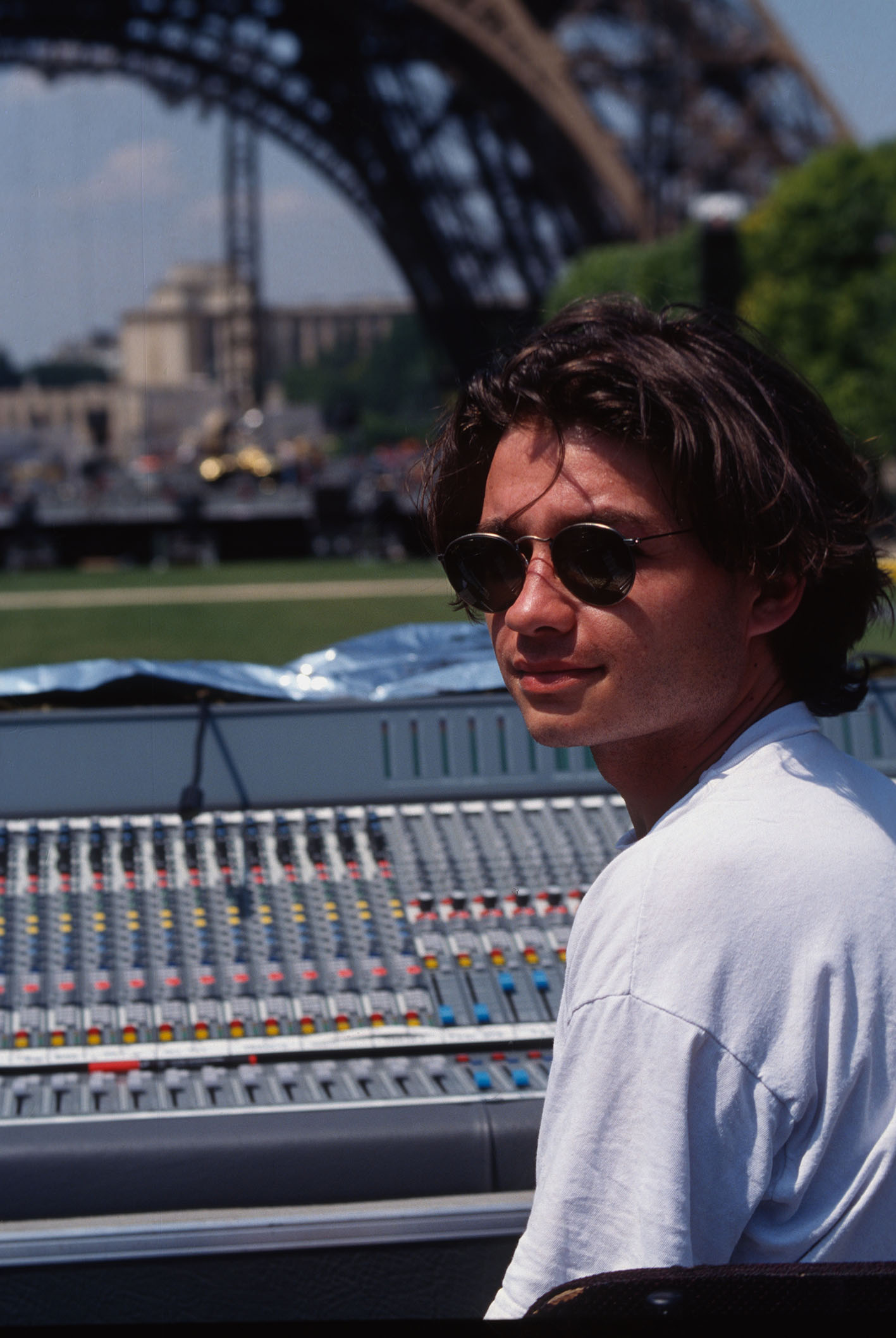
Being charge of the live sound mix for any concert is a difficult task but when you are surrounded by an audience of 1.2 million, the task becomes slightly more nerve racking. We spoke to Renaud Letang regarding the set-up.
The sound mix desk was positioned precisely in the middle of the Champ de Mars, about 150 metres from the front of the stage, and it also housed the control desk for the projections and other lighting effects. From there Renaud Letang had direct contact with the vast majority of the crew and could listen to the output from the first few banks of speakers that lined the Champ de Mars.
We spoke with Renaud during a gap between sound rehearsals the day before the concert.
On how he met JMJ
“In the studio. I met him in the Guillaume Tell studios in Paris when working on the album version of Calypso. I was an assistant at the time, then I progressed to recording the live material from the La Défense concert and then I did the Europe in Concert tour.“
On the location
“Well, the big problem as far as we are concerned on the mixing desk is that the concert site is so long and so thin. That means that we have to have a lot of sound towers down the Champ de Mars.
“It also means that we have to add an artificial delay between the speakers as the sound from the font of the stage takes two and a half seconds to reach the end of the gardens.”
On who he is in communication with during the concert itself
“Everybody. We have a bank of small speakers along the mixing desk where we hear the messages from all sorts of people. That is an amazing amount of communication all of the time.
“The stage, the lighting crew, the laser crew, even the Patrouille de France aerobatics team come through our intercom system. It’s not easy to hear them all during the concert but we have to manage somehow. “
On the rehearsals
“They have been going fine. Our biggest problem is that we have to turn the sound volume right down at 8pm, so that does not give us much time to get the balance right. Getting a live event to sound right to the crowd involves a lot of fiddling to tune the mix to the location. Yesterday I only got an hour and a half to do this, and today I’m not going to get any more. That’s no time at all to get everything ready.”
On the live television broadcast mix
“That is an entirely separate mix. The television crews have a lorry next to the stage which performs that function. Everything for television transmission is recorded in there. We keep everything separate because we are involved in two different jobs. The television mix has to be optimised for small audio systems, whilst the balance here on the huge live sound system would sound awful if we used that mix. The output is about 150 kilowatts, I think.
“A third mixing desk is actually on stage with a different balance for the musicians themselves on stage. They need a different mix again in order that they can hear their own output, and the music being played by the others alongside them.”
On the Jarremix album, released just before the concert
“Yes, I worked on Jarremix, and Chronologie, Calypso. The remixes have been planned for quite a time. Various people in England and France have been working on the versions but the album was released to coincide with this concert.“
13/Interview
Marc Jaumot
Fireworks
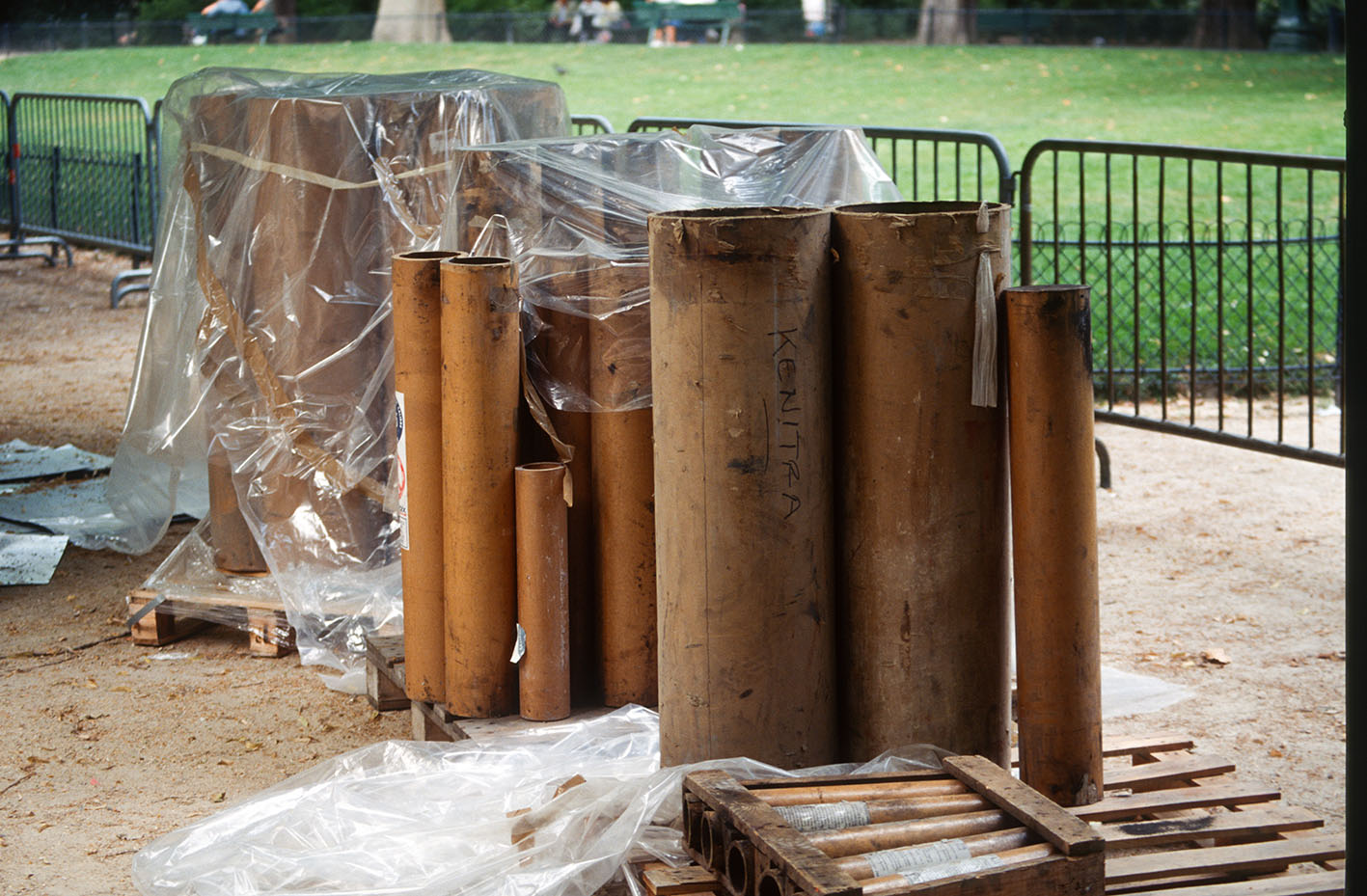
Since Europe in Concert, Jean-Michel Jarre has been experimenting with a type of pyrotechnic that he had not used before - namely on-stage fireworks. We spoke with Marc Jaumot from the company Lacroix who was responsible for all the fireworks during the Concert for Tolerance show.
In fifteen years, the number of fireworks in France has doubled - 20,000 displays every year, from large metropolis to the smallest villages, from Bastille Day commemorations to great sports and musical events. Fireworks have also become one of the favourite accessory for numerous artists such as Jean-Michel Jarre, Pink Floyd, Prince and the Rolling Stones.
Lacroix, a 100% French company are market leaders in pyrotechnics and are famous for the fireworks used for the French Revolution Bicentenary celebrations with J.P Goude, as well as the Albertville Olympic Games with P.Decouffle and the Eurotunnel inauguration.
Getting to speak to Marc Jaumont was a feat in itself. The production area where the majority of the pyrotechnics were stored was under tighter security than the stage itself and our passes were scrutinised long and hard before we were let in.
However, after finishing an interview with Europe 1, Marc was happy to talk about his work with Jean-Michel Jarre, even though the small matter of completing the preparation for the following day’s spectacular was not yet finished.
With all the on stage fireworks, it is interesting to see how Jean-Michel Jarre, being the person who spends most of his time at the front of the stage, knows where to stand to avoid the fountains of light that erupt from the floor. Clearly some precise timings are involved here.
On synchronising the fireworks with the music of the concert
“The fireworks which are far away from the stage are simply fired manually by listening to the music from during the concert itself.
“Those which are closer to the event itself are fired under the control of a computer program which in fact we are still working on now. MIDI signals and other cues are interpreted by a computer program which is especially designed for the purpose.”
“The firework launches are positioned everywhere. On stage, on the Eiffel tower itself, further away down the Trocadéro and a few will be positioned on the lighting towers above the crowd.”
The pyrotechnics within the audience arena were seen little on the video but the effect was marvellous. A whole avenue of light erupted from many of the towers during many of the tracks, flames of red and yellow, giving the audience a feeling of being more than mere spectators.
On placing the fireworks in such diverse places and authorisations
“Having the City of Paris Authorities behind one does help a lot, but there are always a few people who are intent on kicking up a fuss.“
On working with JMJ
“Personally, I have been working with him for four years. Before, one of my friends, Daniel Azancot who used to work for us was in charge of Jean-Michel’s work. However, Daniel’s specialist knowledge is in large firework effects to be seen from a distance. This meant that he was not really interested in the on-stage effects which have become part of Jean-Michel’s shows of late. It is very hard for two people to work together on one concert, so in the end I took over Jean-Michel’s work because I was interested in both types of pyrotechnic work.”
On the statistics of the fireworks on the night
“That’s not something which we are interested in. Those who involve themselves in traditional firework displays calculate those sorts of statistics. We try to create far more subtle effects which mere figures do not do justice to. The overall visual effect is what we are interested in.”
On whether he's ready for the show
“We have not had enough time to finish our computer programs. It’s going to be a rush.”
14/Interview
Trinimas
Marionettes
Not since Paris La Défense has Jean-Michel Jarre been joined on stage by marionettes. They made a spectacular return in Paris under the Eiffel Tower.
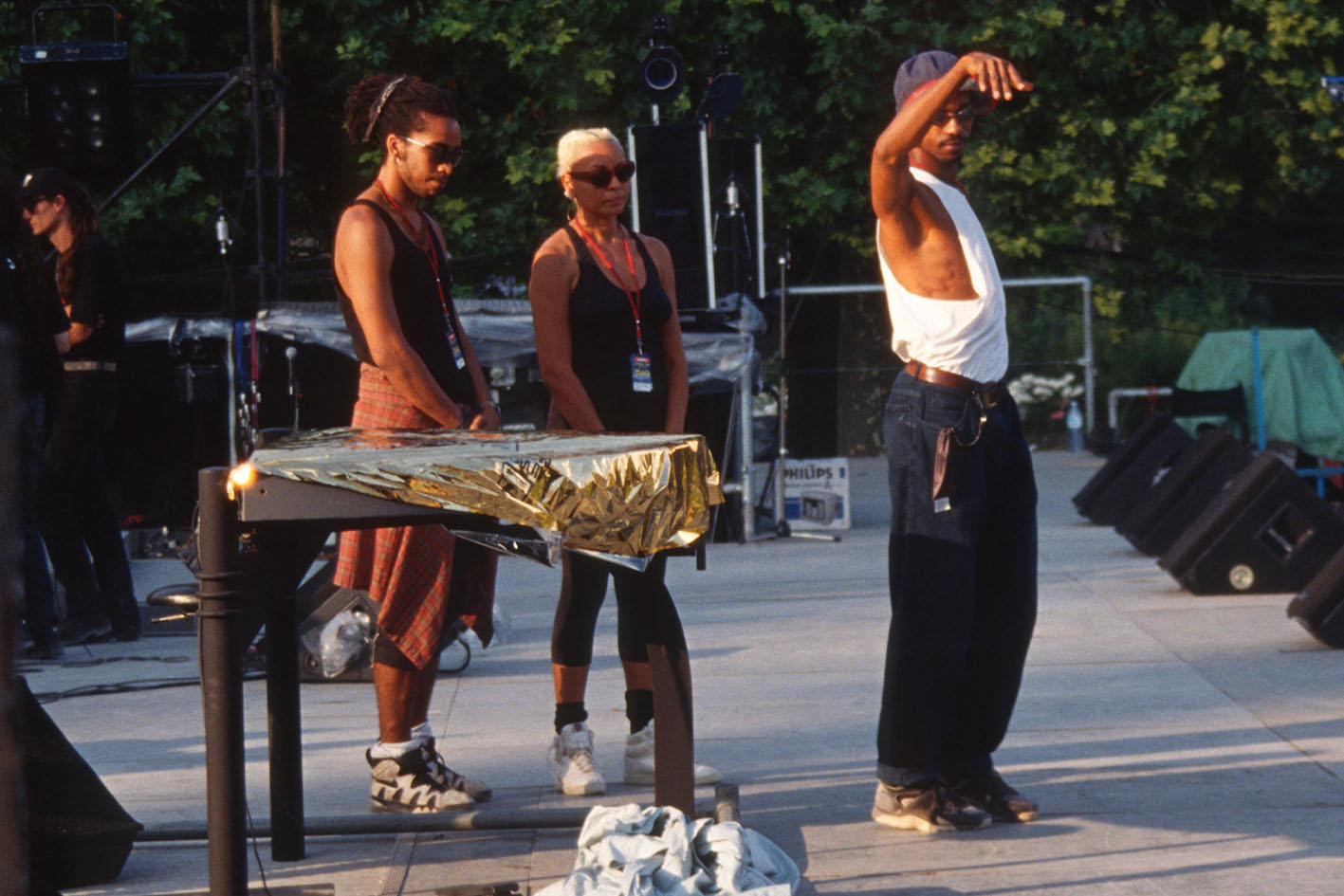
We spoke with Earl Thompson, Robert Michael Guy-James and Mica Marsh, all involved with the design and performance of the marionettes. They all work for Peter Minshall, as they explained and in total there were eight puppets used for the show and as we spoke, the very simplistic marionettes that had been designed especially for the concert, representing the three symbols of tolerance, were on stage for the first time.
On Trinimas AND THE MARIONETTES
“We are based in Trinidad and Peter Minshall is the designer. Usually he is a carnival band designer but of course, because of the type of costumes he designs, he gets a lot of international work.
“This is the second concert Peter has made with Jean-Michel Jarre, previously Paris La Défense. The team changes but it is basically the same spirit.”
On the new puppets designed representing the tolerance symbols
“That’s it, that is the end of it. They will just be under special lighting. This is the most simple one we’ve done but it is going to be extremely effective, This is the theme, it is more or less the feeling he got from the music and that is what he thought of. Tolerance is simple. They are more or less static but maybe inter-changing position, although very slow.”
The other marionettes were kept tightly underwraps, giving everyone a big surprise for the full dress rehearsal the next day. They were certainly one of the highlights of the show, appearing during the Africanised Eldorado and remaining on-stage during Calypso and Rendezvous 4.
15/Feature
The After-Party
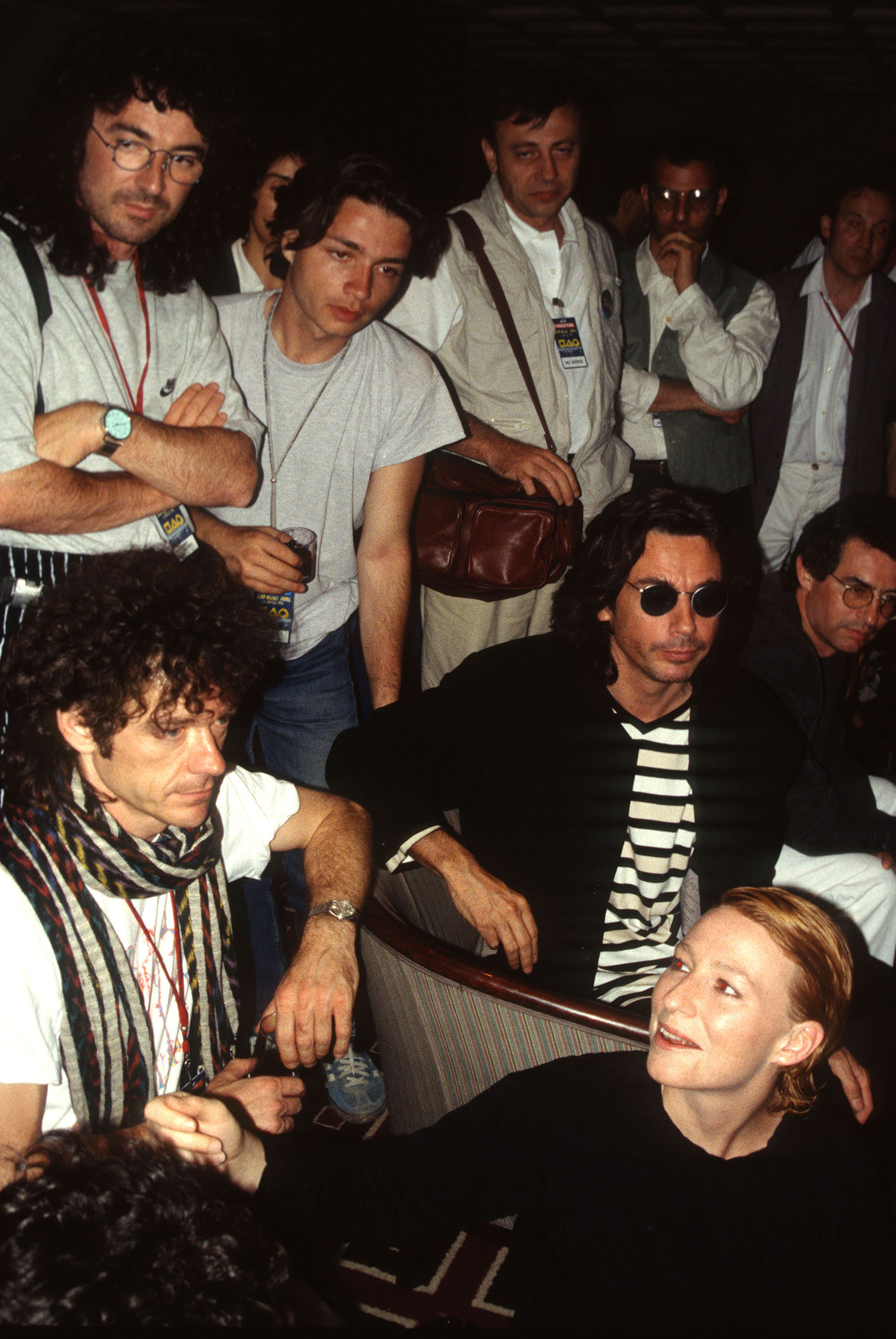
The time - midnight, 14th July 1995. The place - the Paris Hilton Hotel. The occasion? A party hosted by Jean-Michel Jarre to celebrate his Concert for Tolerance. Armed with our invitations, we enter the, appropriately named, Eiffel Suite.
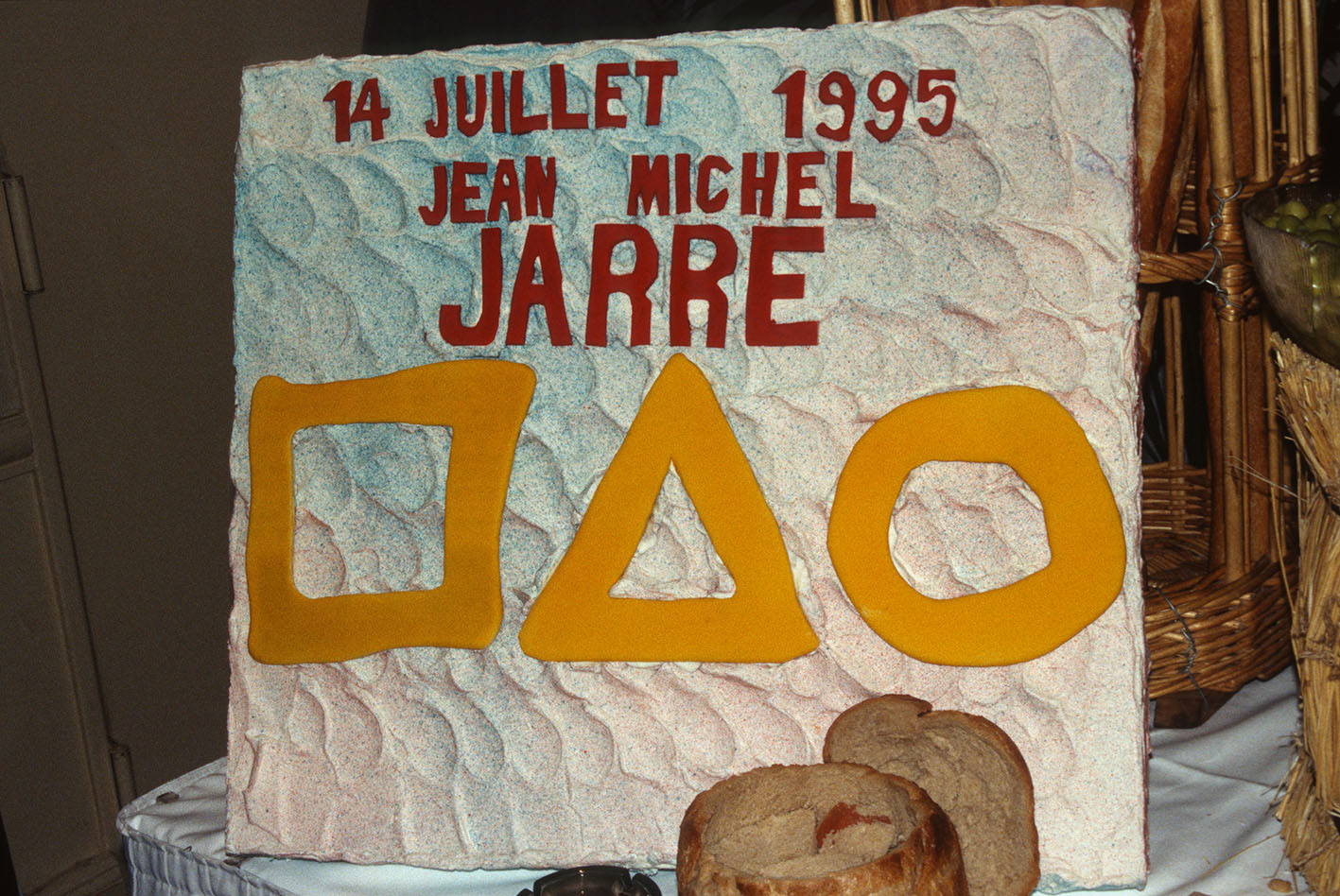
With the champagne flowing, an impressive buffet of cheeses, pastries and exotic fruit and a large cake decorated with the Tolerance logo, we joined the group around the television to marvel at the film recording of the concert.
Soon after, Jean-Michel Jarre and his entourage arrived and he was overwhelmed by people wanting to congratulate him, photograph him and generally ask him how he felt about the show. The musicians filtered in slowly, teasing each other about the way they looked on film, Patrick Rondat was overjoyed with how Vivaldi how gone (“I felt that it was almost perfect”).
The film finished and was promptly rewound so everyone could watch from the start, including Mike Mansfield who had just arrived to view his handiwork. Jean-Michel joined Charlotte on sofa, Khaled mimicked Jean-Michel playing his laser harp, the shy Dominique Perrier appeared on screen to everyone’s delight. The film was compulsory viewing, so much so that when Jean-Michel‘s assistant, Fiona, tried to leave for a moment, Jean-Michel refused by gently placing his hand on top of her head.
The party started thinning after the end of the second showing, lingering on the mass of confetti blowing around the stage, as it was after 4am by this time. Finishing at around 5.30am, Jean-Michel left to contemplate his success and look forward to the signing session later on the same day. No wonder he was tired.
16/Feature
The Fans - Signing session
They had been gathering since 10 o’clock the morning after the concert to meet Jean-Michel Jarre at FNAC’s Forum des Halles store. There were fans from around the world; Britain, Holland, France, Belgium, Switzerland, Denmark, Italy, Australia and even the ex-Yugoslavia were represented.
The FNAC organisers were becoming worried about the number of people who had turned up, but they were to be reassured that Jean-Michel would stay until every signature had been made.
“It’s a record”, explained one of the store stewards, “almost six hundred people ! Normally, musicians stay for about half an hour, whether there is anyone to see them or not. He’s been here nearly two hours and he’s still signing.”
Jean-Michel stayed for about two hours during which time he shook innumerable hands, admired the collections of memorabilia brought along, such as a copy of La Cage, whilst keeping an eye on images of the previous night’s concert projected on a nearby screen.
Despite the tiredness built up over the past few days, it has been an amazing personal success for him. The fans waited, Jean-Michel Jarre shook hands, signed albums and met every single one of them. It was the moment hundreds of fans had waited for.
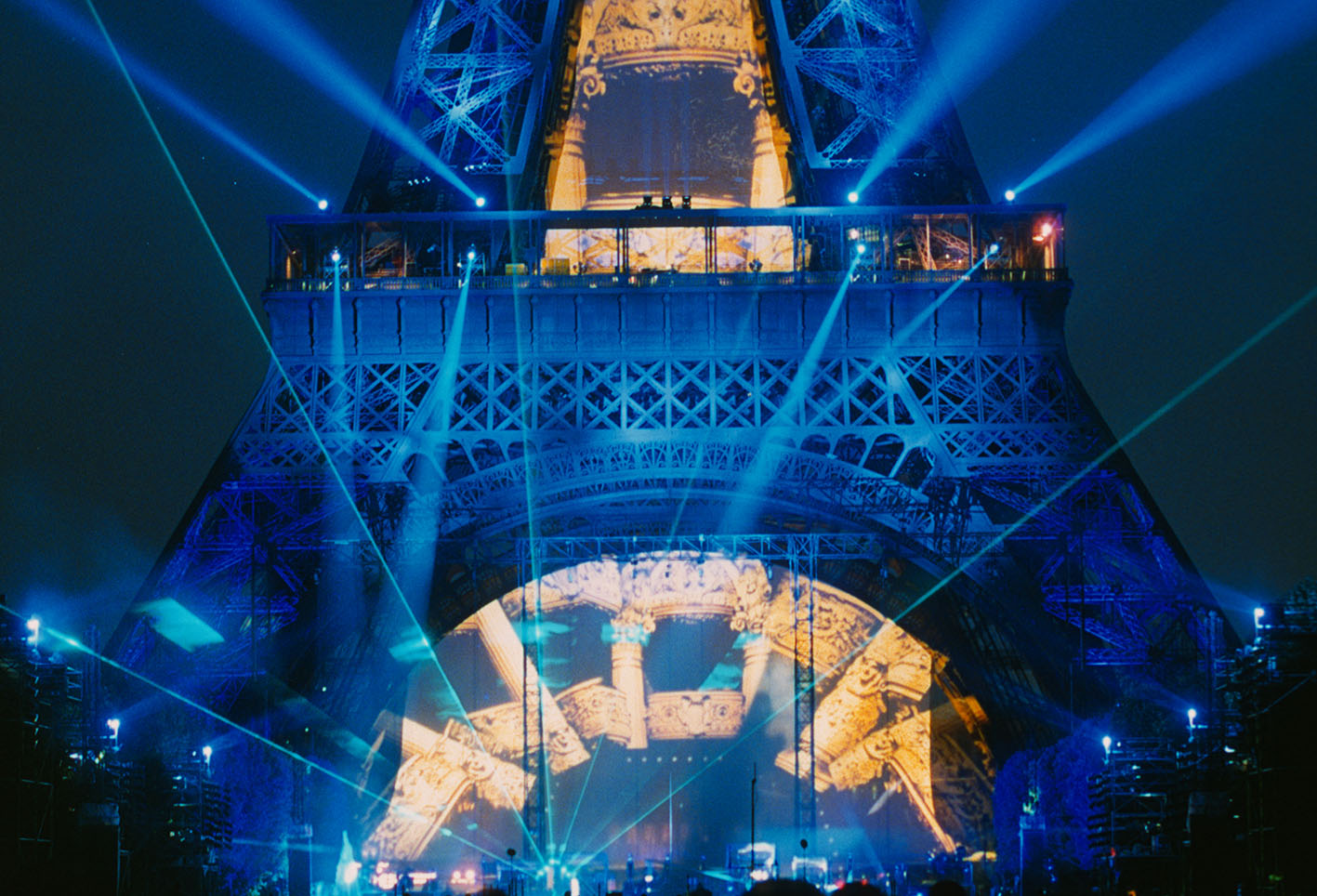
17/Feature
UNESCO's Year for Tolerance
The year of 1995 was decreed as the Year for Tolerance upon the initiative of UNESCO, on the grounds that tolerance is an essential factor for world peace.
It was on Bastille Day 1995 that the first Concert for Tolerance took place, in Paris at the foot of the Eiffel Tower, with a further four concerts planned at equally symbolic sites around the World. Jean-Michel Jarre’s aim was to bring together as many people as possible to celebrate tolerance and difference in a dynamic way.
The United Nations General Assembly made this decision in 1993 upon a UNESCO initiative and in the light of the resurgence of :
Ethno-nationalist conflicts;
Discrimination against minority groups;
Acts of xenophobia, particularly against refugees and asylum-seekers, migrant workers and immigrants;
Racist organisations and ideologies, and acts of racial violence;
Religious extremism;
Acts of violence and intimidation committed against writers, intellectuals, and other individuals exercising their freedom of opinion and expression;
Intolerance fostered by political movements or ideologies, on the grounds that social ills such as crime, unemployment, deterioration in public health, and urban stress should be attributed to specific groups in society;
Intolerance expressed through marginalization and exclusion from society of vulnerable groups, or violence and discrimination against them.
Intolerance is one of the greatest challenges confronting us on the eve of the twenty-first century. Intolerance is both an ethical and political issue. It is the rejection of differences among individuals and cultures. When intolerance becomes collective or institutionalized, it erodes democratic principles and poses a threat to world peace.
UNESCO has always stood for diversity. UNESCO believes that diversity enriches our world and is an engine for progress. Differences among cultures and individuals can lead to disagreements and even disputes. These are a healthy consequence of puralism and democracy. However, UNESCO condemn the use of violence as a means of resolving disputes or enforcing views on others.
It is a fact that in most societies today, many different religions, cultures and lifestyles exist. It is essential to recall that the basic human values that unite us are stronger than the forces that pull us apart. UNESCO’s message is simple : “United, Yes. Uniform, No”.
UNESCO are entering 1995, the Year for Tolerance, convinced that the absence of armed conflicts among States is not the sole guarantee of world peace; and that, fifty years after UNESCO’s Constitution was drafted, it is still “in the minds of men that the defences of peace must be constructed.”
Tolerance is one of those defences of peace. It’s a fact that most people consider themselves tolerant until challenged to their “tolerance threshold”: the one nationality group, mode of behaviour, that they simply cannot tolerate. We need to think more about tolerance because intolerance is on the increase and because extreme intolerance kills.
It kills in our societies through violent attacks on individuals and violent incidents between gangs or clans. Intolerance kills on a wider scale when it becomes institutionalized, for example, as genocide. It kills on a massive scale when the general public’s tolerance threshold is identified and exploited to fulfil the political and territorial ambitions of an individual or group of individuals.
But why is tolerance important now ? One reason is the need for new tools to deal with a new category of threats to peace and we need a new sense of individual responsibility in the building of peace.
On the one hand, new threats are posed to international security after the breakdown of the political order in place since the end of World War II. On the other hand economic, social and political crises within national borders have been the breeding grounds of discontent.
These are potential areas of conflict. Exploiting people’s intolerance in this time of confusion proves a very effective tool in getting them to fight.
Many countries are now facing tensions between different groups. These are the result of years of oppression and tyranny. A new sense of freedom, combined with a sense of loss of a fixed, if unpleasant, order of things, has left people , little used to democracy, uncertain of how to express their new freedom.
Ethnic, cultural, religious and social conflicts are on the increase, and becoming more widespread. Under these conditions, States may well disintegrate and further increase the threat of wars. The world of anarchy and the daunting prospect of an upsurge in local and regional conflicts, opposing hundreds of different entities, is born out of the disintegration of nation-states.
UNESCO, as lead Organisation for the United Nations Year of Tolerance aims to :
Take a closer look at the root causes of intolerance
Mobilise public opinion in favour of tolerance and inform people about the dangers associated with the current increase in intolerance.
Develop practical guidelines for governments, teachers, social scientists and public institutions in order to enable them to resolve problems of intolerance.
UNESCO’s strategy is to inform, legislate and above all, educate for tolerance.
This piece is about
