
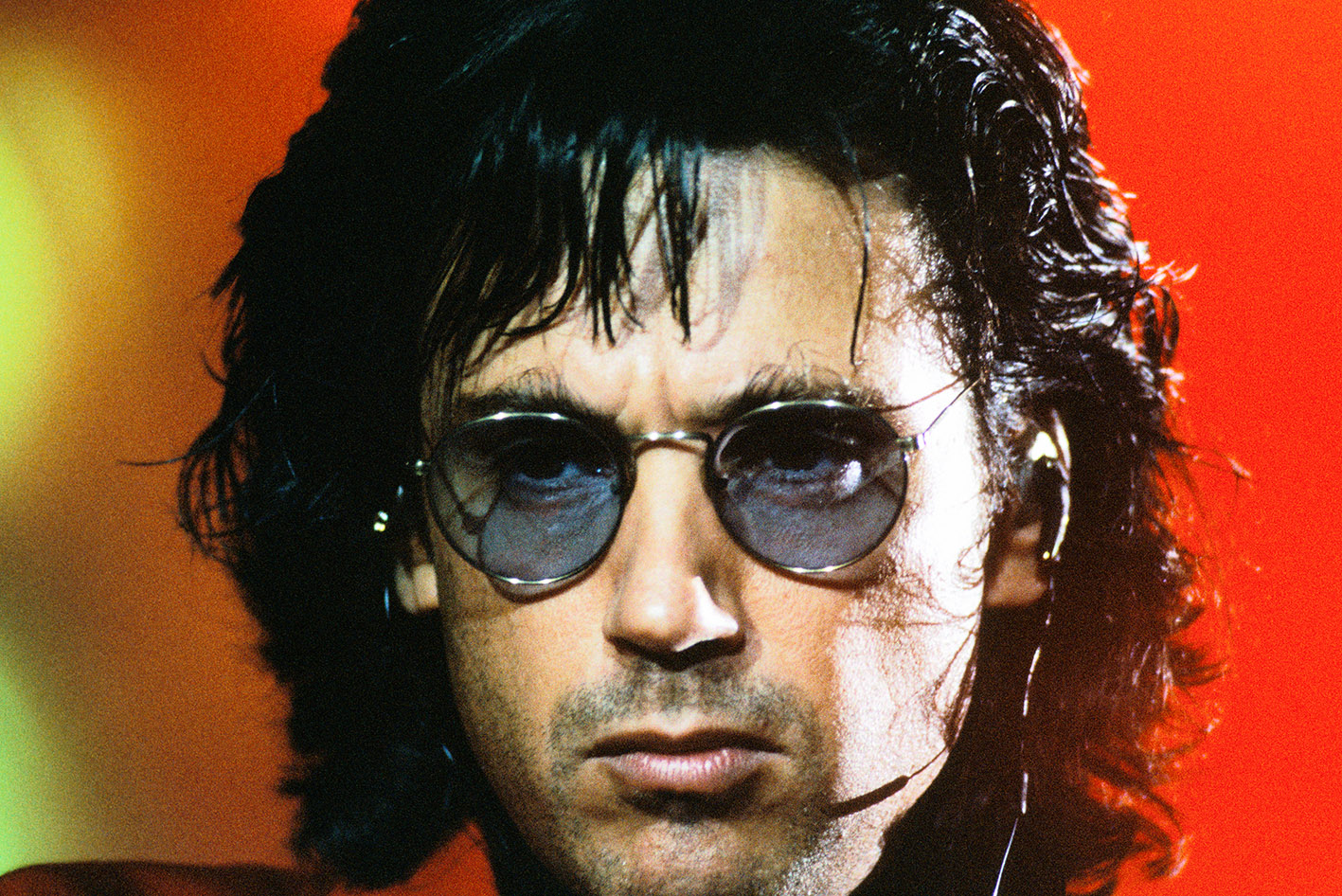
Access All Areas / Words Mark Gidley
Hong Kong 1994
A live double-album of Jean Michel Jarre's historic performance in Hong Kong in 1994
01/Feature
Hong Kong in Concert
Back in 1981, Jean-Michel Jarre caused a mini-sensation by performing concerts behind the closed walls of China. Jarre was the first international artist to perform in Beijing and Shanghai after the Cultural Revolution and the Concerts in China tour represented Jarre’s desire to involve himself with the Chinese culture.
On a near-identical stage to that used for Europe in Concert last year, Jarre performed in the Far East for the first time in 13 years, on March 11th 1994, in the new Hong Kong Stadium. In order to ensure that the show could go on in Hong Kong, Jarre agreed to perform for free. A couple of days before the show, he explained his motives.
“It is no secret that I really wanted to do this. I see the stadium as an opportunity to give a different image of Hong Kong to the world. It is known as a business centre, and this is a chance to build a bridge to culture. It’s my personal interest.
“I was looking for the opportunity to develop my friendship with the Chinese community on a personal basis. I hope this will lead to me being able to come back in 1997 and do something else.
"That would be fantastic - the chance to perform in the middle of something finishing and something starting, a mixture of East and West.”
Photographs by Arnaud de Wildenberg
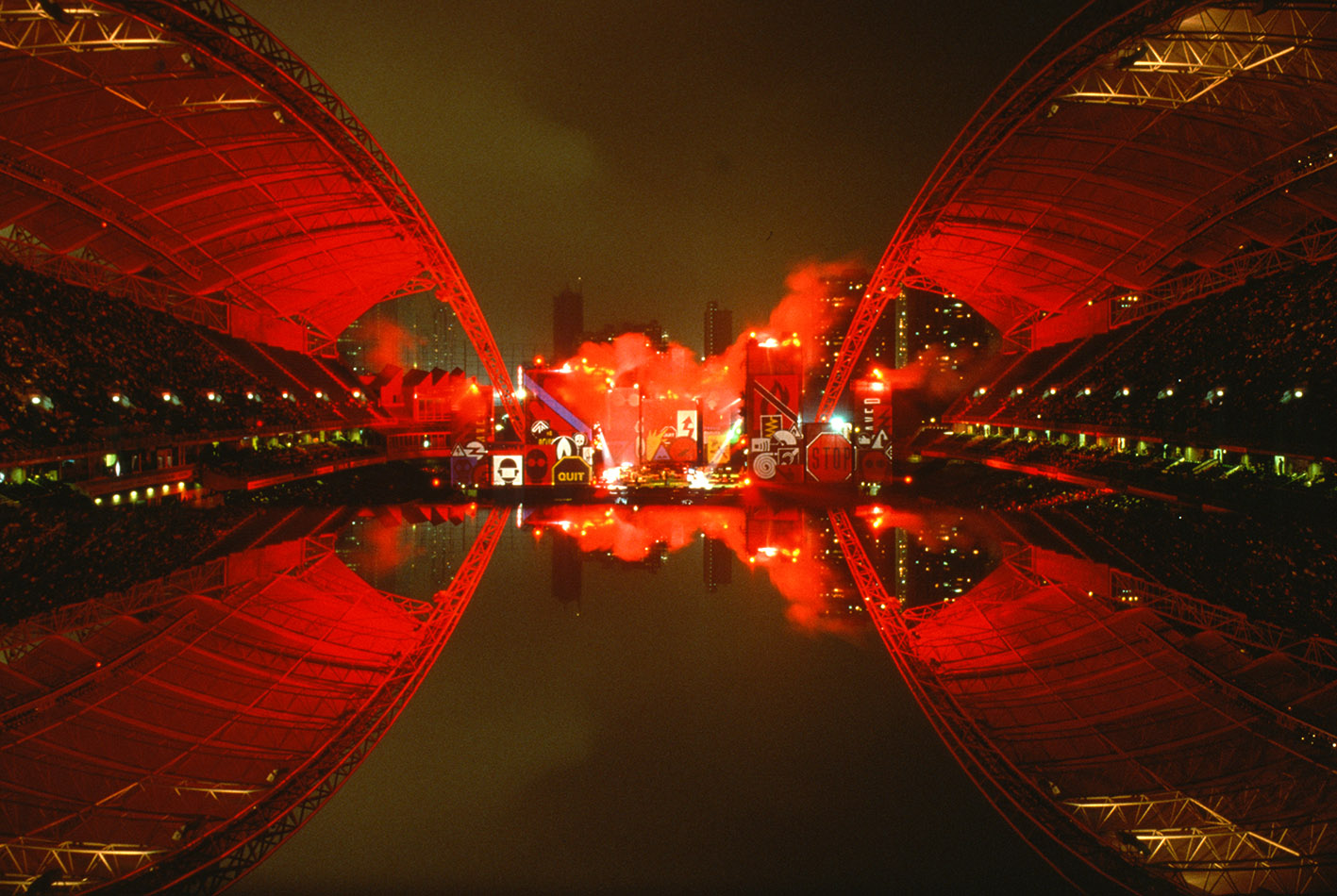
The Opening was a sell-out, with all 40,000 tickets being sold in just two days, such was the interest in Jean-Michel Jarre’s concert.
The show had a definite Eastern feel, with a completely re-arranged version of Fishing Junks at Sunset which lasted almost 12 minutes. It featured a traditional Chinese orchestra and an amazing Chinese dragon. Also new to the show was a beautiful version of Souvenir of China, where Jean-Michel was accompanied by Dominique Perrier for a stunning solo.
Jean-Michel Jarre, sporting a dazzling new black and white striped jacket, performed with a new musician; Michel Vally replacing Guy Delacroix on bass, and sadly, due to other commitments, Michel Geiss also couldn’t assist with the show.
The show had some big differences and some subtle differences from those shows seen last year for Europe in Concert.
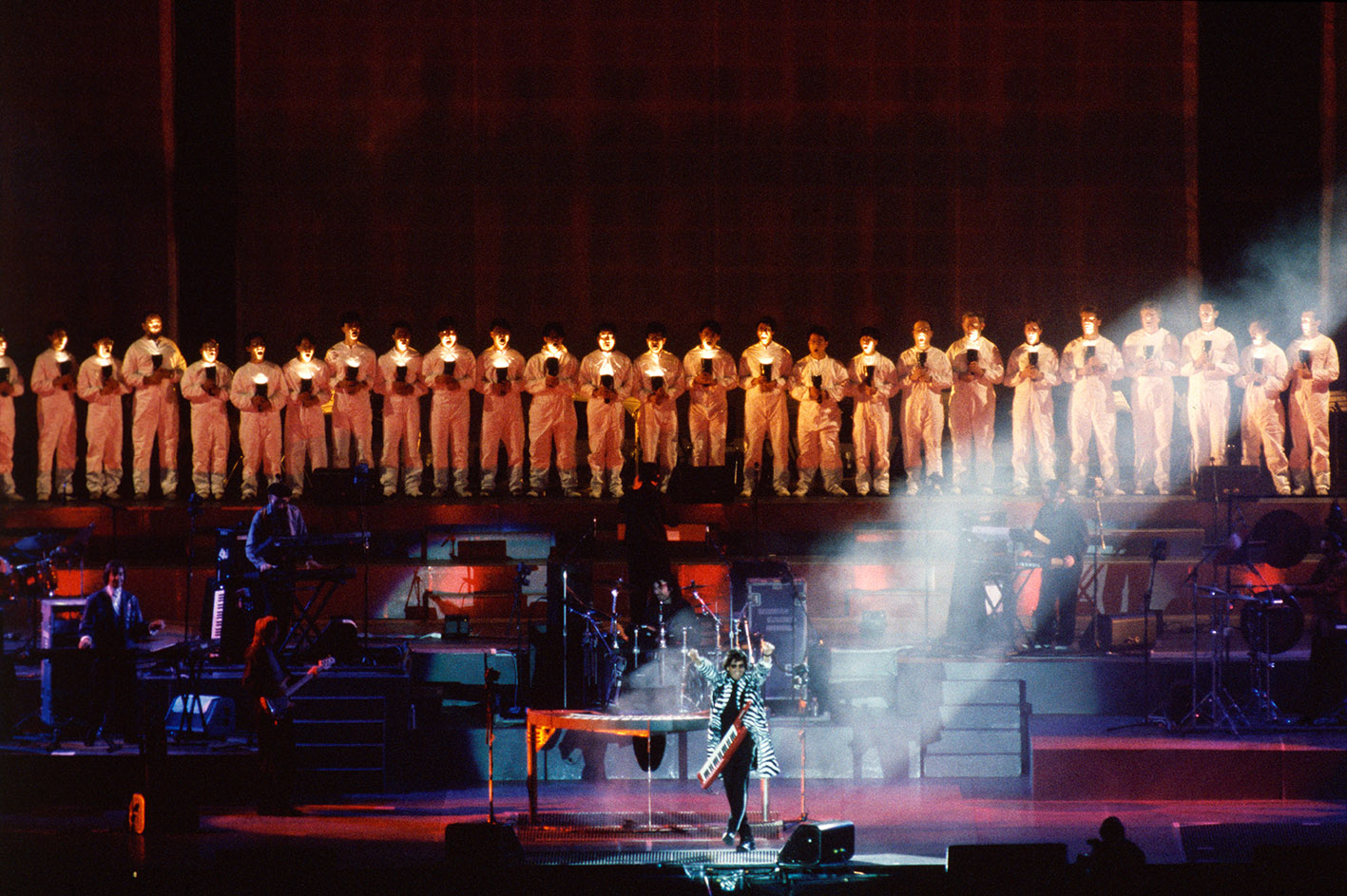
One of the main differences was the start to the evening. With the throbbing heartbeat introducing the performance to the seated crowd, instead of his usual inconspicuous entrance in heavy overcoat to the introductory notes of Chronologie I, Jarre walked to centre stage from the back and took his place behind the familiar semi-circular Lag keyboard. The keyboard lit up brightly as Jarre played the now anthem-like track of Chronologie II, partly thanks to new keys after one was broken at the final concert in 1993 in Tours.
However, gone were the dinosaurs and many of the laser images that accompanied the track in Europe, replaced by the furious sequence of projections 5, ON, 4, IN, 3, OFF, 2, OFF, 1, UP projected as a back image.
Red swirls of light filled the screens as the local Hong Kong 100-strong choir filed onto the back of the stage. Ending in a triumphant crescendo of the choir and Rondat's solo, it was a tremendous start to the extravaganza.
With the applause still ringing around the stadium, Jarre greeted the crowd with the words, “Good evening Hong Kong. I am very happy to be here this evening for the opening of this magnificent Hong Kong Stadium. I haven't performed in Asia for quite a few years and I'm happy to be back in Asia, sharing the evening with the Chinese community and all of you. Thankyou.”
Finishing with 'Thankyou' in Chinese, the Voice of Time continued the spectacle, this time under a different guise but still with the same words of wisdom. Equinoxe IV followed with the shrill cries from Rondat's guitar and the familiar lunar landscapes as a setting.
The first surprise of the evening followed, with Jarre describing it as the track he composed “after my first trip to China and has been inspired by the first impressions I've got from the Chinese community” - the beautiful and unforgettable Souvenir of China.
Similar to the performance in Lyon, Jarre played the track sitting down with the Roland keyboard resting upon his legs. The infamous Nikon camera clicks reverberated around the stadium as the screens filled with a deep red glow and Chinese emblems and masks were emblazened on top in a striking white and orange. Guy Delacroix was sadly missed here but Dominique Perrier made up for it with his solo performance. A track that you never ever get tired of.
The Voice of Time returns with the screens now a glorious purple, again with the same 'Where are you going', accompanied by the clock movements and chimes. This was Chronologie IV. Laser images dancing, running, jumping, somersaulting and leaping around the screens. Lasers play into the crowd and Jarre encourages the local Hong Kong crowd to clap along with the familiar images being projecting onto the screens. The finale ends with Jarre playing the final lingering note from his portable keyboard above his head.
Oxygene IV follows with now a solitary figure watching over Jarre as he plays the track from the analogue keyboards and his portable.
Chronologie VI follows with the humidity in the air very clear now as the lights search out into the stadium. The humidity in Hong Kong is famous but it has to be experienced to be believed. The keyboards had to be kept covered in plastic sacks (Docklands all over again) during rehearsals and onlookers saw Jarre playing the Lag from underneath the plastic !
With the choir torch-lit and the Sex-No Sex images scrolling slowly around the screens, Jarre appears with the familiar bright red accordion, tapping the beat with his feet. This is a part he clearly enjoys and was certainly one of the highlights of the show, both musically and visually.
The infamous Laser Harp, now designed by a new company, literally unfolds in front of Jarre for Chronologie III, a distinct bright green colour. Striking it with his usual vigour, Jarre precedes the hugely talented vocals of Julie Lecrenais. The familiar plush red curtains are pulled aside to reveal the morphing sequence between ape to man, to owl, to man again. To close, the beam folds back up again and disappears under the stage - a very nice effect indeed.
Magnetic Fields II followed with a very nice new introduction before the main piece - although maybe the one used for Europe in Concert was preferable. Jarre, again using the Roland portable, is almost obliterated by the dry ice effect but the crowd is probably concentrating on the laser beams that are flying out from the stage into the stadium, forever changing direction and position. With Jarre running across the stage with great haste to join him, Dominique Perrier solo's the finale with the screens flashing white, black, white, black, revealing the frightening array of scaffolding behind.
With multitudes of roman candles shooting from everywhere possible on stage, Chronologie VIII premiers in Hong Kong. Less laser images this time but Mahut is ever present and Jarre encourages the crowd with his enthusiastic clapping. The Chinese theme enters at the end with masks and pagodas rising from (seemingly) beneath stage as Jarre waves to all corners of the stadium on the walkways.
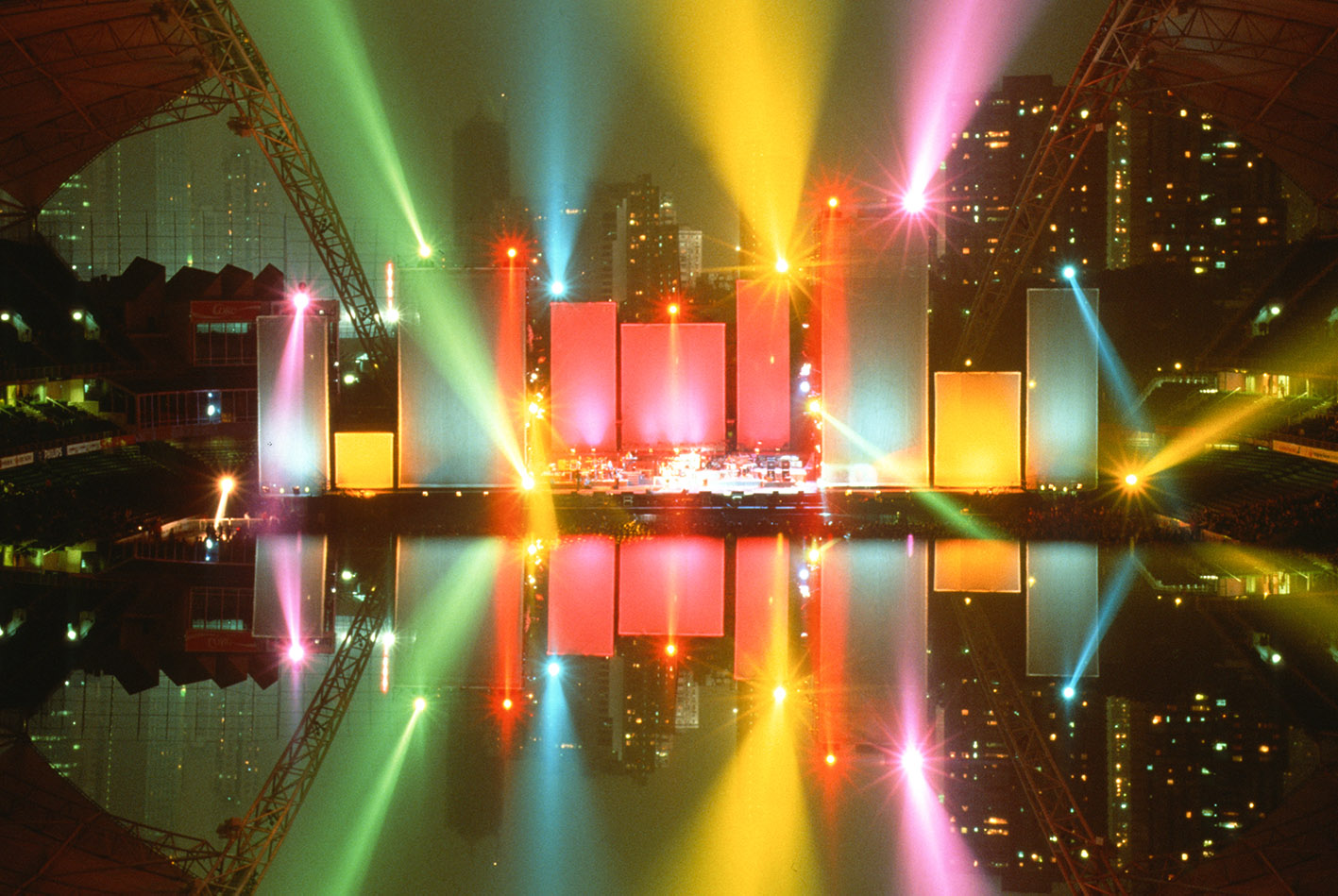
The Supermarket of the Century followed as usual (strawberries, strawberries, strawberries) and the Digisequencer kicks in with Jarre illuminated from above. Rondat, seated, joins in with his delicate guitar rifts and all seemed well until the Digisequencer stopped suddenly mid-track. A remarkable recovery is made by Rondat in what seemed less than a second until Jarre manages to start it up again. As in Barcelona where Jarre invited Spanish flamenco, for Hong Kong he invited a local Chinese percussionist with traditional Chinese instruments to join the track, just left of centre stage.
With smoke pouring from the top of the screens and fireworks cracking above stage, the track finally reached a finale with Jarre playing the baroque organ.Whether Jarre would continue to use the Barbarian Organ after the problems with it in Europe were answered when the simplistic notes of Band in the Rain echoed around the vast stadium. Still with it's distinct umbrella but lacking the rain and wind effects, the track captivated the crowd and these cheered with joy when the waterfall effect of fireworks melted down over the stage.
One of the most anticipated pieces was the newly re-arranged Fishing Junks at Sunset which Jarre had enthused about to reporters the previous day. Together with local musicians and local instruments, this was a complex re-arrangement and will perhaps make the Hong Kong live CD that extra bit special. Since this track has never been played live anywhere but the Far East, it was remarkable to hear it being live once again, especially in the vast setting of a stadium.
It was an especially remarkable performance after the rehearsals the night before were stopped short because the local Hong Kong authorities decided it was necessary to cut the power at 11pm. Jarre was informed by producer Jean-Claude Camus and called out to the crew 'We have a big problem, the power is cut at 11pm and so we have to play Fishing Junks with the Chinese orchestra now. Unfortunately we can only play it once.'
For the actual performance, Jarre accompanied on the semi-circular Lag and the other French musicians added futuristic touches to it, but the ever-present Chinese notes overpowered all to create a beautiful new rendition of the piece. Fishing Junks sailed across the screens as a wonderfully animated Chinese dragon entered the stage from the left, swirling to the centre stage and surrounding Jarre on the keyboard before leaving the other side.
In complete contrast, Rondat's guitar screeches echo around the stadium for the introduction to Rendezvous IV and finally the local audience were on their feet, really enjoying the track. With the familiar leap into the air, Jarre brings the track to an end with a huge applause from the crowd.
The encore of Rendezvous II was powerful as usual and one can never tire of hearing this track played live. To finish, with Jarre conducting the choir, ballerinas swayed with white handkerchief at the side of the stage to symbolise the theme of Peace.
Introducing the musicians before leaving stage, Jarre was destined to return for the encore of Chronologie IV, played with ever-present vigour and enthusiasm. It was initially intended for Jarre to walk through the crowd for this using his portable keyboard but the organisers refused after both the safety of Jarre and the audience was considered. A shame as it would have been reminiscent of Jarre's performance in China.
Reflecting on the show, Jarre commented, “It is very difficult to put a project like this on. On a personal level, artistically speaking ... I was pleased at the warmth of the response from the crowd.”
02/Interview
Jean Michel Jarre
As a celebration of the concerts in 1993 and 1994, a live album from the Hong Kong show was released, mixed by Michel Geiss. Jean Michel Jarre reflects on both the concert and the release of the live album.
Why were you interested in performing in Hong Kong and releasing an album from it ?
“I gave this concert to celebrate the opening of the new stadium in Hong Kong. The organisers had to choose between Michael Jackson and myself and I was chosen for historical reasons; I was the first Western musician to have been allowed to play in China and the Chinese public demanded more. For me, it was a unique chance to give another concert over there.
“In Hong Kong, you are on the front-line between high technology and basic Oriental values. It is really a unique meeting point, the mixture of the East and West and this comes across in my live album. Why a double album ? I wanted to give listeners an idea of the entire concert with it’s unique atmosphere rather than offering only short extracts from it. Also, the concert was my reunion with Asia, and I wanted it to be described in a full picture of sounds. As soon as you arrive in Asia, you are hit by the fact that the inhabitants see time in a totally different way to us. Shortening the album would have been difficult - they are willing to devote all the time needed for a project, so I had to offer that much time too.”
What do you feel when you arrive on stage in front of the enormous crowds ?
“I have both a feeling of elation and closeness to the audience. The people are there waiting and I want to take them by the hand and lead them into my universe, to tell them a story to get closer to them. You have to understand that the Chinese audience is more wild than ours - they make noise, move around and respond fantasically. It is a fantastic feeling which comes across well on the album. Looking back at it, I am always a bit nervous, but I don’t think of the possible break-downs and problems. If I thought about them, I’d never be able to appear live. I have only once had major problems and almost not been in a position to carry on with a concert. There are always so many things to attend to before a show, right up to the last moment, that I get stuck into the work and don’t think about anything else. For me, finally appearing on stage is a deliverance.
“The Hong Kong concert was particularly difficult, because even the night before the show the stage had not been finished. The rehearsals with the Chinese were difficult and complex with scheduling difficulties and the language barrier. However, everything went well ‘artisically’ at the end.”
What is the basic difference between this concert and those which you have given before ?
“Many things have changed. The sequences of Oxygene were totally recreated. Magnetic Fields and Equinoxe had new and totally improvised introductions to provide new sounds and transitions between tracks. Totally new mini-tracks were added, such as the Voice of Time, a laser voice which talks to the audience. The feeling of some of the tracks was totally different too, with Laurent Faucheux’s rhythmic parts and Mahu’s percussion with I adore. Mahu has a technique of perfectly integrating acoustic instruments with my sequences, giving an effect halfway between music and poetic noise. All of this helps me a lot on stage. Patrick Rondat, too, has managed to integrate his personal style of hard rock into my music by, for example, doubling my sequences in Chronologie 4 where we ‘answer’ each other non-stop.
“The organisers definitely wanted me to play Fishing Junks at Sunset, a piece which I composed for my 1981 concerts and which was a great success with Souvenir of China. I tried to play it in a different way by involving Chinese musicians with whom I would have a musical dialogue on stage. Despite its complexity, the recording of this piece gives a powerful impression of the emotions which were felt during the concert. It was a track where totally unexpected feelings were stirred both on stage and in the audience. It was one of those situations which occur naturally and which make a concert fantastic. One of these days, it is my aim to perform with a symphony orchestra; it is one of my musical aims.”
During Digisequencer, as in many other parts of the album, there are many improvisations. Is this a direction in which you want to go ?
“Yes. Digisequencer has not always been the name of the track. We also called it Russian Dragon but decided that we preferred the original name. This track is a dialogue between my synthesiser sequences and Patrick Rondat’s guitar. It is a totally new track and the stage version is completely improvised. Patrick has his basic riffs, and we answer each other’s music but it never ends up twice the same. To be able to improvise at any time with different sequences and patterns is the direction in which I want to go. I used the filters on the Minimoog and analogue synthesisers to create live effects.”
In Band in the Rain, we saw you with a street organ which surprised everyone.
“To my mind, the street organ was always the sequencer’s ancestor, a hand sequencer if you like ! I wanted to have a bit of fun and to swap from high technology to the basic instrument of the street. I feel that I am basically a street musician; that’s why I feel so much better playing outdoors rather than inside a standard concert hall. I have a lot in common with the circus people and travellers.”
I have the impression that this album represents the end of an era for you, and the beginning of a whole new musical direction.
“It is, in fact, more of a return to my roots. Now, I want to start on new ideas, particularly to develop the ability to modify sound effects live on stage. Today, technology has facilitated the creation of new sounds, but MIDI does not enable you to transform them in real time. With more direct interfaces and more user friendly instruments, I will be able to ‘work’ the sounds live.”
Do you prefer touring, as with Europe in Concert or one-off concerts such as Hong Kong ?
“I wanted to tour at least once in my life, just to experience it. Certainly, we had many difficulties, but we were well received across Europe in places more used to the traditional Anglo-Saxon style of concert. Now, I want to return to the concept of large concerts designed around a particular location, story, architecture and culture, rather than a series of events. I am more interested working on unique projects - this was the concept which I started and which I wish to continue developing. The Hong Kong concert was a first stage towards preparing my next projects with UNESCO.”
03/By the numbers
Hong Kong facts
- HK$11 million
- total cost of staging the show
- 120
- overseas crew members
- 300
- local crew members
- 7
- principal musicians
- 20-piece
- orchestra
- 100-member
- local choir
- 40,000 spectators
- sold out in two days
- 80 tonnes
- of freight
04/Interview
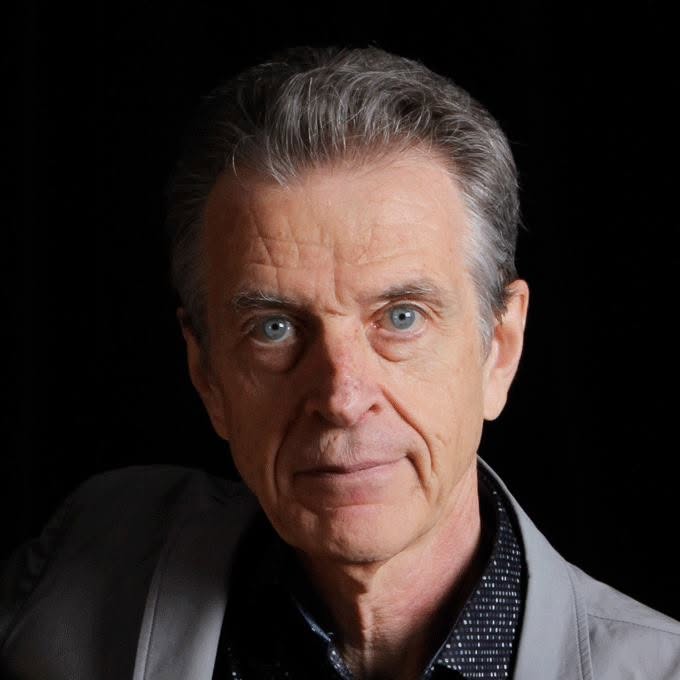
Michel Geiss
Live album producer
On the choice of tracks
The choice of tracks belongs to Jean-Michel Jarre. There are artistic or other reasons. For example, Rendezvous II has already been included on several live albums, so it will not be on the next one. Jean-Michel's choice also tries to reflect the mood of the concert, without feeling obliged to follow the playing order of the public performance.
On HOW this album differs from previous live albums
I think the album is a very good one and different from the past ones, because of the use of the guitar with Patrick Rondat. I do like the sound of it, which is a mix between my suggestions and Jean-Michel Jarre's requests.
I do think that synthesizers are difficult to mix in an interesting way, compared to traditional singer/band scheme. Sounds are often very sensitive to slight modifications, especially sustained ones (like strings or pads).
The album will be an occasion to listen to Jean-Michel Jarre's music in a different way. For example, the Chronologie songs sound quite different from the studio versions. I hope you'll like it, even if it is only a home reduction of the real extravaganza.

This piece is about
